Skip to content

Rendered lard (pork fat)

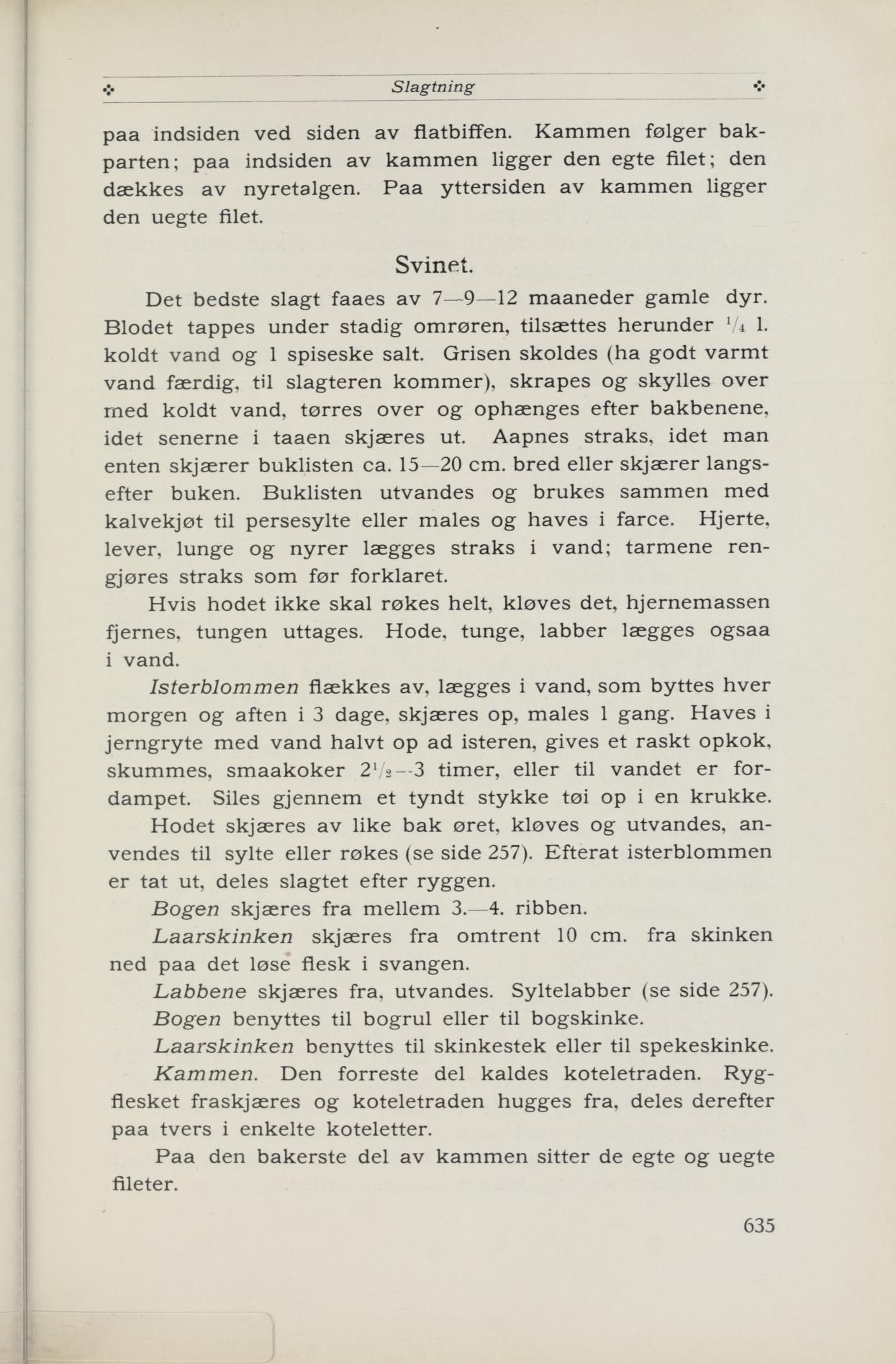
Erken's method for rendering lard (ister) from pork: the fat is soaked in cold water for three days with water changes morning and evening, ground once, brought to a boil with water halfway up the fat, skimmed and simmered 2½–3 hours until the water has evaporated, and strained through cloth into a crock. From the butchering chapter, page 635 in Stor kokebok (1914).

Source: Henriette Schønberg Erken, Stor kokebok, 1914-utg. s. 635 (falt i det fri)

Be the first to rate

About the dish

From the chapter on butchering, the section "The pig." After the pig has been scalded, opened, and the offal placed in water, the leaf lard (kidney and belly fat) is taken out and rendered into lard — the household's most important fat before margarine took over. Soaking for three days gives a white fat with a mild flavor and long shelf life.

How to make it

  1. 1

    Peel off and soak

    Peel the leaf lard off the carcass and put the fat in plenty of cold water. Change the water morning and evening for three days, so the fat becomes white and mild.

  2. 2

    Cut and grind

    Cut the fat into pieces and run it once through a meat grinder with a coarse plate, or chop it small with a knife.

  3. 3

    Bring to a boil

    Put the fat in a thick-bottomed pot and pour on cold water until it stands halfway up the fat. Give it a quick boil and skim well.

  4. 4

    Simmer

    Let it simmer gently for 2½–3 hours, or until all the water has evaporated and the fat is glossy and clear. Stir now and then so it does not burn.

  5. 5

    Strain and store

    Strain the hot fat through a thin cloth or cheesecloth into a clean crock. Cool without a lid, cover, and store cold and dark.

Changes from the original

Quantities are not given in the original; stated as about 2 kg raw fat to give a workable starting point. "Ground once" has been modernized to a meat grinder with a coarse plate (or fine chopping with a knife). Straining through "a thin piece of cloth" has been modernized to cloth/cheesecloth. The iron pot can be replaced with a thick-bottomed pot.

Tidsmaskin – hva endret seg?

Velg to utgaver og se hva Henriette Schønberg Erken la til, fjernet eller endret mellom dem.

1914 (korrekturlest, s. 635)Modernisert~92% av teksten endretfjernetlagt til
Isterblommen flækkes av, lægges i vand, som byttes hver 2 kg isterblomme (rått svinefett fra buk og nyrer) (fritt for kjøttrester og hinner). 1 l kaldt vann (til smeltingen, ca. halvveis opp på fettet). kaldt vann til utvanning (skiftes morgen og aften kveld i 3 dage, skjæres op, males 1 gang. Haves døgn). Flekk isterblommen av slaktet og legg fettet i jerngryte rikelig kaldt vann. Skift vannet morgen og kveld i tre døgn, så fettet blir hvitt og mildt.. Skjær fettet opp i biter og kjør det én gang gjennom kjøttkvern med vand halvt op ad isteren, gives grov skive, eller hakk det smått med kniv.. Legg fettet i en tykkbunnet gryte og hell på kaldt vann til det står halvveis opp på fettet. Gi et raskt opkok, skummes, smaakoker 2½—3 oppkok og skum godt.. La det småkoke svakt i 2½–3 timer, eller til vandet alt vannet er fordampet. Siles gjennem dampet bort og fettet er blankt og klart. Rør av og til så det ikke brenner seg.. Sil det varme fettet gjennom et tyndt stykke tøi op tynt klede eller osteklut opp i en ren krukke. Avkjøl uten lokk, dekk til og oppbevar kaldt og mørkt.

Note til Modernisert

Mengder er ikke oppgitt i originalen; angitt som ca. 2 kg råfett for å gi et arbeidsbart utgangspunkt. «Males 1 gang» er modernisert til kjøttkvern med grov skive (eller finhakking med kniv). Sil gjennom «et tyndt stykke tøi» er modernisert til klede/osteklut. Jerngryte kan erstattes med tykkbunnet gryte.

Community interpretations

Be the first to share your own version.

See interpretations

Frequently asked questions

How long must the leaf lard soak in water?
For 3 days. The water is changed every morning and evening, so that blood residue is drawn out and the fat becomes white and mild.
How long should the lard cook?
After a quick boil and skimming it simmers 2½–3 hours, or until all the water has evaporated.
How is the fat handled at the end?
It is strained through a thin piece of cloth and poured into a crock, where it sets into white lard.
Why is the fat cooked with water?
Water is filled halfway up along the lard in the iron pot so that the fat does not burn before it has melted; the water evaporates during cooking.

Related recipes

More dishes in the same category from the archive

Read also

Kommentarer

Ingen kommentarer ennå. Bli den første til å dele!