Skip to content

Chocolate Pralines

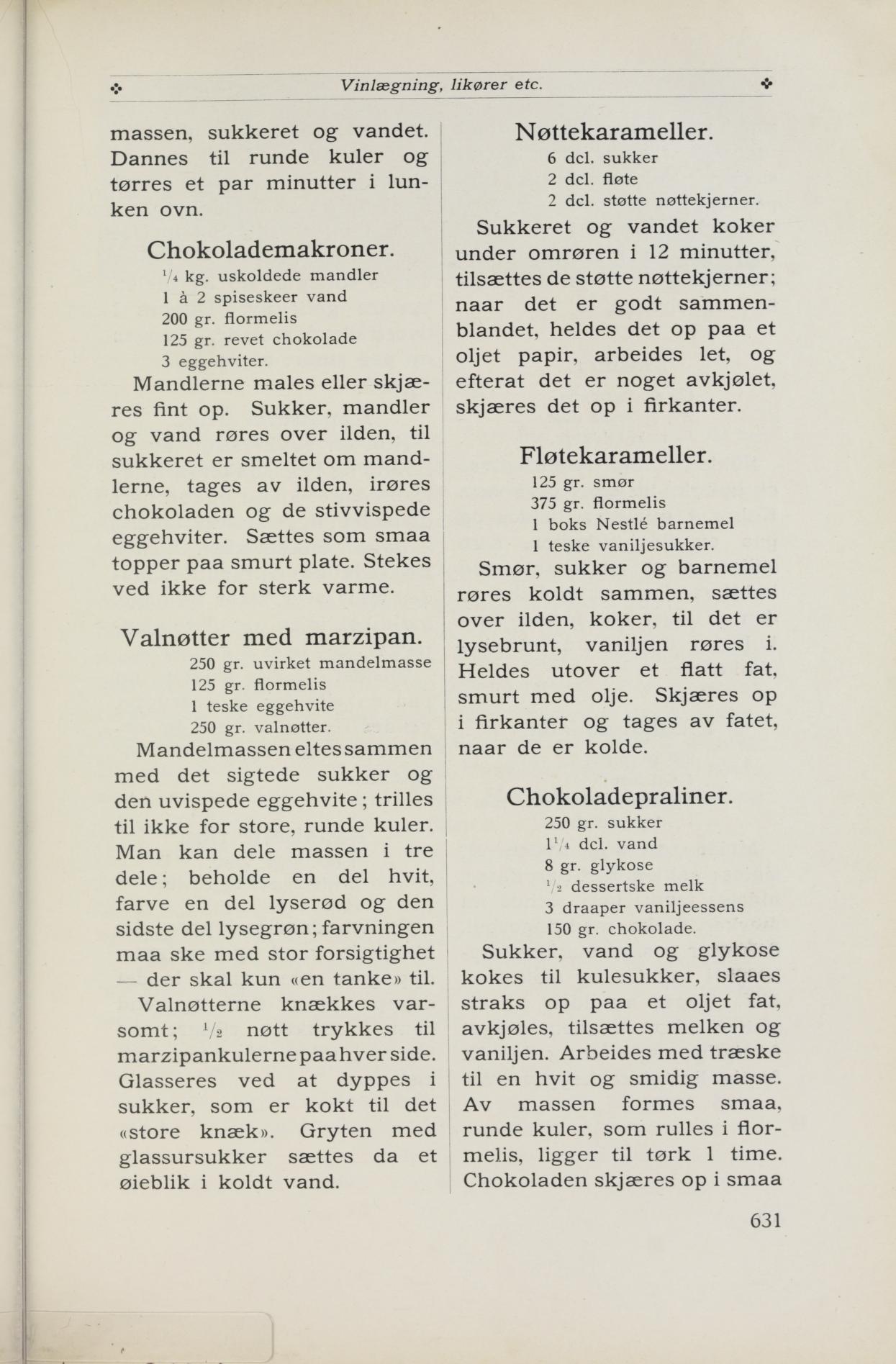
Chocolate pralines from Erken 1914: a sugar syrup with glucose boiled to 115 °C, worked into a white fondant with milk and vanilla, shaped into balls, dried, and dipped in melted chocolate. Variation with hazelnut paste.

Source: Henriette Schønberg Erken, Stor kokebok, 1914-utg. s. 631 (falt i det fri)

Be the first to rate

About the dish

Classic fondant pralines from the confectionery chapter in Erken's "Stor kokebok" (1914). The sugar syrup is boiled to the "soft-ball stage" and worked out on a dish into white fondant – a technique she describes in several places. Erken also gives a variation with hazelnut paste instead of fondant.

How to make it

  1. 1

    Boil the sugar syrup

    Boil the sugar, water, and glucose syrup to the soft-ball stage, about 115 °C (240 °F).

  2. 2

    Cool down

    Pour the mixture out at once onto a lightly oiled dish, a marble slab, or parchment and let it cool.

  3. 3

    Work into fondant

    Add the milk and vanilla essence and work the mass with a wooden spoon until it turns white and pliable.

  4. 4

    Shape balls

    Shape small, round balls from the mass, roll them in powdered sugar, and let them dry for 1 hour.

  5. 5

    Coat with chocolate

    Cut the chocolate into small pieces and melt it over a water bath without adding sugar. Dip the balls in the chocolate and lift them out with a fork. Place them on paper until they set.

  6. 6

    Variation

    Instead of the fondant mass, you can use a mass of 250 g hazelnuts and 180 g powdered sugar stirred with 2 egg whites.

Changes from the original

"Soft-ball stage" is specified as about 115 °C (240 °F). Glucose corresponds to modern glucose syrup. The oiled dish is replaced by parchment or a marble slab. A dessert spoon is converted to about 1 tsp, and vanilla essence can be replaced by vanilla extract.

Tidsmaskin – hva endret seg?

Velg to utgaver og se hva Henriette Schønberg Erken la til, fjernet eller endret mellom dem.

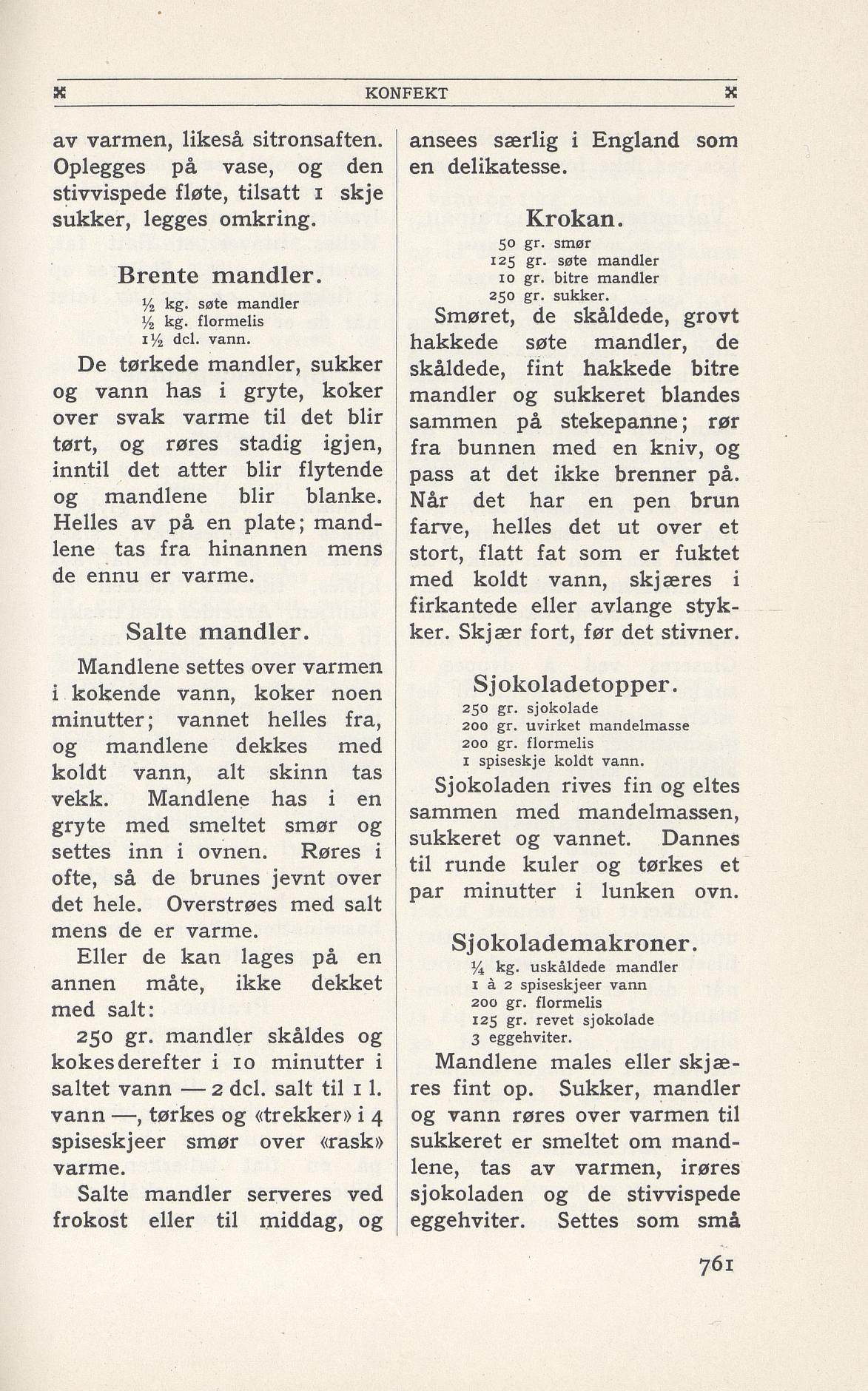
1914 (korrekturlest, s. 631)1949 (korrekturlest, s. 761)~32% av teksten endretfjernetlagt til
250 gr. sukker 1¼ del. vand vann 8 gr. glykose 1 dessertske ½ dessertskje melk 3 draaper dråper vaniljeessens 150 gr. chokolade. sjokolade. Sukker, vand vann og glykose kokes til kulesukker, slaaes slåes straks op paa et oljet fat, avkjøles, tilsættes tilsettes melken og vaniljen. Arbeides med træske treskje til en hvit og smidig masse. Av massen formes smaa, små, runde kuler, som rulles i flormelis, ligger til tørk 1 time. Chokoladen Sjokoladen skjæres op i smaa små stykker, smeltes i vandbad vannbad uten at tilsætte å tilsette den noget sukker. Sukkerkulerne Sukkerkulene dyppes heri og tages tas op med sølvgaffel. Istedenfor sukkermassen kan man ta ¼ ½ kg. hasselnøtter, 180 gr. flormelis til 2 eggehviter.
Community interpretations

Be the first to share your own version.

See interpretations

Frequently asked questions

What is the "soft-ball stage" and why is it important?
The soft-ball stage is the ball stage of sugar boiling (about 115–118 °C), where a drop of syrup forms a ball in cold water. If the sugar is boiled too little, the mass turns out loose; too long, and it turns hard and won't work up white and pliable.
Why should the chocolate be melted over a water bath without sugar?
A water bath gives mild, even heat so the chocolate doesn't burn. Sugar is not added, since the filling with 250 g sugar and powdered sugar is already sweet enough – and sugar can make the chocolate grainy.
How long does it take, and is there a variation without sugar mass?
Allow about 2 hours and 15 minutes in all, of which the balls need to dry 1 hour before dipping. As an alternative to the sugar mass, you can use a nut mass of ¼ kg hazelnuts, 180 g powdered sugar, and 2 egg whites.

Related recipes

More dishes in the same category from the archive

Read also

Kommentarer

Ingen kommentarer ennå. Bli den første til å dele!