Skip to content

Fruit Syrup (Cordial)

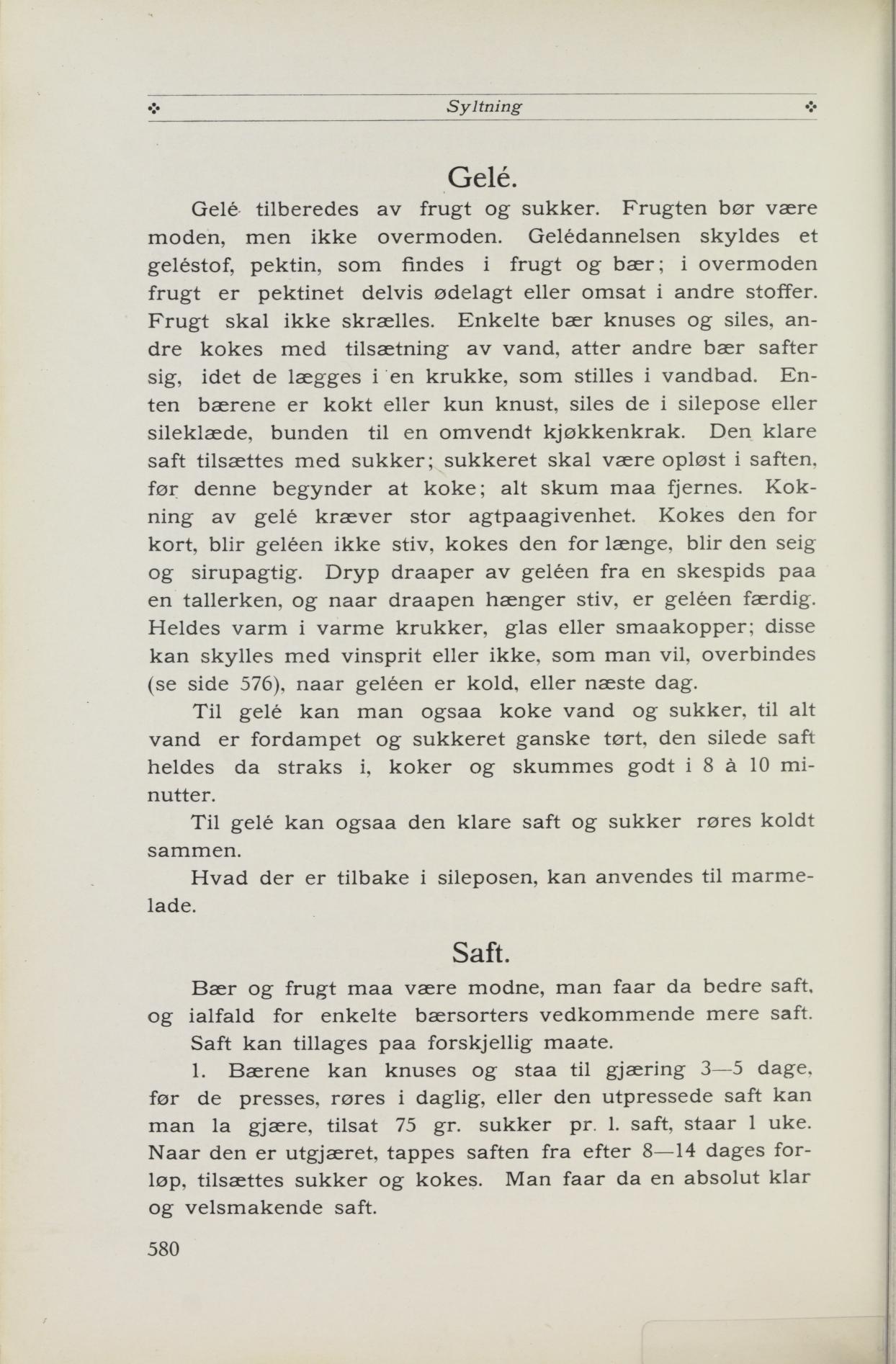
Erken's five methods for making fruit syrup: 1) fermenting crushed berries 3–5 days or the juice with 75 g sugar per liter for a week, then drawing off, sugar and boiling; 2) strained juice bottled and sterilized at 70 °C for ½ hour, later sugar and boiling down or 90 °C for 10 min; 3) sour syrup with 4 days' fermentation to avoid sediment; 4) berries and sugar in layers for 2 days; 5) berries boiled with water, strained and boiled with sugar. The pressing residue is fermented 1–2 weeks with water and 5 g citric acid per kg, pressed and boiled into household syrup.

Source: Henriette Schønberg Erken, Stor kokebok, 1914-utg. s. 580 (falt i det fri)

Be the first to rate

About the dish

Erken's collected overview of fruit-syrup making in the preserving chapter, with five different methods – fermented syrup, sterilized syrup in bottles, sour syrup, layered syrup with sugar and boiled syrup – plus a recipe for household syrup made from the pressing residue.

How to make it

  1. 1

    Method 1 – fermented syrup

    Crush the berries and let them stand to ferment for 3–5 days before pressing; stir the mass daily. Or let the pressed juice ferment with 75 g sugar per liter of juice for one week. When the juice has finished fermenting, it is drawn off after 8–14 days, sugar is added and it is boiled. This gives a completely clear and flavorful syrup.

  2. 2

    Method 2 – sterilized in bottles

    Fill the strained juice into bottles and sterilize at 70 °C (160 °F) for half an hour. Let the bottles stand in a draft-free place until the juice is completely clear. Add sugar and boil down, or sterilize at 90 °C (195 °F) for 10 minutes. Ordinary bottles can be used; they are corked and tied over with twine or wire.

  3. 3

    Method 3 – sour syrup

    For sour syrup, the crushed berries should stand to ferment for 4 days before the juice is pressed off, otherwise a lot of sediment easily forms in the bottles after a while.

  4. 4

    Method 4 – layered with sugar

    Layer berries and sugar in a suitable vessel. Let stand for 2 days and then pour into a straining cloth.

  5. 5

    Method 5 – boiled syrup

    Boil the berries with water until they have released their juice. Strain off and boil the juice with sugar.

  6. 6

    Household syrup from the pressing residue

    Collect the pressing residue of the various berries in a vessel, add up to 1 liter of water per kg of mass plus 5 g citric acid. Let stand to ferment for 1–2 weeks in a cool place and stir daily. Press and boil with sugar into household syrup.

Changes from the original

The five methods have been set out as numbered steps/alternatives in modern Norwegian. The amounts have been kept (75 g sugar per liter of juice, 5 g citric acid per kg of pressing residue); the unclear OCR reading "8 à 1 l. vand" is rendered as "up to 1 liter of water per kg of mass." Sterilization temperatures have been kept as in the original.

Tidsmaskin – hva endret seg?

Velg to utgaver og se hva Henriette Schønberg Erken la til, fjernet eller endret mellom dem.

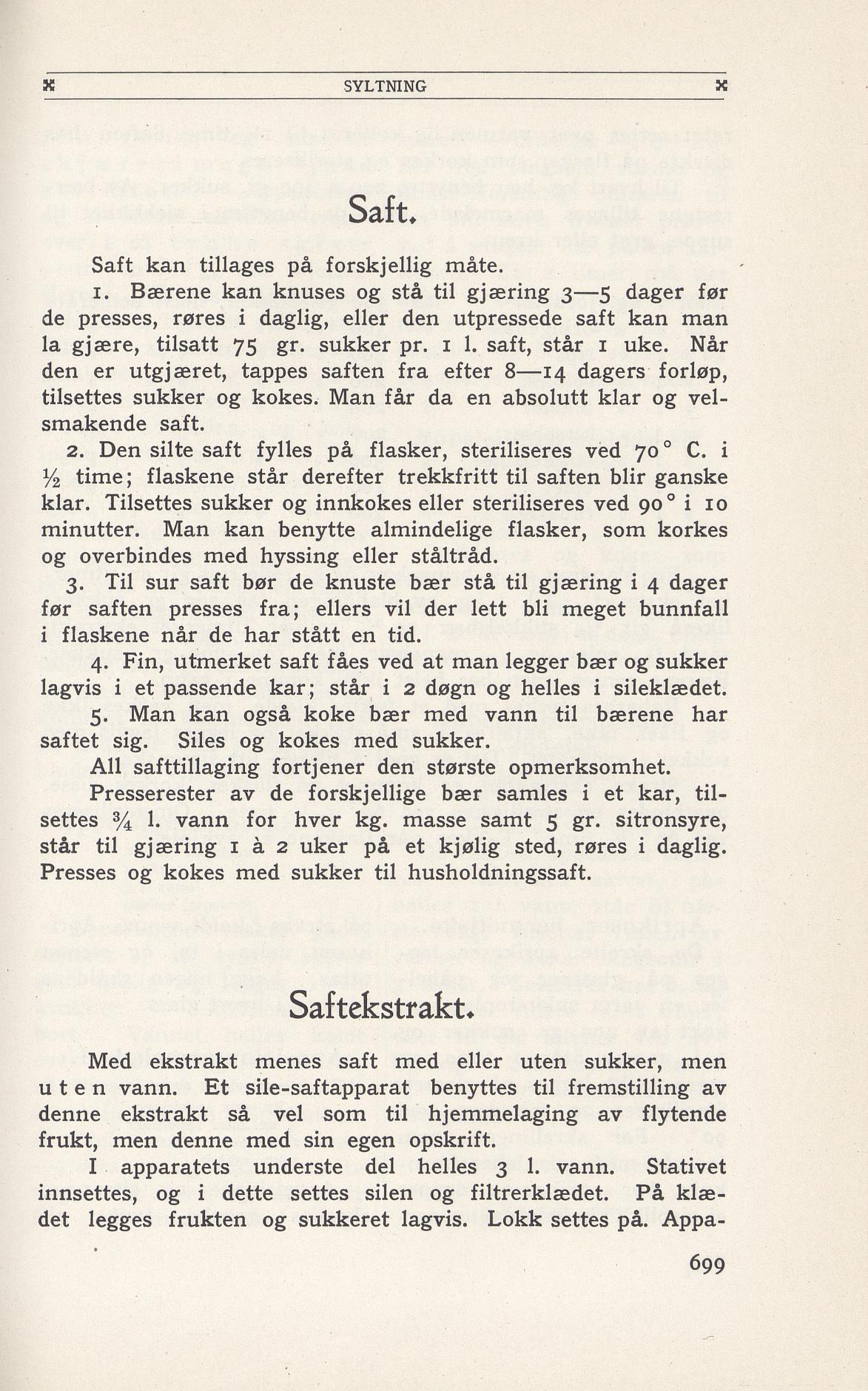
1914 (korrekturlest, s. 580)1949 (korrekturlest, s. 699)~39% av teksten endretfjernetlagt til
Saft kan tillages paa forskjellig maate. Bær og frugt maa være modne, man faar da bedre saft, og ialfald for enkelte bærsorters vedkommende mere saft. måte. 1. Bærene kan knuses og staa stå til gjæring 3—5 dage, dager før de presses, røres i daglig, eller den utpressede saft kan man la gjære, tilsat tilsatt 75 gr. sukker pr. 1 l. saft, staar står 1 uke. Naar Når den er utgjæret, tappes saften fra efter 8—14 dages dagers forløp, tilsættes tilsettes sukker og kokes. Man faar får da en absolut absolutt klar og velsmakende vel smakende saft. 2. Den silede silte saft fyldes paa fylles på flasker, steriliseres ved 70° C. 70°C. i ½ 1/2 time; flaskerne staar flaskene står derefter trækfrit, trekkfritt til saften blir ganske klar. Tilsættes Tilsettes sukker og indkokes innkokes eller steriliseres ved 90° i 10 minutter. Man kan benytte almindelige flasker, som korkes og overbindes med hyssing eller staaltraad. ståltråd. 3. Til sur saft bør de knuste bær staa stå til gjæring i 4 dage, dager før saften presses fra; ellers vil der let lett bli meget bundfald bunnfall i flaskerne, naar flaskene når de har staat stått en tid. 4. Fin, udmerket utmerket saft faaes ved, fåes ved at man lægger legger bær og sukker lagvis i et passende kar; staar står i 2 døgn og heldes helles i sileklædet. 5. Man kan ogsaa også koke bær med vand, vann til bærene har saftet sig. Siles og kokes med sukker. Al safttillagning All safttillaking fortjener den største opmerksomhet. Presserester av de forskjellige bær samles i et kar, tilsættes 8 à 1 tilsettes 1/2 l. vand vann for hver kg. masse samt 5 gr. citronsyre, staar sitronsyre, står til gjæring 1 à å 2 uker paa et kjølig sted, røres i daglig. Presses og kokes med sukker til husholdningssaft.
Community interpretations

Be the first to share your own version.

See interpretations

Frequently asked questions

Why should the berries be ripe?
Ripe berries and fruit give better juice, and for some kinds of berries also more juice.
How long should the juice ferment?
By method 1, crushed berries can stand to ferment 3–5 days with daily stirring before pressing. Alternatively, the pressed juice is left to ferment with 75 g sugar per liter for one week; the juice is drawn off after 8–14 days, sugar is added and it is boiled. Then it becomes completely clear and flavorful.
Which temperatures are used for sterilizing?
By method 2, the strained juice is filled into bottles and sterilized at 70 °C for ½ hour. The bottles stand in a draft-free place until the juice is completely clear, and then sugar is added and the juice is boiled down or sterilized at 90 °C for 10 minutes.
Where does the recipe come from?
From Henriette Schønberg Erken's "Stor kokebok" (1914), page 580.

Related recipes

More dishes in the same category from the archive

Read also

Kommentarer

Ingen kommentarer ennå. Bli den første til å dele!