Erken's roast veal from 4 kg leg of veal with three alternative methods: oven roasting with a thick flour-based paste over the meat for a juicy result, oven roasting for a sharp browning with boiling water and milk, or braising in a pot with milk, water and a cream-thickened sauce. Roasting time about 3 hours. Served with browned potatoes, salad, jam or vegetables.
Source: Henriette Schønberg Erken, Stor kokebok, 1914-utg. s. 199 (falt i det fri)
Be the first to rate
About the dish
The recipe appears in the meat chapter, after an introduction on blanching and using the various parts of the calf. Erken gives three alternative roasting methods for the same leg roast: a mild one with a paste over the roast, one for a sharp browning in the oven, and a pot method.
How to make it
1
Prepare the meat
Pound the roast well – it makes the meat tender; pound it even if the meat has hung for a few days. Remove the sinew membrane by inserting the knife under it and skinning it off while holding the membrane taut.
2
Method 1 – juicy roast with paste
Make a paste of 50 g butter and 75 g flour, thin with the meat stock and bring to a boil. Place the roast in the pan with the rest of the butter underneath, and spread the thick sauce over the top of the roast. Set the roast in a properly hot oven. After 20 minutes, baste the roast with the juices in the pan, and add 5 dl boiling water. Then baste about every quarter hour. The roast turns juicy, tender and excellent, but not sharply browned.
3
Method 2 – sharply browned roast
If you want the roast sharply browned, sprinkle it with a little salt, rub it with cold butter, place it in a hot pan and set it in a hot oven. When the roast begins to brown after about half an hour, add up to 1 liter of boiling water and 5 dl boiling milk a little at a time. Baste often.
4
Method 3 – braised in a pot
Pound the roast, lard it and brown it in butter. Thin with 5 dl boiling milk and 5 dl boiling water a little at a time. Let the sauce reduce and thicken it with the cream. Stir in a little cold butter just before plating and bring the sauce to a boil.
5
Roasting time and serving
Allow about 3 hours for the roasting. Serve the roast with browned potatoes, salad, jam or various vegetables.
Changes from the original
Ingredient quantities have been converted to modern units (deciliters instead of «del.», grams kept). The method has been divided into numbered steps with the three roasting methods as separate steps, in modern Norwegian. «Hinden» is rendered as the sinew membrane. Oven temperatures have not been added beyond the original's «properly hot oven»/«hot oven», described as strong heat.
📖1914
Original 1914 recipe
Verbatim from the first edition of the Big Cookbook.
Foto: Faksimile: Nasjonalbiblioteket
ProofreadPage 199
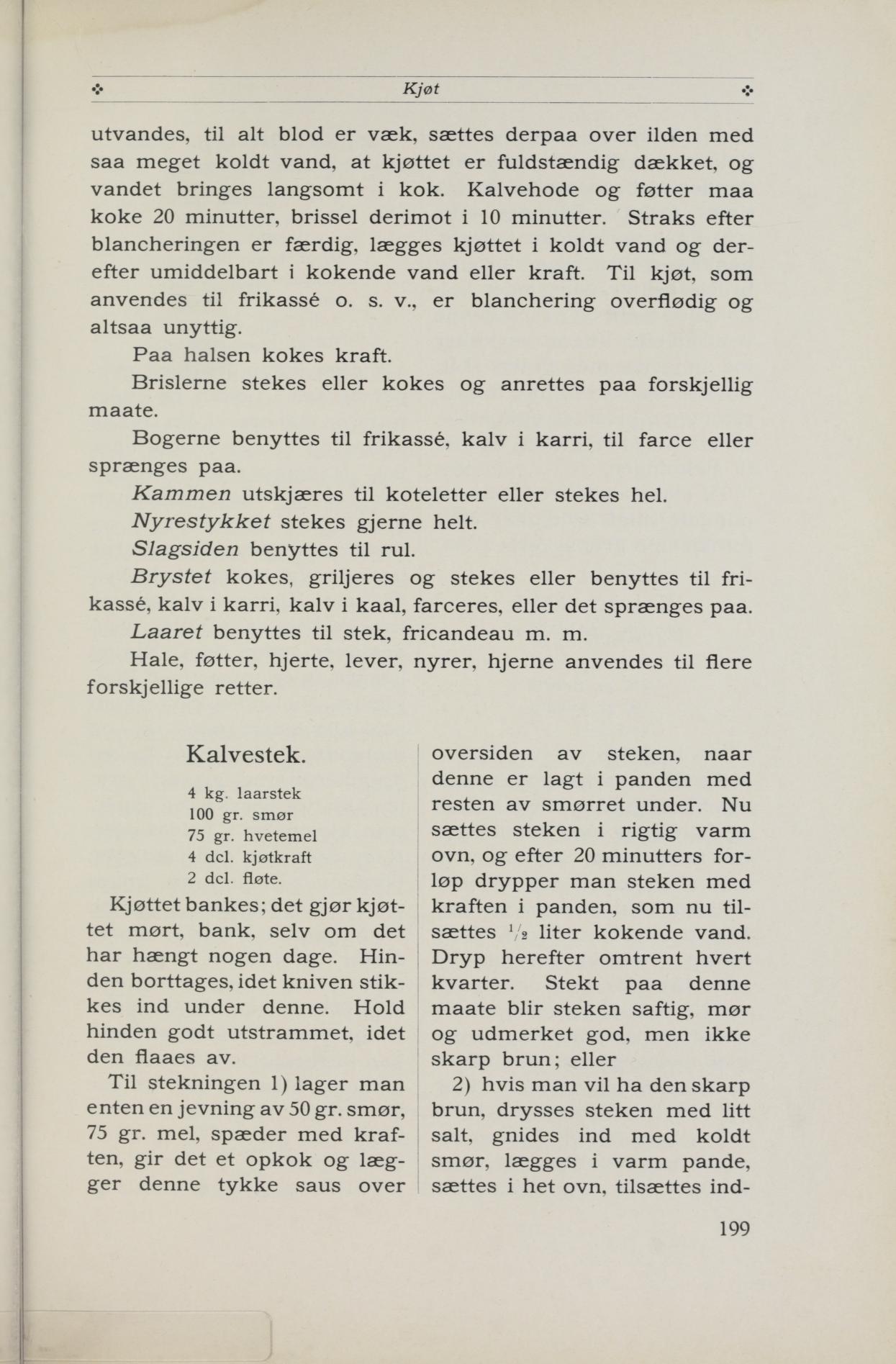
4 kg. laarstek
100 gr. smør
75 gr. hvetemel
4 del. kjøtkraft
2 del. fløte.
Kjøttet bankes; det gjør kjøttet mørt, bank, selv om det har hængt nogen dage. Hinden borttages, idet kniven stikkes ind under denne. Hold hinden godt utstrammet, idet den flaaes av.
Til stekningen 1) lager man enten en jevning av 50 gr. smør, 75 gr. mel, spæder med kraften, gir det et opkok og lægger denne tykke saus over oversiden av steken, naar denne er lagt i panden med resten av smørret under. Nu sættes steken i rigtig varm ovn, og efter 20 minutters forløp drypper man steken med kraften i panden, som nu tilsættes ½ liter kokende vand. Dryp herefter omtrent hvert kvarter. Stekt paa denne maate blir steken saftig, mør og udmerket god, men ikke skarp brun; eller
2) hvis man vil ha den skarp brun, drysses steken med litt salt, gnides ind med koldt smør, lægges i varm pande, sættes i het ovn, tilsættes indtil 1 l. kokende vand og ½ l. kokende melk, naar den begynder at brunes efter ca. ½ times forløp. Dryppes ofte.
3) Skal man steke i gryte, bankes steken, spækkes og brunes i smør, paaspædes ½ l. kokende melk og ½ l. kokende vand litt efter litt; sausen koker ind og jevnes med fløten. Litt koldt smør røres i like før anretningen, gives et opkok.
Man maa beregne ca. 3 timer til stekningen.
Til steken serveres brunede poteter, salat, syltetøier eller forskjellige grønsaker.
📖1949
Revised 1949 recipe
From the revised edition of the Big Cookbook.
Foto: Faksimile: Nasjonalbiblioteket
ProofreadPage 230
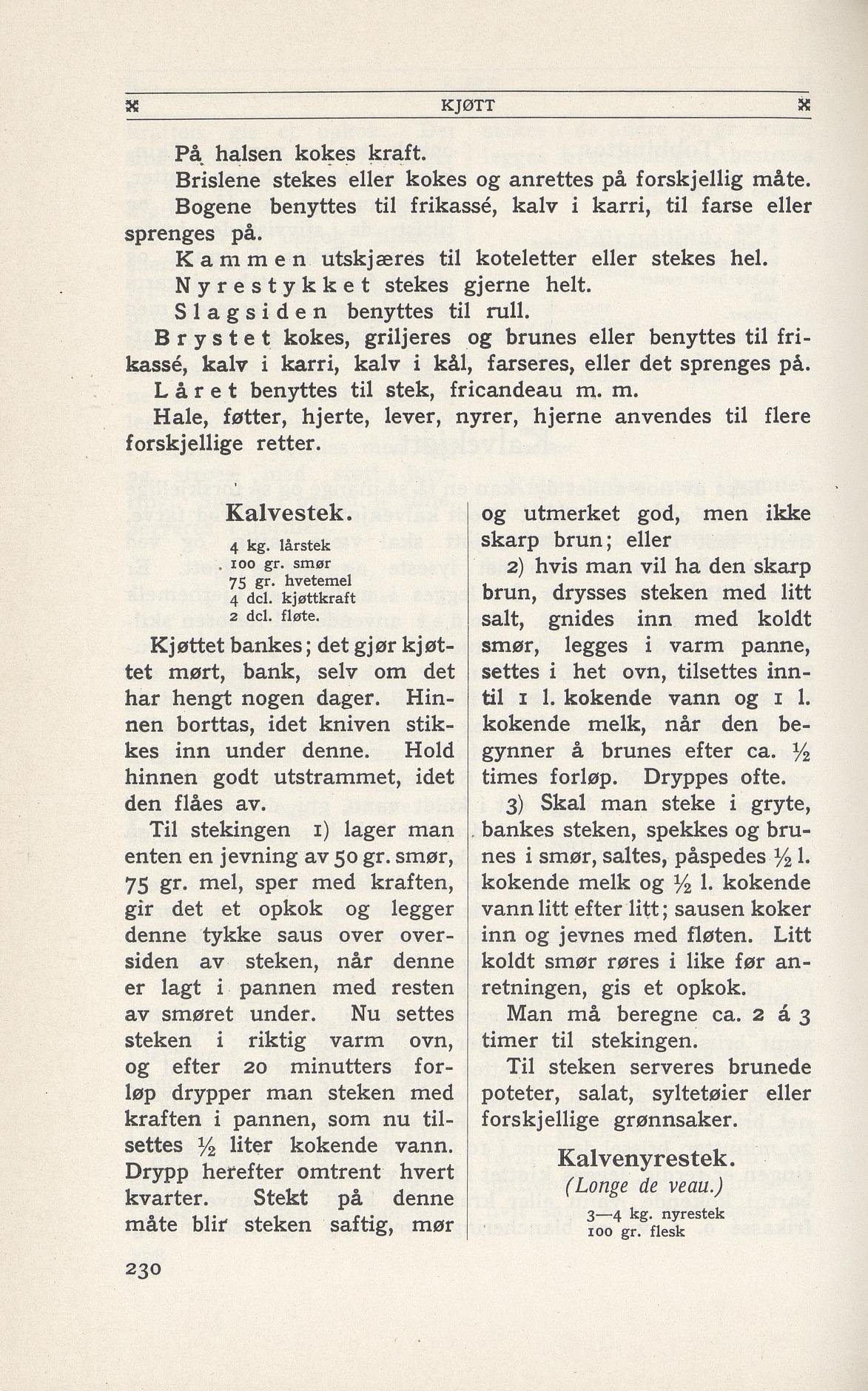
4 kg. lårstek
100 gr. smør
75 gr. hvetemel
4 dl. kjøttkraft
2 dl. fløte.
Kjøttet bankes; det gjør kjøttet mørt, bank, selv om det har hengt nogen dager. Hinnen borttas, idet kniven stikkes inn under denne. Hold hinnen godt utstrammet, idet den flåes av.
Til stekingen 1) lager man enten en jevning av 50 gr. smør, 75 gr. mel, spedes med kraften, girs det et opkok og legges denne tykke saus over oversiden av steken, når denne er lagt i pannen med resten av smøret under. Nu settes steken i riktig varm ovn, og efter 20 minutters forløp drypper man steken med kraften i pannen, som nu tilsettes ½ liter kokende vann. Drypp herefter omtrent hvert kvarter. Stekt på denne måte blir steken saftig, mørt og utmerket god, men ikke skarp brun; eller
2) hvis man vil ha den skarp brun, drysses steken med litt salt, gnides inn med koldt smør, legges i varm panne, settes i het ovn, tilsettes inntil 1 l. kokende vann og 1 l. kokende melk, når den begynner å brunes efter ca. ½ times forløp. Dryppes ofte.
3) Skal man steke i gryte, bankes steken, spekkes og brunes i smør, saltes, påspedes ½ l. kokende melk og ½ l. kokende vann litt efter litt; sausen koker inn og jevnes med fløten. Litt koldt smør røres i like før anretningen, gis et opkok.
Man må beregne ca. 2 å 3 timer til stekingen.
Til steken serveres brunede poteter, salat, syltetøier eller forskjellige grønnsaker.
In stores now
Clean, minimally processed groceries matched to the ingredients — approximate prices.
Modernised → 1949 (proofread, p. 230)~74% of the text changedremovedadded
4 kg kalvestek av lår (banket, hinne fjernet). kg. lårstek 100 g gr. smør (50 g til jevningen, resten i pannen). 75 g hvetemel. gr. hvetemel 4 dl kjøttkraft. 2 dl fløte (til grytemetoden). salt. 5 dl kokende vann (til metode 1; inntil 1 liter i metode 2). 5 dl kokende melk (til metode dl. kjøttkraft 2 og 3). Bank steken godt – dl. fløte. Kjøttet bankes; det gjør kjøttet mørt, bank bank, selv om kjøttet det har hengt noen nogen dager. Fjern senehinnen ved å stikke Hinnen borttas, idet kniven stikkes inn under den og flå den av mens du holder denne. Hold hinnen godt utstrammet.. Lag utstrammet, idet den flåes av. Til stekingen 1) lager man enten en jevning av 50 g smør og gr. smør, 75 g gr. mel, spe spedes med kjøttkraften og gi kraften, girs det et oppkok. Legg steken opkok og legges denne tykke saus over oversiden av steken, når denne er lagt i pannen med resten av smøret under, og legg den tykke sausen over oversiden av steken. Sett under. Nu settes steken i riktig varm ovn. Etter ovn, og efter 20 minutter minutters forløp drypper du man steken med kraften i pannen, og tilsetter 5 dl som nu tilsettes ½ liter kokende vann. Dryp deretter Drypp herefter omtrent hvert kvarter. Steken Stekt på denne måte blir steken saftig, mør mørt og utmerket god, men ikke skarpt brun.. Vil du skarp brun; eller 2) hvis man vil ha steken skarpt brun, drysser du den skarp brun, drysses steken med litt salt, gnir den gnides inn med kaldt koldt smør, legger den legges i varm panne og setter den panne, settes i het ovn. Når steken begynner å brunes etter ca. en halv time, ovn, tilsettes inntil 1 liter l. kokende vann og 5 dl 1 l. kokende melk litt etter litt. Dryp ofte.. Bank steken, spekk melk, når den begynner å brunes efter ca. ½ times forløp. Dryppes ofte. 3) Skal man steke i gryte, bankes steken, spekkes og brun den brunes i smør. Spe på 5 dl smør, saltes, påspedes ½ l. kokende melk og 5 dl ½ l. kokende vann litt etter litt. La efter litt; sausen koke koker inn og jevn den jevnes med fløten. Rør inn litt kaldt Litt koldt smør røres i like før anretningen og gi sausen anretningen, gis et oppkok.. Beregn opkok. Man må beregne ca. 2 å 3 timer til stekingen. Server Til steken med serveres brunede poteter, salat, syltetøy syltetøier eller forskjellige grønnsaker.
Note on Modernised
Ingrediensmengder er omregnet til moderne enheter (desiliter i stedet for «del.», gram beholdt). Fremgangsmåten er delt i nummererte trinn med de tre stekemetodene som egne trinn, i moderne norsk. «Hinden» er gjengitt som senehinne. Ovnstemperaturer er ikke lagt til utover originalens «rigtig varm ovn»/«het ovn», som er beskrevet som sterk varme.
How long a roasting time does a 4 kg leg of veal need?
Allow around 3 hours (210 minutes) in all. The roast is first set in a properly hot oven, and after 20 minutes it is basted with the juices in the pan – then about every quarter hour.
Why should the meat be pounded, and must the membrane be removed?
The pounding makes the meat tender, and Schønberg Erken recommends pounding even if the meat has hung for a few days. The membrane is removed by inserting the knife under it, holding the membrane taut and skinning it off.
What is the point of the butter-and-flour mixture on top of the roast?
You make a paste of 50 g butter and 75 g flour, thin with meat stock and bring it to a boil. This thick sauce is spread over the top of the roast, while the rest of the butter goes underneath in the pan. This way the roast turns juicy.
How many servings does the recipe give, and where does it come from?
The recipe serves 10 and is taken from Henriette Schønberg Erken's «Stor kokebok» from 1914, page 199.