Skip to content

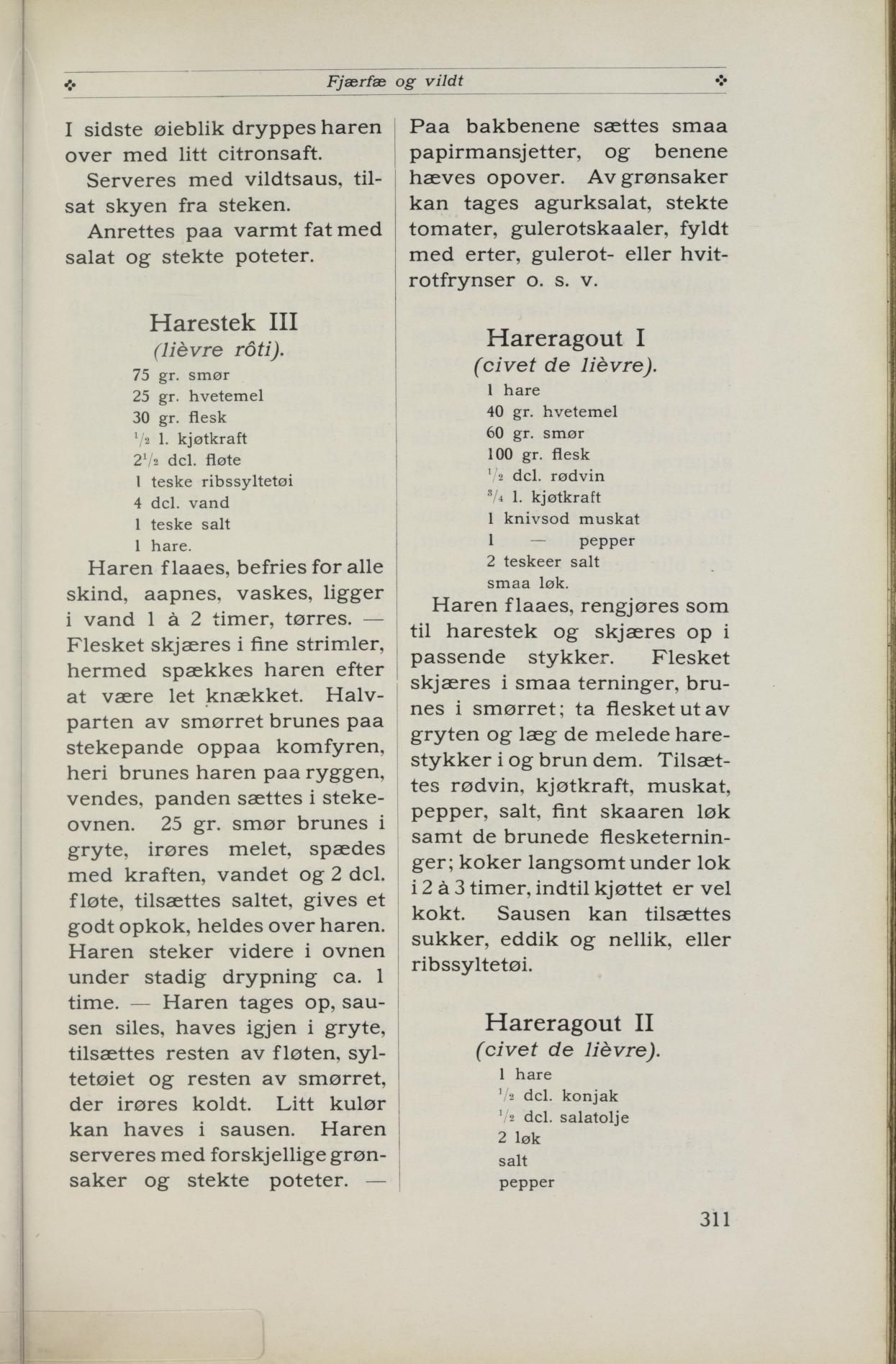
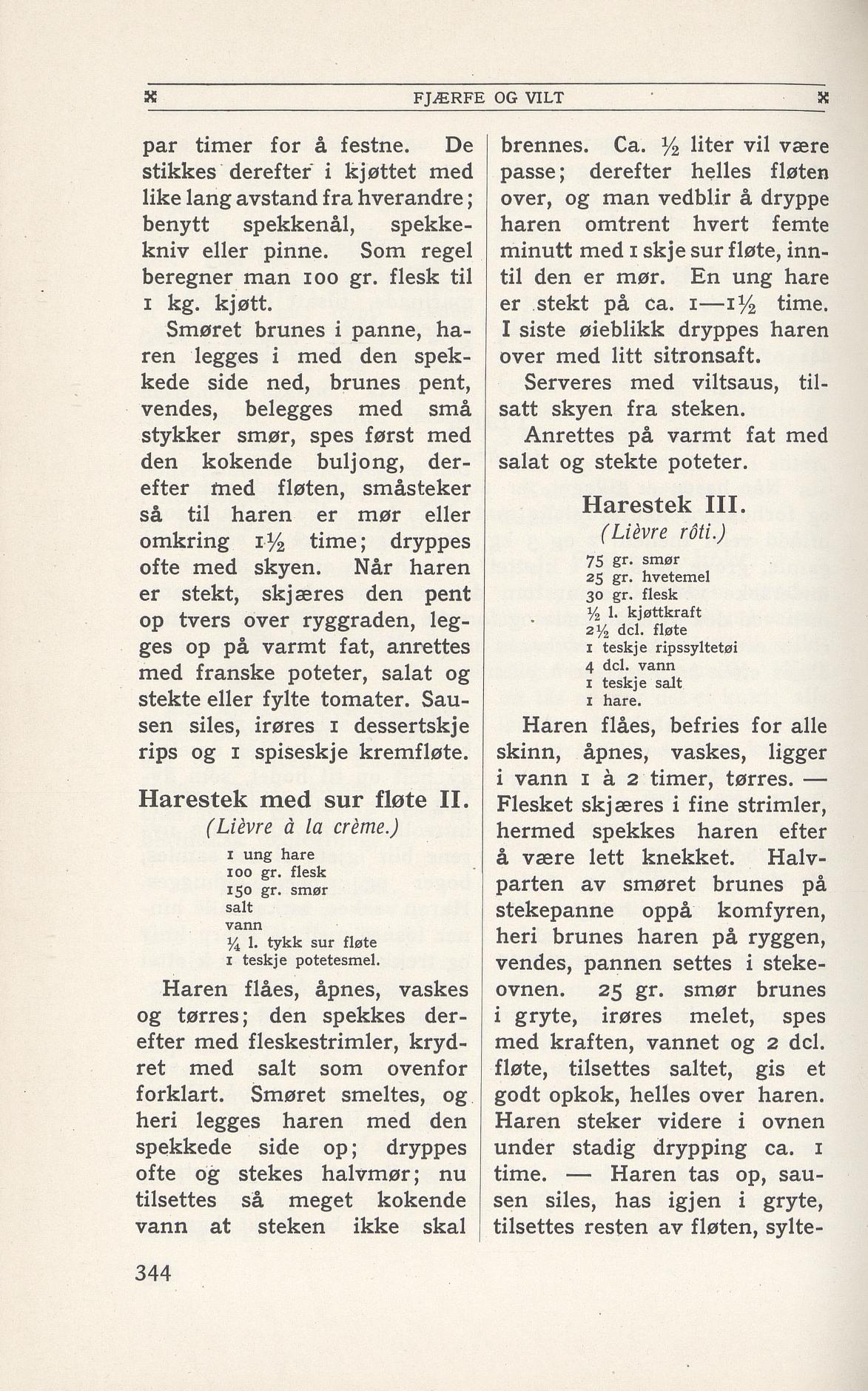
Roast Hare III (lievre roti)

Roast hare III from Erken's Stor kokebok 1914: hare is larded with pork, browned, and roasted about 1 hour in the oven while basted with a flour-based sauce of meat stock, water, and cream; the sauce is finished with cream, red currant jelly, and cold butter. Served with fried potatoes and vegetables.

Source: Henriette Schønberg Erken, Stor kokebok, 1914-utg. s. 311 (falt i det fri)

Be the first to rate

About the dish

The third of Erken's roast-hare variants in the game chapter. The hare is larded with pork and roasted in the oven under constant basting, with a cream sauce made directly in the pot and poured over the roast. The serving with paper frills on the hind legs and a garnish of vegetables reflects the bourgeois presentation ideals of the time.

How to make it

  1. 1

    Clean the hare

    Skin the hare, remove all membranes and skin, cut it open along the belly, wash it well, and let it sit in water for 1-2 hours. Dry it well.

  2. 2

    Lard the hare

    Cut the pork into fine strips. Crack the hare carefully so it lies flat, and lard it with the pork strips.

  3. 3

    Brown the hare

    Brown half of the butter in a frying pan on the stovetop. Brown the hare first on the back, turn it, and put the pan into the oven.

  4. 4

    Make the sauce

    Brown 25 g butter in a pot, stir in the flour, and thin with meat stock, water, and 2 dl cream. Add salt and give the sauce a good boil. Pour it over the hare.

  5. 5

    Finish roasting

    Continue roasting the hare in the oven for about 1 hour while basting regularly with the sauce.

  6. 6

    Finish the sauce

    Take up the hare. Strain the sauce back into the pot, add the rest of the cream and the jelly/jam, and stir in the rest of the butter cold. Add a little coloring if desired.

  7. 7

    Serving

    Lay the hare on a warm platter, put small paper frills on the hind legs, and lift the legs upward. Serve with fried potatoes and vegetables, e.g. cucumber salad, fried tomatoes, carrot cups filled with peas, or carrot and parsley-root fringes.

Changes from the original

Quantities are given in modern units (grams, dl, l, teaspoon). "Flesk" is interpreted as fresh, fatty pork belly for larding. Hare is added as an explicit ingredient. Coloring is made optional, and the method is divided into numbered steps in modern Norwegian.

In stores now

Clean, minimally processed groceries matched to the ingredients — approximate prices.

Product data and prices via Kassalapp. Prices are updated daily and may vary.

Time machine – what changed?

Pick two editions and see what Henriette Schønberg Erken added, removed or changed between them.

1949 (proofread, p. 344) → Modernised~83% of the text changedremovedadded
1 hare (flådd og renset). 75 gr. g smør (halvparten til bruning, 25 gr. hvetemel g til sausen, resten røres inn kaldt). 25 g hvetemel. 30 gr. g flesk ½ l. kjøttkraft 2½ dd. (fet svinesideflesk til spekking). 2,5 dl kjøttkraft. 2,5 dl fløte (2 dl i sausen, resten til slutt). 1 teskje ripssyltetøi ts ripsgelé eller ripssyltetøy. 4 del. vann dl vann. 1 teskje ts salt. Haren flåes, befries for sukkerkulør (valgfritt, til farge). Flå haren, fjern alle hinner og skinn, åpnes, vaskes, ligger del den opp langs buken, vask den godt og la den ligge i vann 1 å 2 timer, tørres. — Flesket skjæres i 1–2 timer. Tørk den godt.. Skjær fleskt i fine strimler, hermed spekkes strimler. Knekk haren efter å være lett knekket. Halvparten forsiktig så den ligger flatt, og spekk den med fleskestrimlene.. Brun halvparten av smøret brunes på i en stekepanne oppå komfyren, heri brunes på platen. Brun haren først på ryggen, vendes, snu den, og sett pannen settes inn i stekovnen. stekeovnen.. Brun 25 gr. g smør brunes i en gryte, irøres melet, spes rør inn melet og spe med kraften, vannet kjøttkraft, vann og 2 del. fløte, tilsettes saltet, gis dl fløte. Tilsett salt og gi sausen et godt opkok, helles oppkok. Hell den over haren. Haren steker haren.. Stek haren videre i ovnen under stadig drypping i ca. 1 time. — Haren tas op, time mens du drypper jevnlig med sausen.. Ta opp haren. Sil sausen siles, has igjen tilbake i gryte, tilsettes gryten, tilsett resten av fløten, syltetøiet fløten og gelé/syltetøy, og rør inn resten av smøret, der irøres koldt. Litt smøret kaldt. Tilsett litt kulør kan has i sausen. Haren serveres om ønskelig.. Legg haren på varmt fat, sett små papirmansjetter på bakbena og løft bena oppover. Server med forskjellige grønnsakeri stekte poteter og grønnsaker, f.eks. agurksalat, stekte poteter. tomater, gulrotskåler fylt med erter eller gulrot- og persillerotfrynser.

Note on Modernised

Mengder er oppgitt i moderne enheter (gram, dl, l, teskje). «Flesk» er tolket som fersk, fet svinesideflesk til spekking. Hare er lagt inn som eksplisitt ingrediens. Kulør er gjort valgfri, og fremgangsmåten er delt i nummererte trinn på moderne norsk.

Community interpretations

Be the first to share your own version.

See interpretations →

Frequently asked questions

Why should the hare sit in water before roasting?
After the hare is skinned, cleaned of all membranes, and opened, it is placed in water for 1-2 hours and then dried. This draws out blood and gives the meat a milder flavor.
How is the hare larded?
30 g pork is cut into fine strips, and the hare is larded with these after it has been lightly cracked. The pork strips add fat and juiciness to the dry hare meat.
How long does the hare roast, and how?
Half of the 75 g butter is browned in a frying pan on the stove, the hare is browned on the back and turned, and the pan is put in the oven. After the sauce (butter, flour, meat stock, water, and cream) has been boiled and poured over, the hare roasts further in the oven under constant basting for about 1 hour.
What gives the sauce its flavor?
The sauce is made from 25 g browned butter and 25 g wheat flour, thinned with 1/4 l meat stock, 4 dl water, and cream, salted with 1 teaspoon salt. Finally it is seasoned with 1 teaspoon red currant jam and the rest of the cream.

Related recipes

More dishes in the same category from the archive

Read also

Kommentarer

Ingen kommentarer ennå. Bli den første til å dele!