Roast hare I from Erken 1914: hare (approx. 2 kg) is skinned and cleaned, larded with salted and peppered strips of pork, browned in butter, and slow-roasted about 1.5 hours with meat stock and cream. Served carved crosswise over the backbone with fried potatoes, salad, and tomatoes, and a sauce with red currant jelly and heavy cream.
Source: Henriette Schønberg Erken, Stor kokebok, 1914-utg. s. 309 (falt i det fri)
Be the first to rate
About the dish
Erken explains that the hare should weigh between 2 and 3 kg unskinned, since large hares tend to be old and tough. The age is tested by tearing at the ear, and the hare should hang 3-6 days depending on the season to become tender. The recipe also includes the book's general instruction on larding meat.
How to make it
1
Skin the hare
Hang the hare up by the hind legs, loosen the skin at the first joint of the legs, and run the knife in under the skin along the belly. Push the skin off down to the head, which is cut off along with the skin. The hare can also be laid on its back on a board, the lowest joint of the legs cut off, and the skin cut open along the belly with a sharp knife before it is flayed off all the way up to the head, which is chopped off.
2
Clean
Cut open the belly and take out the entrails; only the kidneys remain. Collect the blood. Chop off the shoulders and ribs. Wash and dry the hare, loosen all membranes with a sharp knife, and pull them off without damaging the meat. Crack the thigh bones and backbone lightly on the inside.
3
Lard the meat
Cut the pork into strips of equal length, season them with salt and pepper, and let them sit a couple of hours so they become firm. Insert the strips into the meat at even intervals with a larding needle, larding knife, or skewers, on each side of the backbone and in the thighs. Count on about 100 g pork per kg of meat.
4
Brown the hare
Brown the butter in a pan, place the hare in it with the larded side down, and brown it nicely. Turn it and put small pats of butter on top.
5
Roast tender
Thin first with the boiling meat stock, then with the cream. Let the hare slow-roast until tender, about 1 1/2 hours, basting often with the juices.
6
Serve
Carve the hare nicely crosswise over the backbone and lay it on a warm platter. Garnish with fried potatoes, salad, and fried or stuffed tomatoes.
7
The sauce
Strain the juices and stir in 1 teaspoon red currant jelly and 1 tablespoon heavy cream.
Changes from the original
Units modernized (del. = dl, gr. = g); "flesk" is interpreted as fresh, fatty pork belly for larding. Roasting temperature and steps are clarified. The cream amount is read as 1/2 liter where the OCR was unclear. "French potatoes" = French fries/fried potatoes.
📖1914
Original 1914 recipe
Verbatim from the first edition of the Big Cookbook.
Foto: Faksimile: Nasjonalbiblioteket
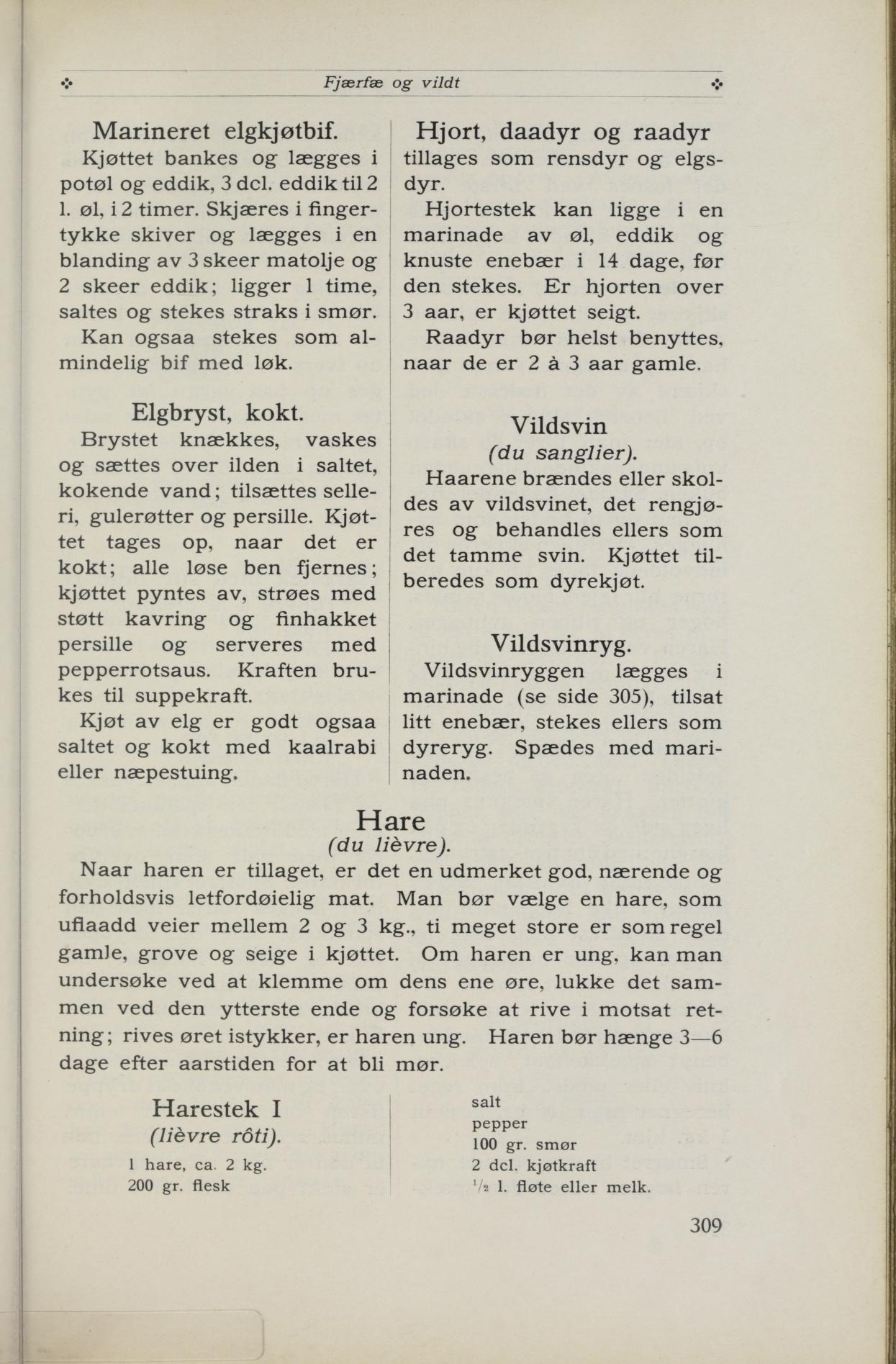
ProofreadPage 309
1 hare, ca. 2 kg
200 gr. flesk
salt
pepper
100 gr. smør
2 del. kjøtkraft
1/2 l. fløte eller melk.
Ved flaaningen hænges haren op i bakbenene, skindet løsnes ved første led av benene, og kniven føres ind under skindet langs med buken. Nu kan man skyve skindet av ned til hodet, som skjæres av tillikemed skindet. Andre foretrækker at lægge haren paa ryggen paa en fjæl, skjære av det nederste led ved benene, skjære skindet op, idet man fører en skarp kniv under skindet langs nedad buken. Skindet flaaes derefter av helt op til hodet, som avhugges. — Buken skjæres op, indvoldene tages ut, kun nyrerne blir igjen, blodet samles, boger og ribben avhugges. Haren vaskes, tørres, alle hinder løsnes med en skarp kniv og trækkes av, uten at kjøttet beskadiges. Laarben og rygraden knækkes let paa indsiden, uten at beskadige kjøttet. Haren spækkes paa hver side av rygraden og paa laarene med fine fleskestrimler.
Spækning av kjøt: Skjær flesket i like lange strimler; disse krydres med salt og pepper og bør helst ligge et par timer for at fæstne. De stikkes derefter i kjøttet med like lang avstand fra hinanden; benyt spækkenaal, spækkekniv eller pinde. Som regel beregner man 100 gr. flesk til 1 kg. kjøt.
Smørret brunes i pande, haren lægges i med den spækkede side ned, brunes pent, vendes, belægges med smaa stykker smør, spædes først med den kokende buljong, derefter med fløten, smaakoker saa, til haren er mør eller omkring 1 1/2 time; dryppes ofte med skyen. Naar haren er stekt, skjæres den pent op tvers over rygraden, lægges op paa varmt fat, pyntes med franske poteter, salat og stekte eller fyldte tomater. Sausen siles, irøres 1 dessertske ribs og 1 spiseske kremfløte.
📖1949
Revised 1949 recipe
From the revised edition of the Big Cookbook.
Foto: Faksimile: Nasjonalbiblioteket
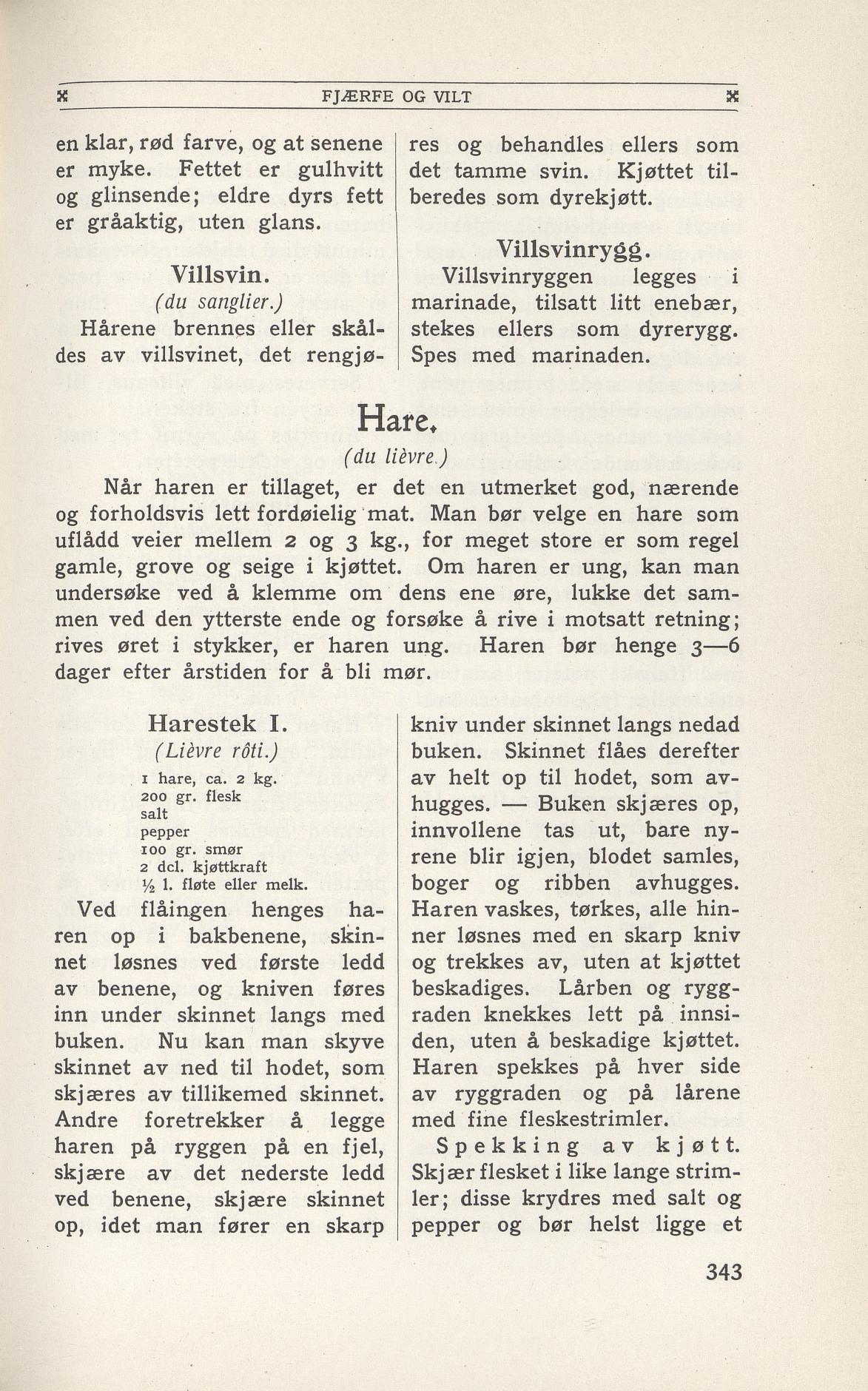
ProofreadPage 343
1 hare, ca. 2 kg.
200 gr. flesk
salt
pepper
100 gr. smør
2 del. kjøttkraft
½ l. fløte eller melk.
Ved flåingen henges haren op i bakbenene, skinnet løsnes ved første ledd av benene, og kniven føres inn under skinnet langs med buken. Nu kan man skyve skinnet av ned til hodet, som skjæres av tillikemed skinnet. Andre foretrekker å legge haren på ryggen på en fjel, skjære av det nederste ledd ved benene, skjære skinnet op, idet man fører en skarp kniv under skinnet langs nedad buken. Skinnet flåes derefter av helt op til hodet, som avhugges. — Buken skjæres op, innvollene tas ut, bare nyrene blir igjen, blodet samles, boger og ribben avhugges. Haren vaskes, tørkes, alle hinner løsnes med en skarp kniv og trekkes av, uten at kjøttet beskadiges. Lårben og ryggraden knekkes lett på innsiden, uten å beskadige kjøttet. Haren spekkes på hver side av ryggraden og på lårene med fine fleskestrimler. Smøret brunes i panne, haren legges i med den spekkede side ned, brunes pent, vendes, belegges med små stykker smør, spes først med den kokende buljong, derefter med fløten, småsteker så til haren er mør eller omkring 1½ time; dryppes ofte med skyen. Når haren er stekt, skjæres den pent op tvers over ryggraden, legges op på varmt fat, anrettes med franske poteter, salat og stekte eller fylte tomater. Sausen siles, irøres 1 dessertskje rips og 1 spiseskje kremfløte.
In stores now
Clean, minimally processed groceries matched to the ingredients — approximate prices.
1914 (korrekturlest, s. 309) → 1949 (korrekturlest, s. 343)~50% av teksten endretfjernetlagt til
1 hare, ca. 2 kg kg. 200 gr. flesk salt pepper 100 gr. smør 2 del. kjøtkraft 1/2 kjøttkraft ½ l. fløte eller melk. Ved flaaningen hænges flåingen henges haren op i bakbenene, skindet skinnet løsnes ved første led ledd av benene, og kniven føres ind inn under skindet skinnet langs med buken. Nu kan man skyve skindet skinnet av ned til hodet, som skjæres av tillikemed skindet. skinnet. Andre foretrækker at lægge foretrekker å legge haren paa på ryggen paa på en fjæl, fjel, skjære av det nederste led ledd ved benene, skjære skindet skinnet op, idet man fører en skarp kniv under skindet skinnet langs nedad buken. Skindet flaaes Skinnet flåes derefter av helt op til hodet, som avhugges. — Buken skjæres op, indvoldene tages innvollene tas ut, kun nyrerne bare nyrene blir igjen, blodet samles, boger og ribben avhugges. Haren vaskes, tørres, tørkes, alle hinder hinner løsnes med en skarp kniv og trækkes trekkes av, uten at kjøttet beskadiges. Laarben Lårben og rygraden knækkes let paa indsiden, ryggraden knekkes lett på innsiden, uten at å beskadige kjøttet. Haren spækkes paa spekkes på hver side av rygraden ryggraden og paa laarene på lårene med fine fleskestrimler. Spækning av kjøt: Skjær flesket i like lange strimler; disse krydres med salt og pepper og bør helst ligge et par timer for at fæstne. De stikkes derefter i kjøttet med like lang avstand fra hinanden; benyt spækkenaal, spækkekniv eller pinde. Som regel beregner man 100 gr. flesk til 1 kg. kjøt. Smørret Smøret brunes i pande, panne, haren lægges legges i med den spækkede spekkede side ned, brunes pent, vendes, belægges belegges med smaa små stykker smør, spædes spes først med den kokende buljong, derefter med fløten, smaakoker saa, småsteker så til haren er mør eller omkring 1 1/2 1½ time; dryppes ofte med skyen. Naar Når haren er stekt, skjæres den pent op tvers over rygraden, lægges ryggraden, legges op paa på varmt fat, pyntes anrettes med franske poteter, salat og stekte eller fyldte fylte tomater. Sausen siles, irøres 1 dessertske ribs dessertskje rips og 1 spiseske spiseskje kremfløte.
Count on around 2.5 hours in total (150 minutes) including preparation with skinning, cleaning, and larding, plus roasting.
What ingredients do I need?
1 hare of approx. 2 kg, 200 g pork for larding, salt and pepper, 100 g butter, 2 deciliters meat stock, and 1/2 liter cream or milk for the sauce.
How do I skin and clean the hare?
Hang the hare up by the hind legs, loosen the skin at the first joint and run the knife under the skin along the belly, push the skin off down to the head, and cut off the head with the skin. Alternatively, lay the hare on its back on a board. Cut open the belly, take out the entrails (the kidneys remain), collect the blood, and chop off the shoulders and ribs. Wash and dry the hare, and loosen all membranes.
Where does the recipe come from?
From Henriette Schonberg Erken's "Stor kokebok" (1914), page 309, as "Harestek I (lievre roti)." It serves 4.