Skip to content

Coarse Rye Bread I

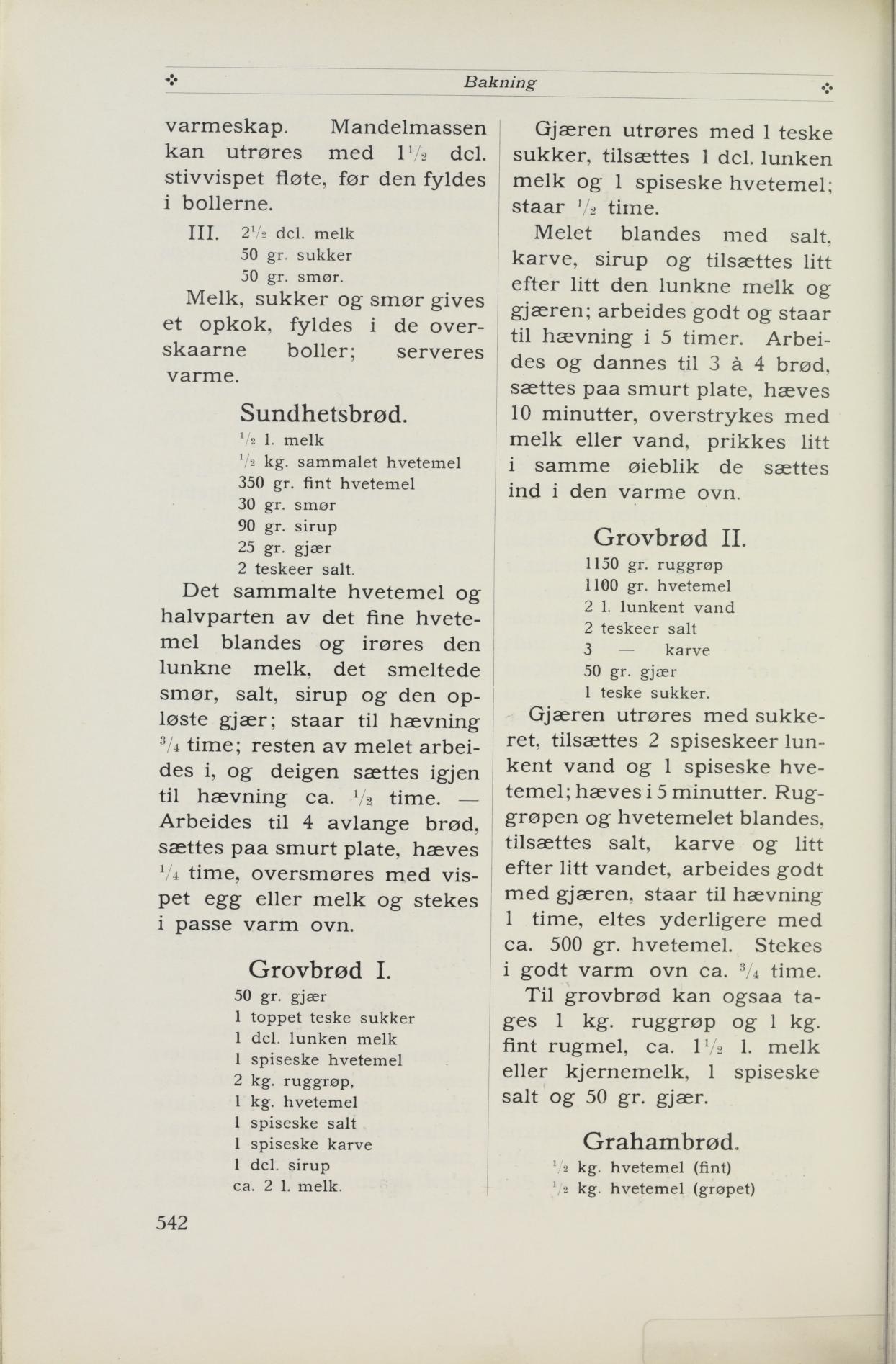
Coarse Rye Bread I from Erken's Stor kokebok (1914, p. 542): rye bread of 2 kg coarse rye meal and 1 kg wheat flour with caraway, syrup, salt, and a yeast starter, risen 5 hours, formed into 3–4 loaves on a sheet, glazed and pricked before baking in a hot oven. Variant with fine rye flour and buttermilk.

Source: Henriette Schønberg Erken, Stor kokebok, 1914-utg. s. 542 (falt i det fri)

Be the first to rate

About the dish

Coarse rye bread with rye meal (coarsely ground rye) and caraway was the everyday bread in Norwegian homes. Erken gives a starter with yeast and a long five-hour rise, and adds a variant with fine rye flour and buttermilk.

How to make it

  1. 1

    Set the starter

    Stir the yeast with 1 tsp sugar, add 1 dl lukewarm milk and 1 tbsp wheat flour. Let stand about 30 minutes.

  2. 2

    Mix the dough

    Mix the coarse rye meal and wheat flour with salt and caraway, add the syrup, then little by little the lukewarm milk and the yeast mixture.

  3. 3

    Knead and rise

    Work the dough well and let it rise about 5 hours.

  4. 4

    Shape the loaves

    Knead the dough down and form 3–4 loaves. Place them on a greased sheet and let them proof 10 minutes.

  5. 5

    Bake

    Brush the loaves with milk or water and prick them with a fork the moment they go into the hot oven, about 220 °C (430 °F). Bake about 1 hour, until the loaves sound hollow when you knock on the underside.

  6. 6

    Variant

    The coarse rye bread can also be made with 1 kg coarse rye meal and 1 kg fine rye flour, about 1.5 l milk or buttermilk, 1 tbsp salt, and 50 g yeast.

Changes from the original

Units modernized (dl, g, tbsp, tsp). The amount of lukewarm milk for the dough itself is not given in the original; here it is estimated at about 1.5 l based on the variant recipe. "Hot oven" is given as about 220 °C (430 °F).

Tidsmaskin – hva endret seg?

Velg to utgaver og se hva Henriette Schønberg Erken la til, fjernet eller endret mellom dem.

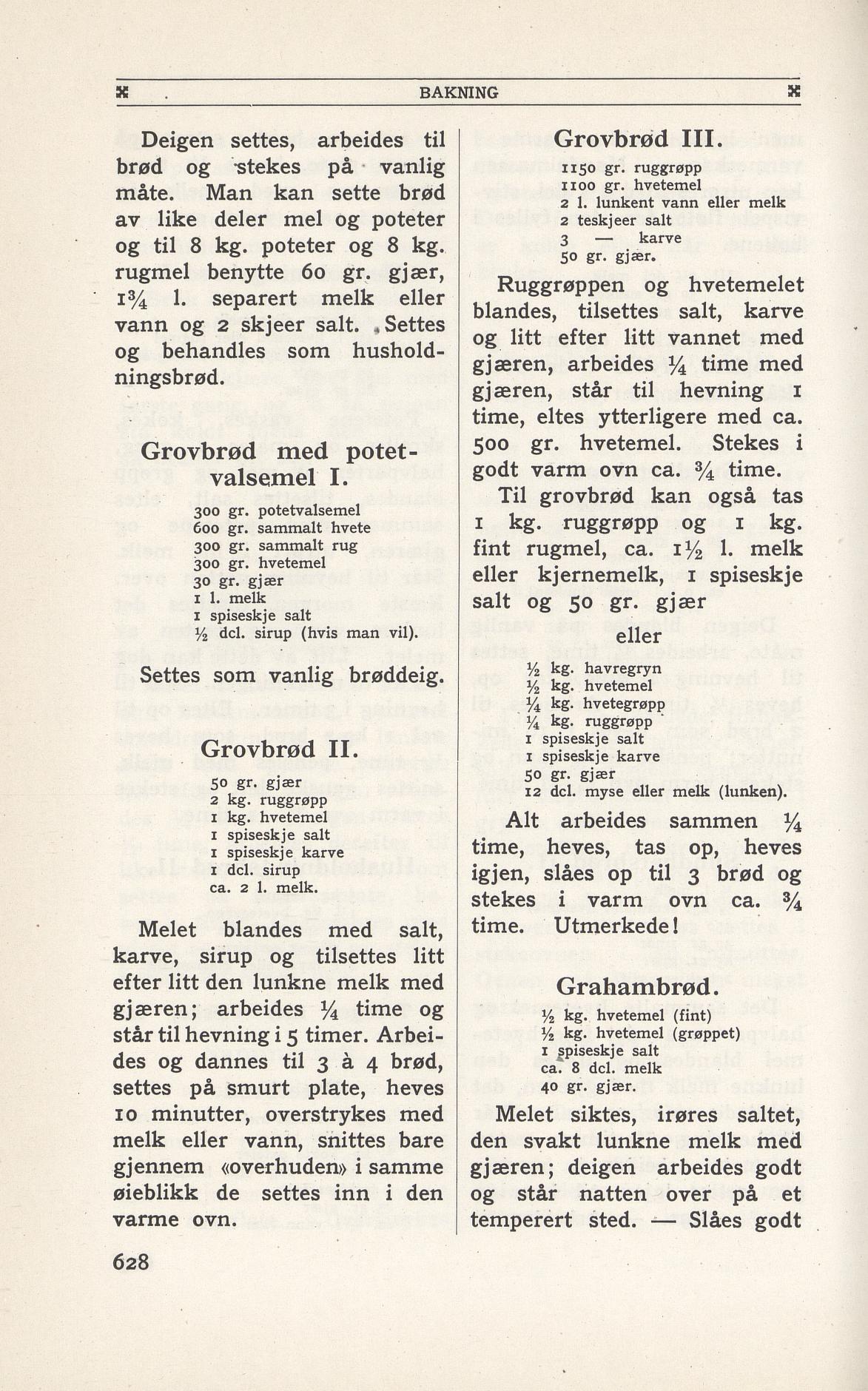
1914 (korrekturlest, s. 542)1949 (korrekturlest, s. 628)~84% av teksten endretfjernetlagt til
50 1150 gr. gjær 1 toppet teske sukker 1 del. lunken melk 1 spiseske ruggrøpp 1100 gr. hvetemel 2 kg. ruggrøp 1 kg. hvetemel 1 spiseske l. lunkent vann eller melk 2 teskjeer salt 1 spiseske 3 — karve 1 del. sirup. Gjæren utrøres med 1 teske sukker, tilsættes 1 del. lunken melk 50 gr. gjær. Ruggrøppen og 1 spiseske hvetemel; staar 1/2 time. Melet blandes med hvetemelet blandes, tilsettes salt, karve, sirup karve og tilsættes litt efter litt den lunkne melk og gjæren; vannet med gjæren, arbeides godt og staar til hævning i 5 timer. Arbeides og dannes 3/4 time med gjæren, står til 3 à 4 brød, sættes paa smurt plate, hæves 10 minutter, overstrykes hevning 1 time, eltes ytterligere med melk eller vand, prikkes litt i samme øieblik de sættes ind ca. 500 gr. hvetemel. Stekes i den varme ovn. godt varm ovn ca. 3/4 time. Til grovbrød kan ogsaa tages også tas 1 kg. ruggrøp ruggrøpp og 1 kg. fint rugmel, ca. 1 1/2 l. melk eller kjernemelk, 1 spiseske spiseskje salt og 50 gr. gjær. gjær eller 1/2 kg. havregryn 1/2 kg. hvetemel 1/4 kg. hvetegrøpp 1/4 kg. ruggrøpp 1 spiseskje salt 1 spiseskje karve 50 gr. gjær 1 1/2 del. myse eller melk (lunken). Alt arbeides sammen 3/4 time, heves, tas op, heves igjen, slåes op til 3 brød og stekes i varm ovn ca. 3/4 time. Utmerkede!

Community interpretations

Be the first to share your own version.

See interpretations

Frequently asked questions

How long does the rising take?
First the yeast mixture (yeast, sugar, lukewarm milk, and 1 tablespoon wheat flour) stands for half an hour. The dough then rises 5 hours, and the shaped loaves proof 10 minutes on a greased sheet. In total, figure on about 7 hours including baking.
Which flour is used, and is there an alternative?
The main recipe uses 2 kg coarse rye meal and 1 kg wheat flour. Alternatively you can take 1 kg coarse rye meal and 1 kg fine rye flour with about 1 1/2 liters milk or buttermilk, 1 tablespoon salt, and 50 g yeast.
What is done with the loaves just before baking?
They are formed into 3–4 loaves, placed on a greased sheet, proofed 10 minutes, brushed with milk or water, and pricked the moment they go into the hot oven.
Where does the recipe come from?
From Henriette Schønberg Erken's "Stor kokebok" (1914), page 542. Caraway and syrup give the bread its characteristic flavor.

Related recipes

More dishes in the same category from the archive

Read also

Kommentarer

Ingen kommentarer ennå. Bli den første til å dele!