Skip to content

Stuffed Cabbage Leaves, Cabbage Rolls

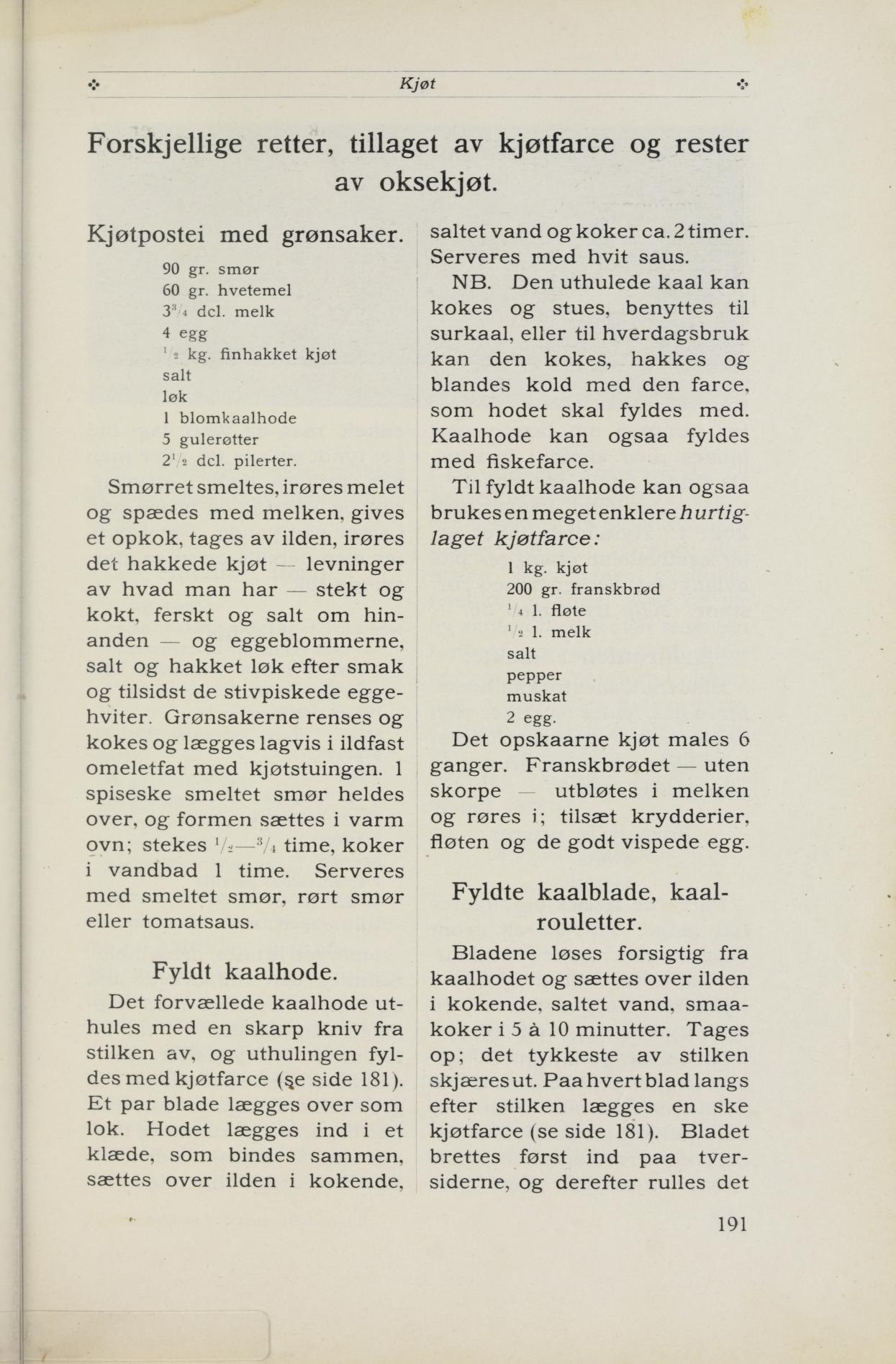
Stuffed cabbage leaves (cabbage rolls) from Erken's Stor kokebok 1914: cabbage leaves are blanched 5–10 minutes, the stem cut out, each leaf filled with a spoonful of ground meat, rolled and tied with string, and boiled ½ hour in the cabbage water. Served with stirred butter.

Source: Henriette Schønberg Erken, Stor kokebok, 1914-utg. s. 191 (falt i det fri)

Be the first to rate

About the dish

Cabbage rolls were an economical way to stretch the ground meat. Erken lets the rolls boil in the cabbage water, and in the next recipe gives a variant where they are browned in butter afterwards.

How to make it

  1. 1

    Blanch the leaves

    Carefully loosen the cabbage leaves from the head and put them in boiling, salted water. Let them simmer 5–10 minutes.

  2. 2

    Trim the leaves

    Take the leaves out and cut out the thickest part of the stem.

  3. 3

    Fill and roll

    Place a spoonful of ground meat on each leaf along the stem. First fold in the sides and roll the leaf tightly around the filling. Tie with scalded string.

  4. 4

    Boil the rolls

    Boil the stuffed cabbage leaves for ½ hour in the water the cabbage was boiled in.

  5. 5

    Serve

    Cut off the string, place the rolls on an oblong platter and serve with stirred butter.

Changes from the original

No quantities are given in the original; the number of cabbage leaves and the amount of ground meat are estimated in a modern ingredient list. The string is retained, but it is scalded as in the original.

In stores now

Clean, minimally processed groceries matched to the ingredients — approximate prices.

Product data and prices via Kassalapp. Prices are updated daily and may vary.

Tidsmaskin – hva endret seg?

Velg to utgaver og se hva Henriette Schønberg Erken la til, fjernet eller endret mellom dem.

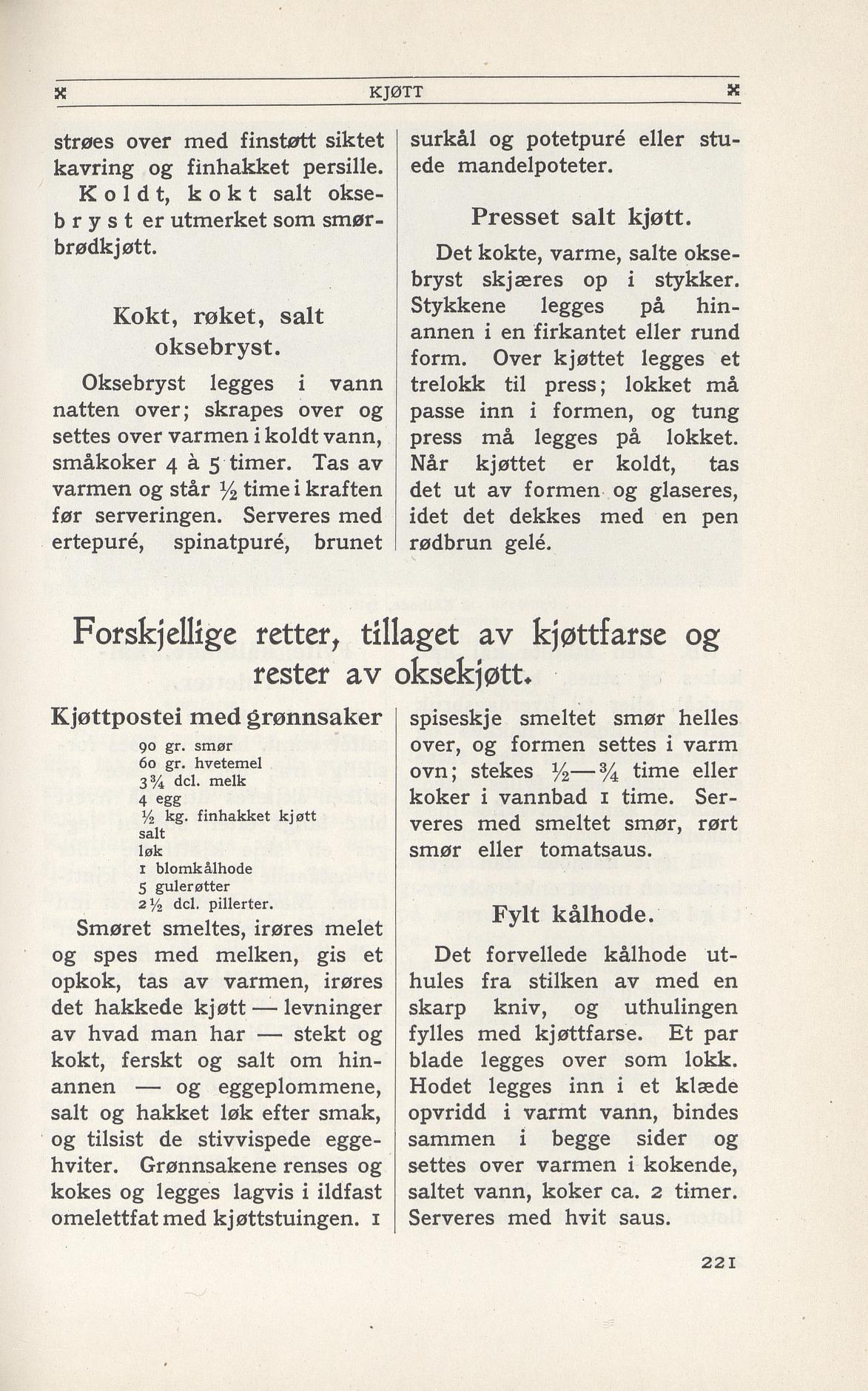
1914 (korrekturlest, s. 191)1949 (korrekturlest, s. 221)~66% av teksten endretfjernetlagt til
kaalblade kjøtfarce (se side 181) saltet vand Bladene løses forsigtig fra kaalhodet og sættes over ilden Kålhodet koker ¾ time i kokende, saltet vand, smaakoker i 5 à 10 minutter. Tages op; vann, bladene løses forsiktig fra; det tykkeste av stilken skjæres ut. Paa hvert blad langsefter langs efter stilken lægges legges en ske kjøtfarce (se side 181). skje kjøttfarse eller ovenstående hurtiglagede kjøttfarse. Bladet brettes først ind paa tversiderne, inn på tverrsidene, og derefter rulles det tæt tett sammen om farcen, farsen, ombindes med skoldet skåldet hyssing. De fyldte kaalblade fylte kålblade koker ½ time i det vand, kaalen vann kålen blev kokt i. Hyssingen tages tas av, og kaalbladene oplægges paa kålbladene oplegges på avlangt fat; serveres med rørt smør. Klip Klipp hyssingen op. av.

Community interpretations

Be the first to share your own version.

See interpretations

Frequently asked questions

How long should the cabbage rolls boil?
The cabbage leaves are first blanched for 5–10 minutes in boiling, salted water. After they are filled and rolled, they boil for half an hour in the same water the cabbage was blanched in.
How do I get the rolls to hold their shape?
Cut out the thickest part of the stem, place a spoonful of ground meat along the stem, fold in the sides and roll the leaf tightly together. Tie around with scalded string, which is cut off and removed before serving.
What is served with stuffed cabbage leaves?
In the recipe from Schønberg Erken's "Stor kokebok" (1914, p. 191) the cabbage rolls are arranged on an oblong platter and served with stirred butter.
Which meat filling is used?
Ordinary ground meat, which Schønberg Erken refers to on page 181 of the same book.

Related recipes

More dishes in the same category from the archive

Read also

Kommentarer

Ingen kommentarer ennå. Bli den første til å dele!