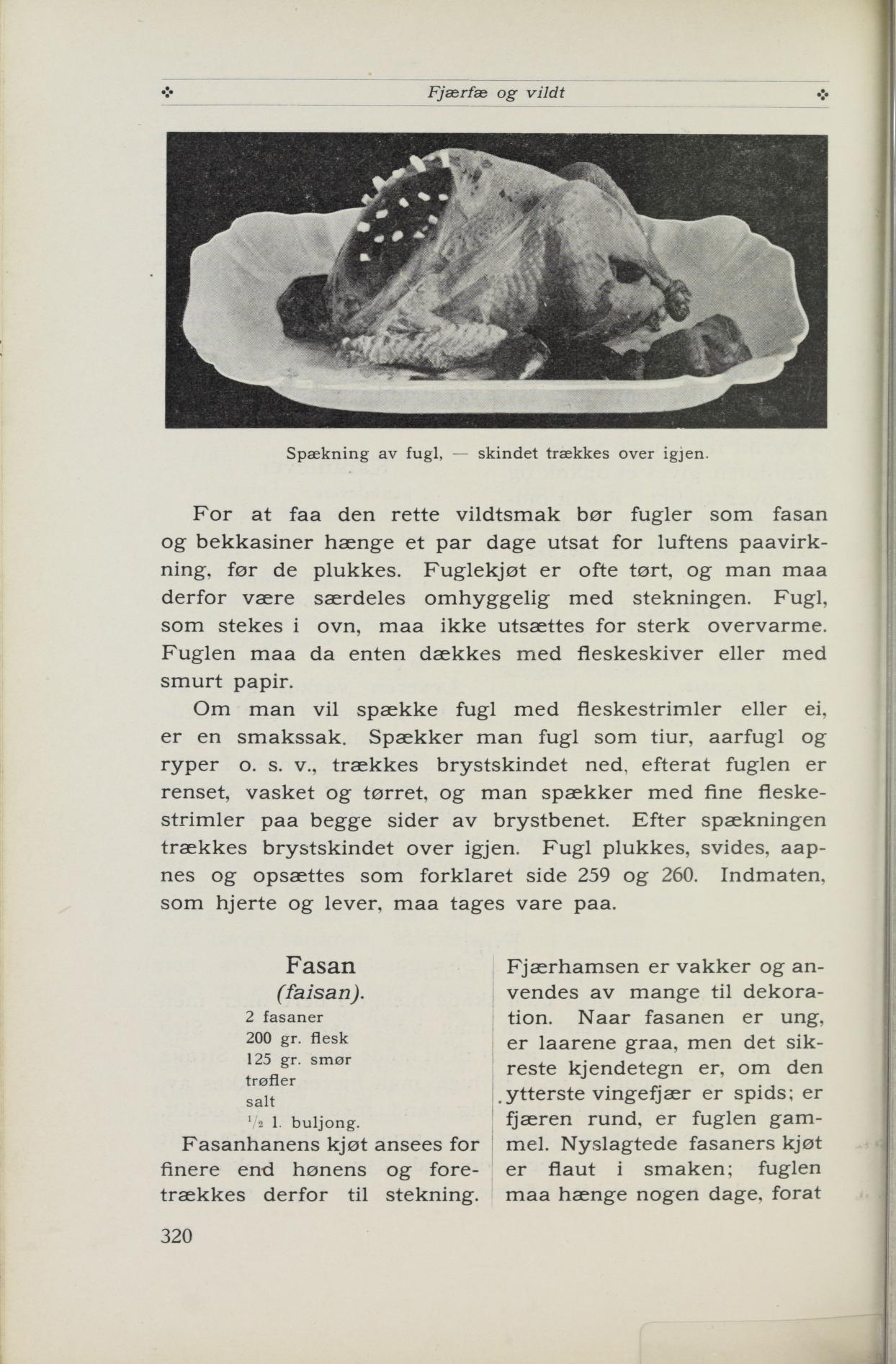
Erken's classic whole roast pheasant from 1914: two aged pheasants are cleaned, salted, optionally filled with butter and truffle, covered with pork slices and browned in butter in an iron pot, roasted 45–60 minutes while being basted with bouillon. Served carved on a hollowed, fried bread base with head, wings, and tail as garnish, with strained jus, cream or bread sauce, fried potato slices, and redcurrant/rowanberry jelly. Figured for 5–6 people per pheasant.
Source: Henriette Schønberg Erken, Stor kokebok, 1914-utg. s. 320 (falt i det fri)
Be the first to rate
About the dish
The recipe opens the pheasant section of the game chapter. Erken first explains how to tell a young pheasant from an old one, and that the bird should hang a few days to gain "game flavor" and become juicy. The presentation on a hollowed, fried bread base — with head, tail, and wings fastened with wire — is typical of the era's festive game service.
How to make it
1
Aging and cleaning
Let the pheasants hang a few days in a cool place, so the meat becomes juicy and takes on a game flavor. Keep the head with neck, wings, and tail if they are to be used for garnish; wipe them clean with a cloth or dry them in the oven at low heat.
2
Plucking
Pluck the birds, singe them, remove the innards, and wash them. Wipe the pheasants inside and out with a cloth. Keep the heart and liver (giblets).
3
Salting and filling
Rub the pheasants inside with salt. Optionally fill them with a mixture of butter and diced truffle, which melts during roasting and keeps the meat juicy.
4
Browning
Cover the breast with pork slices, tying with string if needed. Brown the butter lightly in an iron pot and brown the pheasants together with the giblets.
5
Roasting
Continue roasting under a lid at not-too-strong heat for 45–60 minutes, and baste often with boiling bouillon.
6
Bread base
Cut a bread base 4–6 cm tall, as long and wide as the bird. Hollow out the bread lengthwise, fry it nicely brown in butter or lard, and place it on a warm platter. The base can be fastened to the platter with a little egg white and flour.
7
Plating
Carve the pheasant neatly and lay it in the hollow of the bread so it looks whole. For old-fashioned garnish, run a wire through the beak and neck and fasten the head to one end of the base, the tail to the other, and the wings slightly spread on each side. The garnish may be omitted.
8
Sauce and accompaniments
Strain and skim the jus, bring it to a boil, and serve it separately in a sauce boat, optionally together with cream sauce or bread sauce. Garnish the platter with lettuce, cress, and two lemon halves, and serve fried potato slices and redcurrant or rowanberry jelly alongside.
Changes from the original
Amounts are given in modern units (grams, dl); "flesk" is interpreted as fatty streaky pork/bacon in slices for covering the bird. The bouillon amount in the OCR was unclear and has been set to about 1.5 dl. Oven/roasting instructions are phrased in modern language, and the decorative wire garnish is described as optional, as the original states.
📖1914
Original 1914 recipe
Verbatim from the first edition of the Big Cookbook.
Foto: Faksimile: Nasjonalbiblioteket
ProofreadPage 320
2 fasaner
200 gr. flesk
125 gr. smør
trøfler
salt
1 1/2 dl. buljong.
Fasanhanens kjøt ansees for finere end hønens og foretrækkes derfor til stekning. Fjærhamsen er vakker og anvendes av mange til dekoration. Naar fasanen er ung, er laarene graa, men det sikreste kjendetegn er, om den ytterste vingefjær er spids; er fjæren rund, er fuglen gammel. Nyslagtede fasaners kjøt er flaut i smaken; fuglen maa hænge nogen dage, forat kjøttet skal bli saftig og faa vildtsmaken. Naar den skal renses, tages vare paa hodet med halsen, vingerne og halen, som tørres rene med klædet eller i ovnen ved svak varme. Fuglen plukkes derefter, svides, indmaten tages ut, vaskes, og fasanen tørres ut- og indvendig med et klæde.
Fasanen gnides indi med salt, dækkes med fleskeskiver og brunes tillikemed kraasen i jerngryte i det let brunede smør. Stekes fra 3/4—1 time ved ikke for sterk varme, dryppes med den kokende buljong. Fasanen kan fyldes med en blanding av smør og trøffelterninger; naar dette smelter under stekningen og gjennemtrænger kjøttet, blir dette ikke tørt. Fasanen anrettes paa brødsokkel; denne skjæres ca. 4—6 cm. høi med samme længde og bredde som fuglen; brødet uthules langsefter, stekes pent brunt i smør eller smult og lægges op paa et varmt fat. Fuglen skjæres pent op og lægges i fordypningen av brødet som hel. En staaltraad trækkes gjennem nebbet og halsen og fæstes til brødsokkelens ene ende. Paa samme maate fæstes halen til den anden og vingerne, litt utspilet, fæstes paa hver side. Vil man ikke ha denne pynt, kan den sløifes. Fatet pyntes med salat, karse og 2 halve citroner. Stekte potetesskiver serveres til samt ribs eller rognebærgelé. Skyen fra fuglen siles, skummes, kokes og anrettes særskilt i sauseskaal; likesaa en kremsaus eller brødsaus. Brødsokkelen kan fæstes til fatet ved hjælp av litt eggehvite og mel. 1 fasan beregnes til 5 å 6 personer.
📖1949
Revised 1949 recipe
From the revised edition of the Big Cookbook.
Foto: Faksimile: Nasjonalbiblioteket
ProofreadPage 354
2 fasaner
200 gr. flesk
125 gr. smør
trøfler
salt
1/2 l. buljong.
Fasanhanens kjøtt ansees for finere enn hønens, og forefinnes derfor til steking. Når fasanen er ung, er lårene grå, men det sikraste kjennetegn er om den ytterste vingefjær er spiss; er fjæren rund, er fuglen gammel. Nyslaktede fasaners kjøtt er flaut i smaken. Fuglen må henge nogen dager, forat kjøttet skal bli saftig og få viltsmaken. Når den skal renses, tas vare på hodet med halsen, vingene og halen, som tørkes rene med klædet eller i ovnen ved svak varme.
Fuglen plukkes derefter, svies, innmaten tas ut, vaskes, og fasanen tørres ut- og innvendig med et klæde. Fasanen gnis inni med salt, dekkes med fleskeskiver og brunes tillikemed kråsen i jerngryte i det lett brunede smør. Stekes fra 1/2—3/4 time, ved ikke for sterk varme, dryppes med den kokende buljong. Fasanen kan fylles med en blanding av smør og trøffelterninger; når dette smelter under stekingen og gjennemtrenger kjøttet, blir dette ikke tørt. Ved anretningen pyntes fatet med salat, karse og 2 halve sitroner. Stekte potetskiver serveres til samt rips- eller rognebærgelé. Skyen fra fuglen siles, skummes, kokes og anrettes særskilt i sauseskål; likeså en kremsaus eller brødsaus. I fasan beregnes til 5 å 6 personer.
In stores now
Clean, minimally processed groceries matched to the ingredients — approximate prices.
Modernised → 1949 (proofread, p. 354)~89% of the text changedremovedadded
2 stk fasaner (godt modnet, gjerne hengt noen dager). 200 g fett sideflesk i tynne skiver (til å dekke fuglene). gr. flesk 125 g smør. trøfler (i terninger, til fyll (kan sløyfes)). salt. 1,5 dl buljong (kokende, til dryping). 1 stk loff til brødsokkel (til anretning). gr. smør eller smult trøfler salt 1/2 l. buljong. Fasanhanens kjøtt ansees for finere enn hønens, og forefinnes derfor til steking av brødsokkelen. 2 stk sitroner (delt steking. Når fasanen er ung, er lårene grå, men det sikraste kjennetegn er om den ytterste vingefjær er spiss; er fjæren rund, er fuglen gammel. Nyslaktede fasaners kjøtt er flaut i to, til pynt). salat og karse (til pynt). ripsgelé eller rognebærgelé (til servering). stekte potetskiver (til servering). La fasanene smaken. Fuglen må henge noen dager på kjølig sted, slik at nogen dager, forat kjøttet blir skal bli saftig og får viltsmak. Ta få viltsmaken. Når den skal renses, tas vare på hode hodet med hals, vinger halsen, vingene og hale hvis de skal brukes til pynt; tørk dem halen, som tørkes rene med klut klædet eller i ovnen ved svak varme.. Plukk fuglene, svi dem, ta ut varme. Fuglen plukkes derefter, svies, innmaten tas ut, vaskes, og vask den. Tørk fasanene fasanen tørres ut- og innvendig med en klut. Ta vare på hjerte og lever (krås).. Gni fasanene innvendig et klæde. Fasanen gnis inni med salt. Fyll dem eventuelt salt, dekkes med en blanding av smør og trøffelterninger, som smelter under stekingen fleskeskiver og holder kjøttet saftig.. Dekk brystet med fleskeskiver, bind eventuelt om med tråd. Brun smøret lett brunes tillikemed kråsen i en jerngryte og brun fasanene sammen med kråsen.. Stek videre under lokk i det lett brunede smør. Stekes fra 1/2—3/4 time, ved ikke for sterk varme i 45–60 minutter, og drypp ofte varme, dryppes med den kokende buljong.. Skjær en brødsokkel 4–6 cm høy, like lang og bred som fuglen. Uthul brødet på langs, stek det pent brunt i smør eller smult og legg det på et varmt fat. Sokkelen buljong. Fasanen kan festes til fatet fylles med litt eggehvite og mel.. Skjær fasanen pent opp og legg den i fordypningen i brødet slik at den ser hel ut. Ønsker du gammeldags pynt, trekk en ståltråd gjennom nebb og hals og fest hodet til den ene enden blanding av sokkelen, halen til den andre og vingene litt utspilt på hver side. Pynten kan sløyfes.. Sil smør og skum skyen, kok den opp trøffelterninger; når dette smelter under stekingen og server den for seg i sausenebbe, eventuelt sammen med fløtesaus eller brødsaus. Pynt gjennemtrenger kjøttet, blir dette ikke tørt. Ved anretningen pyntes fatet med salat, karse og to 2 halve sitroner, og server stekte sitroner. Stekte potetskiver serveres til samt rips- eller rognebærgelé til. rognebærgelé. Skyen fra fuglen siles, skummes, kokes og anrettes særskilt i sauseskål; likeså en kremsaus eller brødsaus. I fasan beregnes til 5 å 6 personer.
Note on Modernised
Mengder er oppgitt i moderne enheter (gram, dl); «flesk» er tolket som fett sideflesk/bacon i skiver til å dekke fuglen. Buljongmengden i OCR var utydelig og er satt til ca. 1,5 dl. Ovns-/stekeanvisninger er formulert i moderne språk, og den dekorative pynten med ståltråd er beskrevet som valgfri, slik originalen sier.
In young birds the thighs are gray, but the surest sign is the outermost wing feather: if it is pointed, the bird is young; if it is round, the bird is old.
Can the pheasant be roasted right after the hunt?
No, freshly killed pheasant tastes bland. The bird should hang a few days so the meat becomes juicy and takes on a game flavor.
What do I need for the recipe?
For 10 servings: 2 pheasants, 200 g pork, 125 g butter, truffles, salt, and 1 1/2 dl bouillon. Total time is roughly 100 minutes.
What do you do with the feathers and head?
The head with neck, wings, and tail are kept and wiped clean with a cloth or dried in the oven at low heat — the plumage is beautiful and is used by many to decorate the dish.