Skip to content

Pigeon Ragout (dueragu)

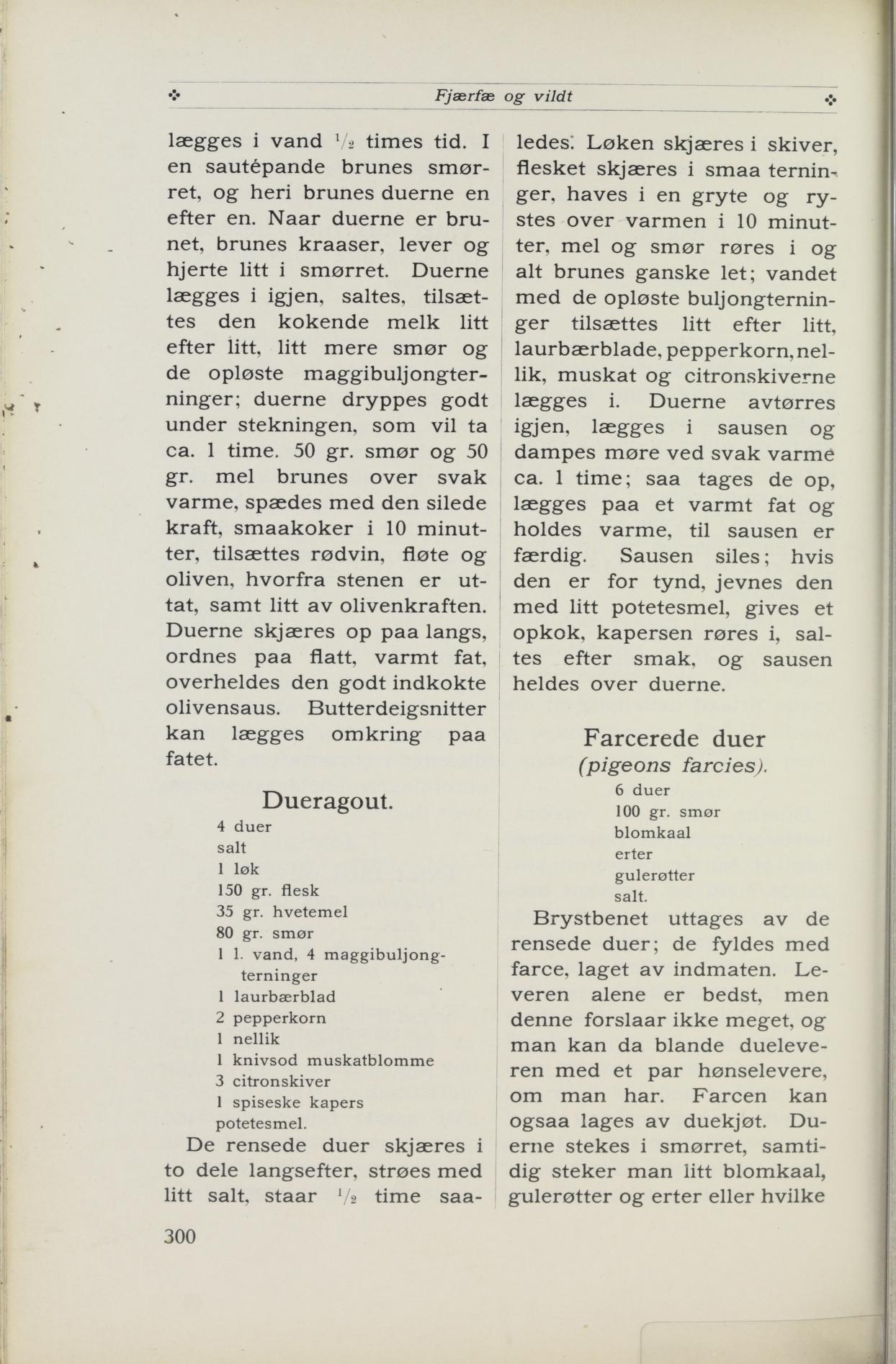
Erken's pigeon ragout from 1914: pigeons split lengthwise, salted, steamed tender for about 1 hour in a brown sauce of pork, onion, flour, butter and bouillon with bay leaf, clove, mace and lemon; the sauce is strained, thickened with potato starch if needed and seasoned with capers.

Source: Henriette Schønberg Erken, Stor kokebok, 1914-utg. s. 300 (falt i det fri)

Be the first to rate

About the dish

From the chapter on poultry and game in "Stor kokebok" (1914). Pigeons were common festive food in older Norwegian households, and Erken here uses Maggi's bouillon cubes - a modern industrial product in her time.

How to make it

  1. 1

    Prepare the pigeons

    Split the cleaned pigeons lengthwise in two, sprinkle a little salt over them and let them stand like that for half an hour.

  2. 2

    Brown pork and onion

    Slice the onion and cut the pork into small cubes. Put it in a pot and sauté it over the heat for 10 minutes.

  3. 3

    Make the sauce

    Stir in flour and butter and let everything brown fairly lightly. Add the water with the dissolved bouillon cubes a little at a time, and put in bay leaf, peppercorns, clove, mace and lemon slices.

  4. 4

    Steam the pigeons tender

    Dry the pigeons off again, place them in the sauce and steam them tender over low heat for about 1 hour.

  5. 5

    Keep warm

    Take up the pigeons, place them on a warm platter and keep them warm until the sauce is finished.

  6. 6

    Finish the sauce

    Strain the sauce. If it is too thin, thicken it with a little potato starch and give it a boil. Stir in the capers, season with salt and pour the sauce over the pigeons.

Changes from the original

The ingredients are given in modern measures and spelling (tablespoon, a pinch of mace, bouillon cubes instead of Maggi bouillon cubes). Pork is interpreted as fresh, fatty pork belly/bacon. The method is divided into numbered steps in modern Norwegian.

In stores now

Clean, minimally processed groceries matched to the ingredients — approximate prices.

Product data and prices via Kassalapp. Prices are updated daily and may vary.

Time machine – what changed?

Pick two editions and see what Henriette Schønberg Erken added, removed or changed between them.

1914 (proofread, p. 300) → Modernised~75% of the text changedremovedadded
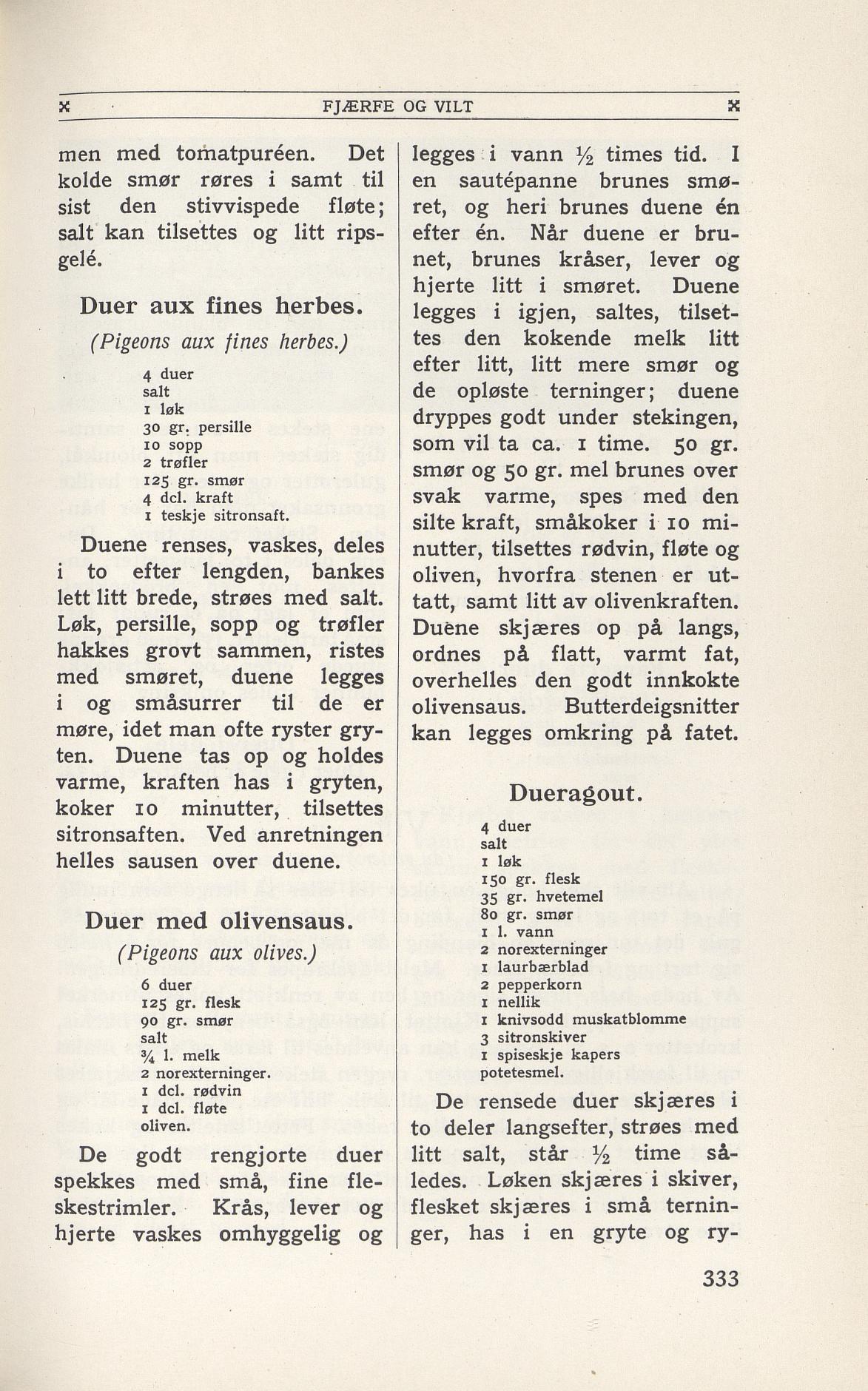
4 stk duer (rensede). 1 stk løk (i skiver). 150 gr. flesk g fet svineside (flesk) (i små terninger). 35 gr. hvetemel g hvetemel. 80 gr. smør g smør. 1 l. vand, l vann. 4 maggibuljongterninger stk buljongterninger (oppløst i vannet). 1 laurbærblad stk laurbærblad. 2 pepperkorn stk pepperkorn. 1 nellik stk nellik. 1 knivsod muskatblomme knivsodd muskatblomme. 3 citronskiver skiver sitron. 1 spiseske kapers potetesmel. De spiseskje kapers. potetmel (til jevning om nødvendig). salt (etter smak). Del de rensede duer skjæres duene i to dele langsefter, strøes med på langs, strø litt salt, staar ½ time saaledes. Løken skjæres salt over og la dem stå slik i skiver, flesket skjæres en halv time.. Skjær løken i smaa terninger, haves skiver og fleskét i små terninger. Legg det i en gryte og rystes rist det over varmen i 10 minutter, minutter.. Rør inn mel og smør røres i og la alt brunes ganske let; vandet lett. Tilsett vannet med de opløste buljongterninger tilsættes oppløste buljongterningene litt efter etter litt, laurbærblade, og legg i laurbærblad, pepperkorn, nellik, muskat muskatblomme og citronskiverne lægges i. Duerne avtørres sitronskiver.. Tørk duene av igjen, lægges legg dem i sausen og dampes damp dem møre ved svak varme i ca. 1 time; saa tages de op, lægges paa time.. Ta duene opp, legg dem på et varmt fat og holdes varme, hold dem varme til sausen er færdig. Sausen siles; hvis ferdig.. Sil sausen. Er den er for tynd, tynn, jevnes den med litt potetesmel, gives potetmel og gis et opkok, kapersen røres i, saltes efter smak, oppkok. Rør inn kapersen, smak til med salt og hell sausen heldes over duerne. duene.

Note on Modernised

Ingrediensene er satt i moderne mål og skrivemåte (spiseskje, knivsodd muskatblomme, buljongterninger i stedet for maggibuljongterninger). Flesk er tolket som fersk, fet svineside/bacon. Fremgangsmåten er delt i nummererte trinn på moderne norsk.

Community interpretations

Be the first to share your own version.

See interpretations →

Frequently asked questions

How long must the pigeons cook?
The pigeons are steamed tender in the sauce over low heat for about 1 hour. Allow around 110 minutes in total, since the pigeons must first be salted and stand for half an hour, and onion and pork are cooked for 10 minutes before the liquid is added.
How are the pigeons prepared?
The cleaned pigeons are split lengthwise in two, sprinkled with a little salt and left like that for ½ hour. Then they are dried off again before being placed in the sauce.
What gives the sauce its flavor?
Onion and pork cubes are lightly browned with flour and butter, and the liquid is 1 liter of water with 4 bouillon cubes. The seasoning is bay leaf, 2 peppercorns, 1 clove, a pinch of mace, 3 lemon slices and a tablespoon of capers. Potato starch is used for thickening.
Where does the recipe come from?
From Henriette Schønberg Erken's "Stor kokebok" from 1914, page 300. It is intended for 4 servings with 4 pigeons.

Equipment for this dish

Advertisement

We may earn a commission if you buy through these links. It does not affect the price.

Related recipes

More dishes in the same category from the archive

Read also

Kommentarer

Ingen kommentarer ennå. Bli den første til å dele!