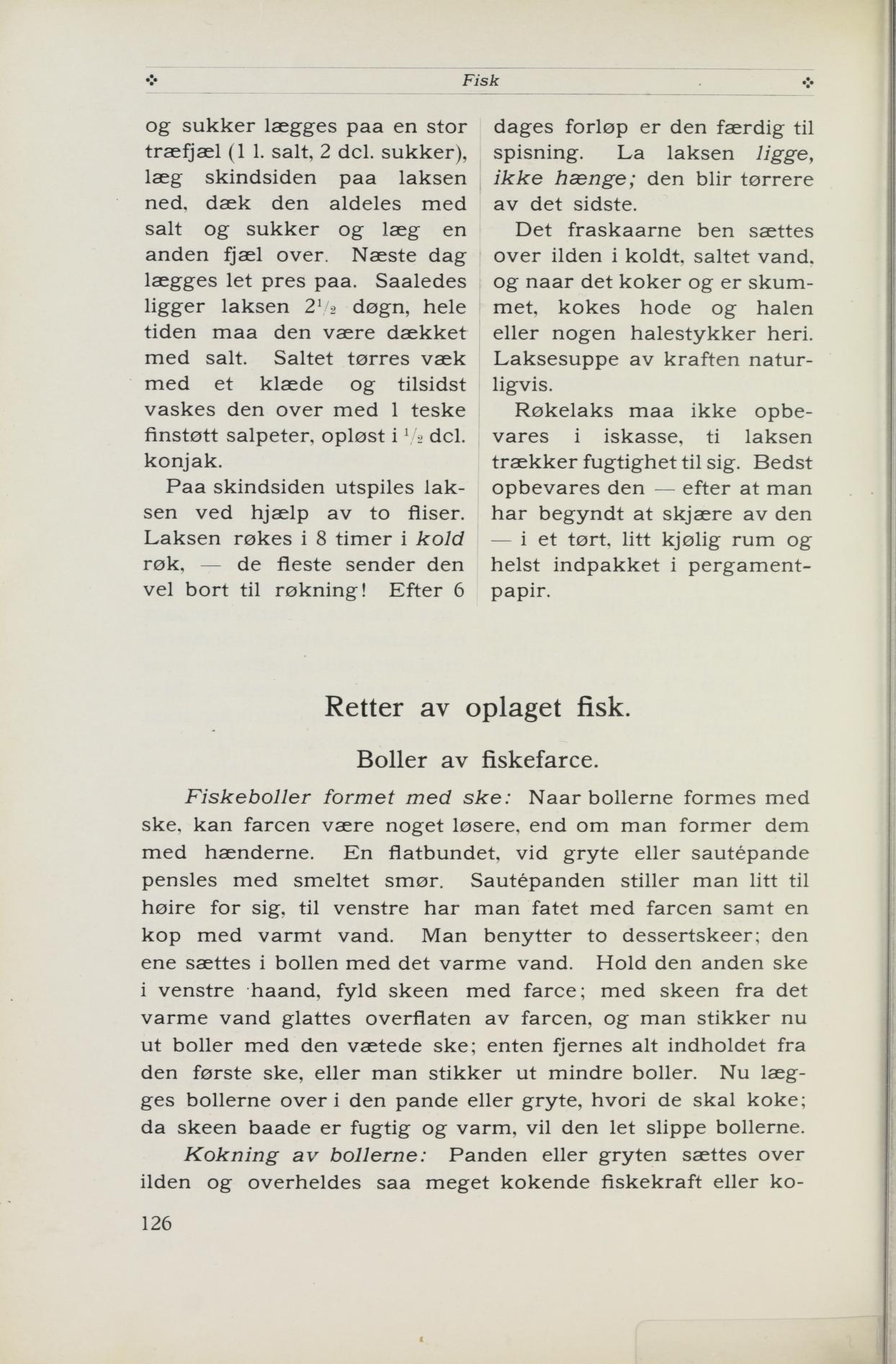
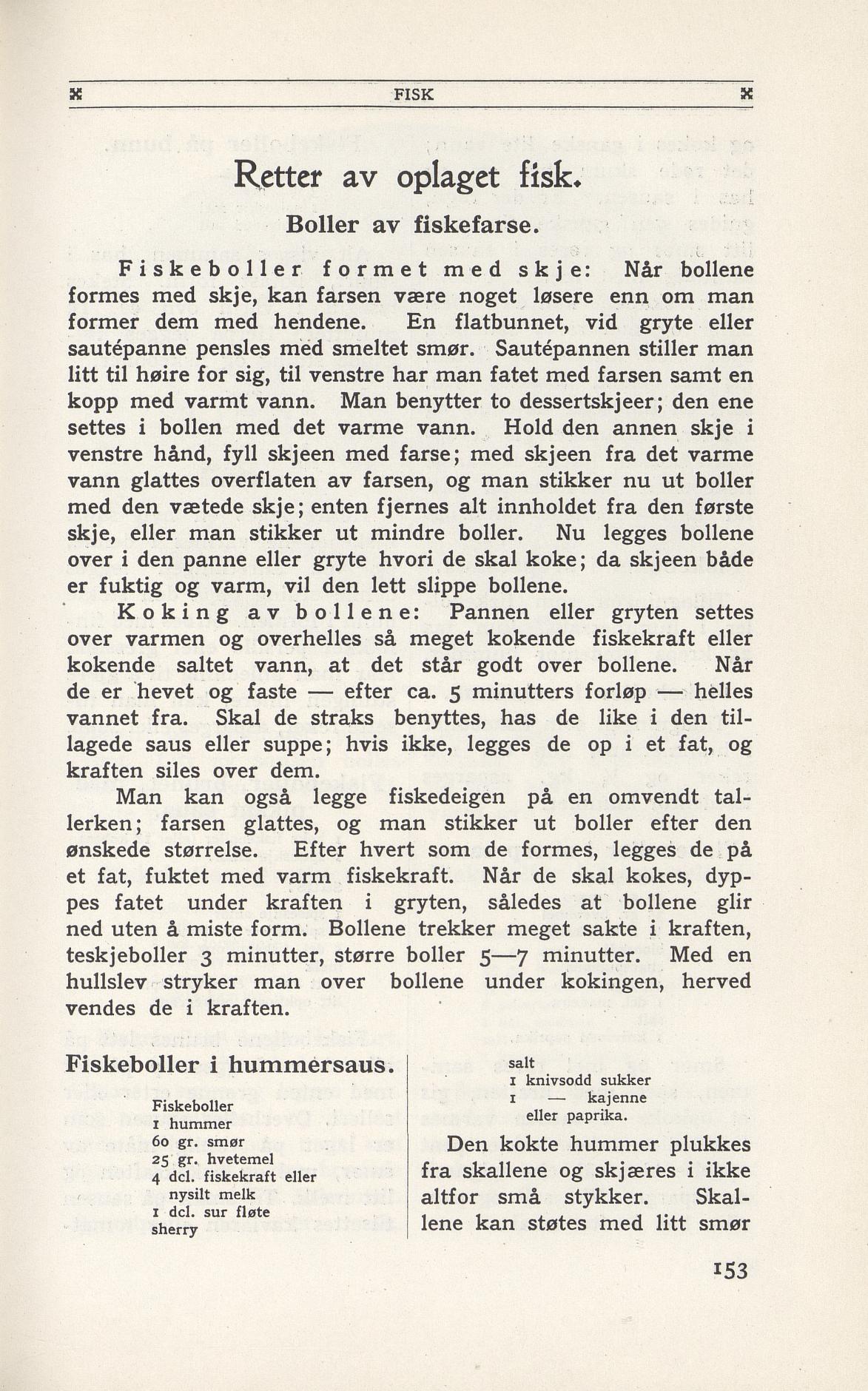
Erken's basic method from Stor kokebok (1914) for shaping fish dumplings with two dessert spoons (or by cutting them out from an upturned plate) and poaching them slowly in boiling fish stock or salted water for 3–7 minutes, for use in soup or sauce.
Source: Henriette Schønberg Erken, Stor kokebok, 1914-utg. s. 126 (falt i det fri)
Be the first to rate
About the dish
This passage appears in the chapter on "Dishes of poached fish" and is Erken's fundamental working description of how to shape and cook fish dumplings from ready-made fish forcemeat. The method is the starting point for the recipes that follow for fish dumplings in lobster sauce, crayfish sauce, shrimp sauce, and sharp sauce.
How to make it
1
Prepare the pan
Brush a wide, flat-bottomed pot or sauté pan with melted butter. Set the pan slightly to your right, and place the dish of forcemeat and a cup of warm water on your left.
2
Shape the dumplings with a spoon
Use two dessert spoons and leave one of them standing in the cup of warm water. Hold the other spoon in your left hand and fill it with forcemeat. Smooth the surface of the forcemeat with the spoon from the warm water, then scoop out dumplings with the moistened spoon – either the whole spoonful or smaller dumplings.
3
Place the dumplings in the pan
Transfer the dumplings to the pan or pot in which they will be cooked. Because the spoon is both moist and warm, it releases the dumplings easily.
4
Alternative shaping on a plate
The forcemeat can also be placed on an upturned plate and smoothed out, and the dumplings cut out in the desired size. As you go, place them on a dish moistened with warm fish stock. When cooking, dip the dish under the stock in the pot so the dumplings slide off without losing their shape.
5
Cook the dumplings
Set the pan over the heat and pour over enough boiling fish stock or boiling salted water to cover the dumplings well. Let the dumplings poach very slowly: teaspoon-sized dumplings in 3 minutes, larger dumplings 5–7 minutes. Stroke over the dumplings with a slotted spoon during cooking so they turn in the stock.
6
Serving and storage
When the dumplings have risen and are firm – after about 5 minutes – pour off the water. If they are to be used right away, place them directly in the prepared sauce or soup; otherwise, arrange them on a dish and strain the stock over them.
Changes from the original
The method has been divided into numbered steps and written in modern Norwegian. Measurements are kept as in the original (no fixed quantities are given for the forcemeat); "sautépande" is rendered as sauté pan and "fat" as dish/plate. Cooking times and temperature specifications are unchanged.
📖1914
Original 1914 recipe
Verbatim from the first edition of the Big Cookbook.
Foto: Faksimile: Nasjonalbiblioteket
ProofreadPage 126
Fiskefarce
smeltet smør til pensling
varmt vand
kokende fiskekraft eller kokende saltet vand
Fiskeboller formet med ske: Naar bollerne formes med ske, kan farcen være noget løsere, end om man former dem med hænderne. En flatbundet, vid gryte eller sautépande pensles med smeltet smør. Sautépanden stiller man litt til høire for sig, til venstre har man fatet med farcen samt en kop med varmt vand. Man benytter to dessertskeer; den ene sættes i koppen med det varme vand. Hold den anden ske i venstre haand, fyld skeen med farce; med skeen fra det varme vand glattes overflaten av farcen, og man stikker nu ut boller med den vætede ske; enten fjernes alt indholdet fra den første ske, eller man stikker ut mindre boller. Nu lægges bollerne over i den pande eller gryte, hvori de skal koke; da skeen baade er fugtig og varm, vil den let slippe bollerne.
Kokning av bollerne: Panden eller gryten sættes over ilden og overheldes saa meget kokende fiskekraft eller kokende saltet vand, at det staar godt over bollerne. Naar de er hævet og faste — efter ca. 5 minutters forløp — heldes vandet fra. Skal de straks benyttes, haves de like i den tillagede saus eller suppe; hvis ikke lægges de op i et fat, og kraften siles over dem.
Man kan ogsaa lægge fiskedeigen paa en omvendt tallerken; farcen glattes, og man stikker ut boller efter den forønskede størrelse. Efterhvert som de formes, lægges de paa et fat, fugtet med varm fiskekraft. Naar de skal kokes, dyppes fatet under kraften i gryten, saaledes at bollerne glider ned uten at miste form. Bollerne trækker meget sagte i kraften, teskeboller 3 minutter, større boller 5—7 minutter. Med en hulslev stryker man over bollerne under kokningen, herved vendes de i kraften.
📖1949
Revised 1949 recipe
From the revised edition of the Big Cookbook.
Foto: Faksimile: Nasjonalbiblioteket
ProofreadPage 153
Fiskeboller formet med skje: Når bollene formes med skje, kan farsen være noget løsere enn om man former dem med hendene. En flatbunnet, vid gryte eller sautépanne pensles med smeltet smør. Sautépannen stiller man litt til høire for sig, til venstre har man fatet med farsen samt en kopp med varmt vann. Man benytter to dessertskjeer; den ene settes i bollen med det varme vann. Hold den annen skje i venstre hånd, fyll skjeen med farse; med skjeen fra det varme vann glattes overflaten av farsen, og man stikker nu ut boller med den vætede skje; enten fjernes alt innholdet fra den første skje, eller man stikker ut mindre boller. Nu legges bollene over i den panne eller gryte hvori de skal koke; da skjeen både er fuktig og varm, vil den lett slippe bollene.
Koking av bollene: Pannen eller gryten settes over varmen og overhelles så meget kokende fiskekraft eller kokende saltet vann, at det står godt over bollene. Når de er hevet og faste — efter ca. 5 minutters forløp — helles vannet fra. Skal de straks benyttes, has de like i den til lagede saus eller suppe; hvis ikke, legges de op i et fat, og kraften siles over dem.
Man kan også legge fiskedeigen på en omvendt tallerken; farsen glattes, og man stikker ut boller efter den ønskede størrelse. Efter hvert som de formes, legges de på et fat, fuktet med varm fiskekraft. Når de skal kokes, dyppes fatet under kraften i gryten, således at bollene glir ned uten å miste form. Bollene trekker meget sakte i kraften, teskjeboller 3 minutter, større boller 5—7 minutter. Med en hullslev stryker man over bollene under kokingen, herved vendes de i kraften.
In stores now
Clean, minimally processed groceries matched to the ingredients — approximate prices.
1914 (korrekturlest, s. 126) → 1949 (korrekturlest, s. 153)~46% av teksten endretfjernetlagt til
Fiskefarce smeltet smør til pensling varmt vand kokende fiskekraft eller kokende saltet vand Fiskeboller formet med ske: Naar bollerne skje: Når bollene formes med ske, skje, kan farcen farsen være noget løsere, end løsere enn om man former dem med hænderne. hendene. En flatbundet, flatbunnet, vid gryte eller sautépande sautépanne pensles med smeltet smør. Sautépanden Sautépannen stiller man litt til høire for sig, til venstre har man fatet med farcen farsen samt en kop kopp med varmt vand. vann. Man benytter to dessertskeer; dessertskjeer; den ene sættes settes i koppen bollen med det varme vand. vann. Hold den anden ske annen skje i venstre haand, fyld skeen hånd, fyll skjeen med farce; farse; med skeen skjeen fra det varme vand vann glattes overflaten av farcen, farsen, og man stikker nu ut boller med den vætede ske; skje; enten fjernes alt indholdet innholdet fra den første ske, skje, eller man stikker ut mindre boller. Nu lægges bollerne legges bollene over i den pande panne eller gryte, gryte hvori de skal koke; da skeen baade skjeen både er fugtig fuktig og varm, vil den let lett slippe bollerne. Kokning bollene. Koking av bollerne: Panden bollene: Pannen eller gryten sættes settes over ilden varmen og overheldes saa overhelles så meget kokende fiskekraft eller kokende saltet vand, vann, at det staar står godt over bollerne. Naar bollene. Når de er hævet hevet og faste — efter ca. 5 minutters forløp — heldes vandet helles vannet fra. Skal de straks benyttes, haves has de like i den tillagede til lagede saus eller suppe; hvis ikke lægges ikke, legges de op i et fat, og kraften siles over dem. Man kan ogsaa lægge også legge fiskedeigen paa på en omvendt tallerken; farcen farsen glattes, og man stikker ut boller efter den forønskede ønskede størrelse. Efterhvert Efter hvert som de formes, lægges legges de paa på et fat, fugtet fuktet med varm fiskekraft. Naar Når de skal kokes, dyppes fatet under kraften i gryten, saaledes således at bollerne glider bollene glir ned uten at å miste form. Bollerne trækker Bollene trekker meget sagte sakte i kraften, teskeboller teskjeboller 3 minutter, større boller 5—7 minutter. Med en hulslev hullslev stryker man over bollerne bollene under kokningen, kokingen, herved vendes de i kraften.
What is the difference between dumplings shaped with a spoon and by hand?
When you shape the dumplings with a spoon, the forcemeat can be a little looser than when you shape them by hand. For spoon-shaping you use two dessert spoons, one of which is kept in a cup of warm water and used to smooth and scoop out the dumplings.
What are the fish dumplings cooked in?
In boiling fish stock or boiling salted water. The dumplings are placed in a flat-bottomed, wide pot or sauté pan that has first been brushed with melted butter.
How long does the recipe take, and how many does it serve?
About 40 minutes in total, and the recipe is intended for 4 servings.
Where does the recipe come from?
From Henriette Schønberg Erken's "Stor kokebok" of 1914, page 126.