Skip to content

Orange Jelly II

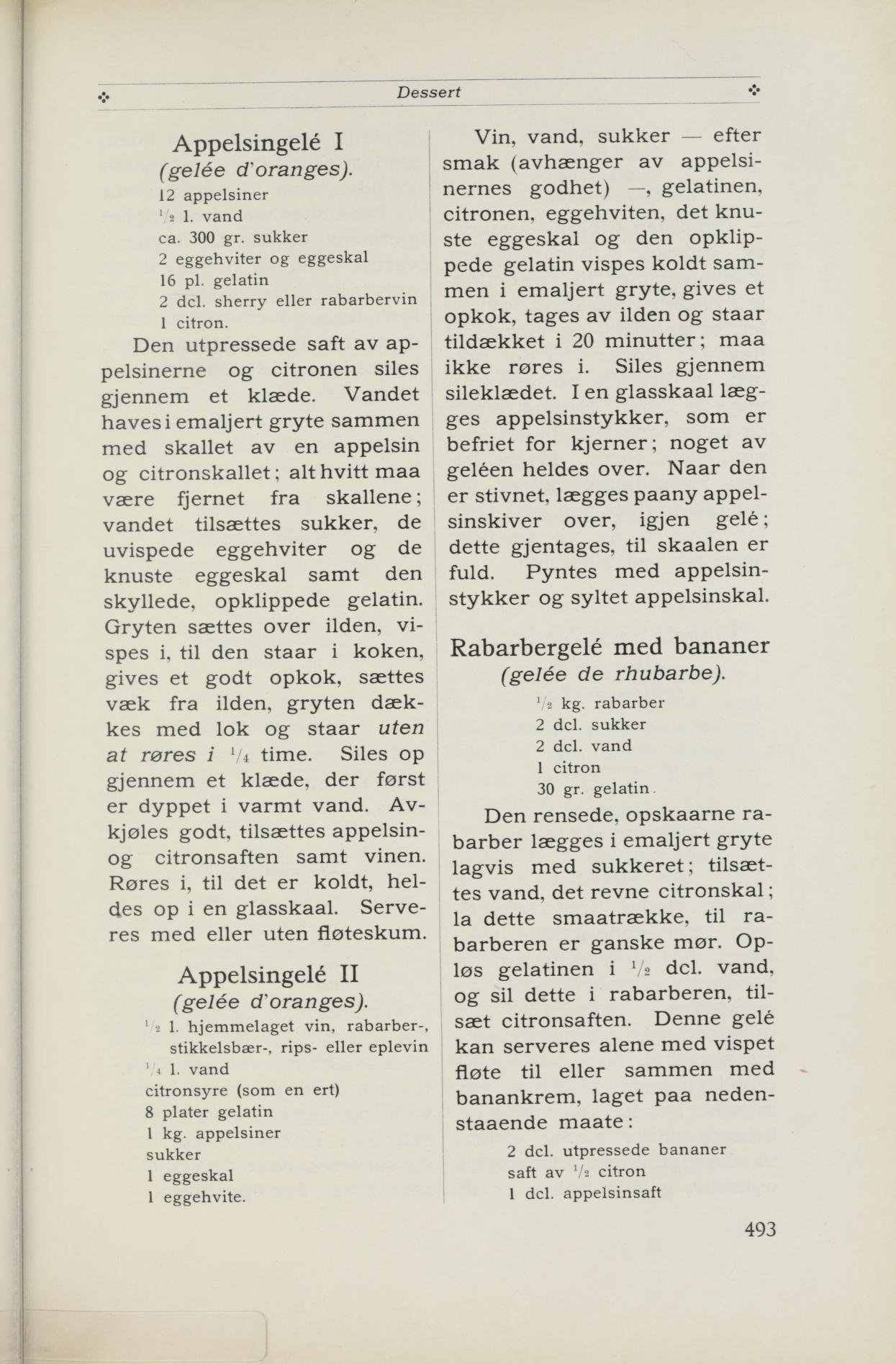
Layered orange jelly on homemade fruit wine: 7.5 dl wine, 2.5 dl water, sugar, citric acid, 8 gelatin sheets, clarified with egg white and eggshell. Poured in layers over orange segments in a glass bowl and garnished with candied orange peel.

Source: Henriette Schønberg Erken, Stor kokebok, 1914-utg. s. 493 (falt i det fri)

Be the first to rate

About the dish

A simpler, layered orange jelly made on homemade fruit wine. Homemade rhubarb, gooseberry, red currant or apple wine was common in Norwegian households at the time.

How to make it

  1. 1

    Mix everything cold

    Whisk together the wine, water, sugar to taste (depending on how good the oranges are), the citric acid, the egg white, the crushed eggshell and the cut-up gelatin cold in an enameled pot.

  2. 2

    Bring to a boil

    Bring the mixture to a boil, take the pot off the heat and let it stand covered for 20 minutes. It must not be stirred.

  3. 3

    Strain

    Strain the jelly gently through a straining cloth.

  4. 4

    Layer

    Place seedless orange segments in a glass bowl and pour a little of the jelly over. When the layer has set, place new orange slices on top and pour on more jelly. Repeat until the bowl is full.

  5. 5

    Garnish

    Garnish with orange segments and candied orange peel before serving.

Changes from the original

Fractional measures have been written out in modern units, citric acid given as a knife tip, gelatin sheets converted to about grams. The method has been divided into numbered steps and the language modernized.

Tidsmaskin – hva endret seg?

Velg to utgaver og se hva Henriette Schønberg Erken la til, fjernet eller endret mellom dem.

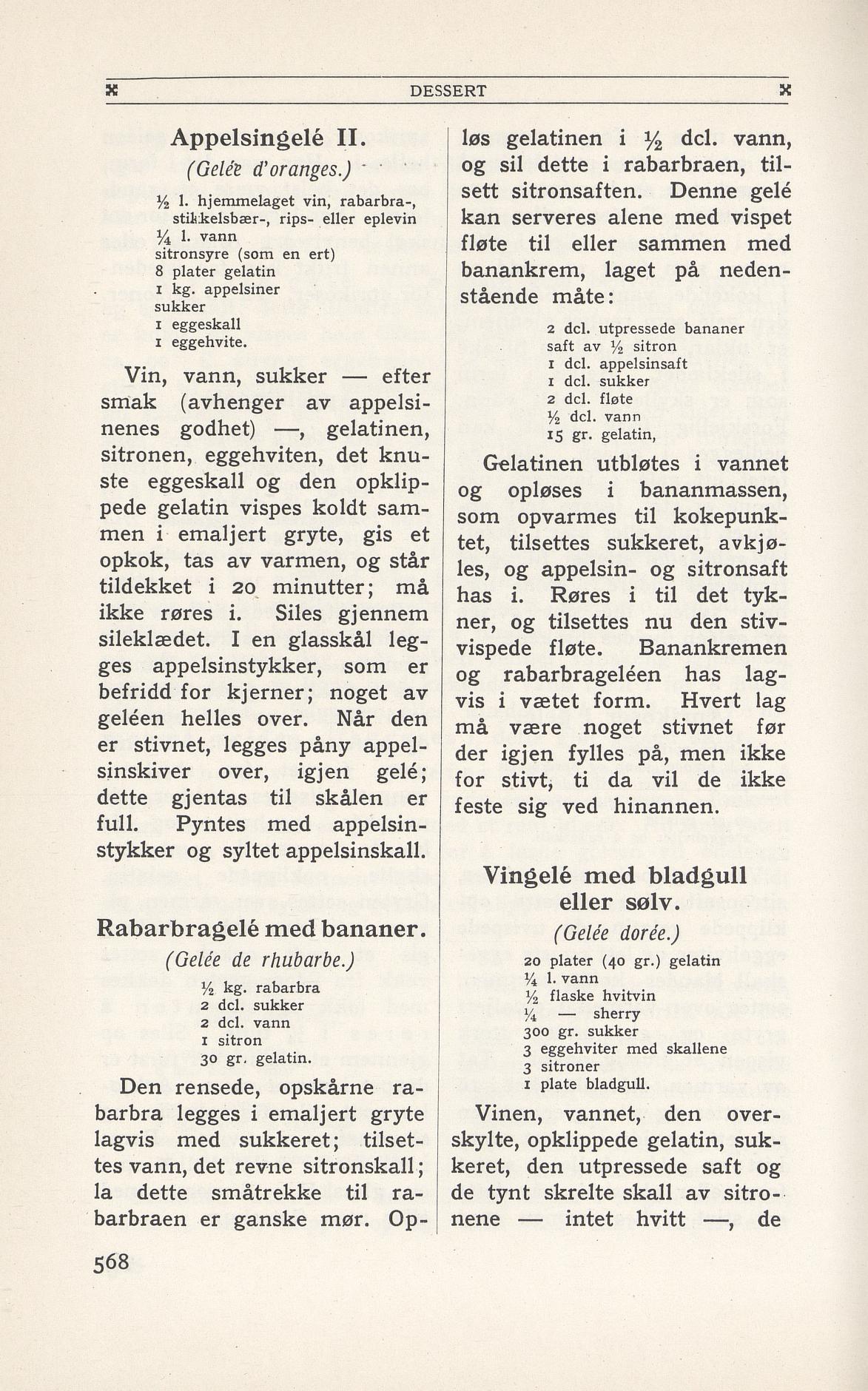
1914 (korrekturlest, s. 493)1949 (korrekturlest, s. 568)~47% av teksten endretfjernetlagt til
(gelée d'oranges). 3/4 Appelsingelé II. (Gelét tforanges.) Ingredienser: ½ l. hjemmelaget vin, rabarber-, rabarbra-, stikkelsbær-, rips- eller eplevin 1/4 ¾ l. vand citronsyre vann sitronsyre (som en ert) 8 plater gelatin 1 kg. appelsiner sukker 1 eggeskal eggeskall 1 eggehvite. eggekvite Fremgangsmåte: Vin, vand, vann, sukker — efter smak (avhænger (avhenger av appelsinernes appelsinenes godhet) —, citronsyren, gelatinen, sitronen, eggehviten, det knuste eggeskal eggeskall og den opklippede gelatin vispes koldt sammen i emaljert gryte, gives gies et opkok, tages tas av ilden varmen, og staar tildækket står tildekket i 20 minutter; maa ikke røres i. Siles gjennem sileklædet. I en glasskaal lægges glasskål legges appelsinstykker, som er befriet befridd for kjerner; noget av geleen heldes helles over. Naar Når den er stivnet, lægges paany legges påny appelsinskiver over, igjen gele; gelé; dette gjentages, gjentas til skaalen skålen er fuld. full. Pyntes med appelsinstykker og syltet appelsinskal. appelsinskall.
Community interpretations

Be the first to share your own version.

See interpretations

Frequently asked questions

Why should the jelly not be stirred after boiling?
The egg white and the crushed eggshell clarify the jelly. When the mixture stands undisturbed and covered for 20 minutes, the impurities gather, and the jelly becomes clear when it is strained through a straining cloth. Stirring would mix the impurities back in.
Which wine is used in this recipe?
Homemade wine — rhubarb, gooseberry, red currant or apple wine — 3/4 liter, together with 1/4 liter water.
Why does it just say "sugar" without an amount?
The amount of sugar is adjusted to taste, because it depends on how sweet and good the oranges are (1 kg oranges is used in all).
How is the jelly built up in the mold?
In a glass bowl, seedless orange pieces are placed, and a little jelly is poured over. When the layer has set, new orange slices and more jelly are added, and this is repeated until the bowl is full. Expect a long setting time — around 6 hours in all.

Related recipes

More dishes in the same category from the archive

Read also

Kommentarer

Ingen kommentarer ennå. Bli den første til å dele!