Skip to content

Creamed Jerusalem Artichokes (topinambours à la crème)

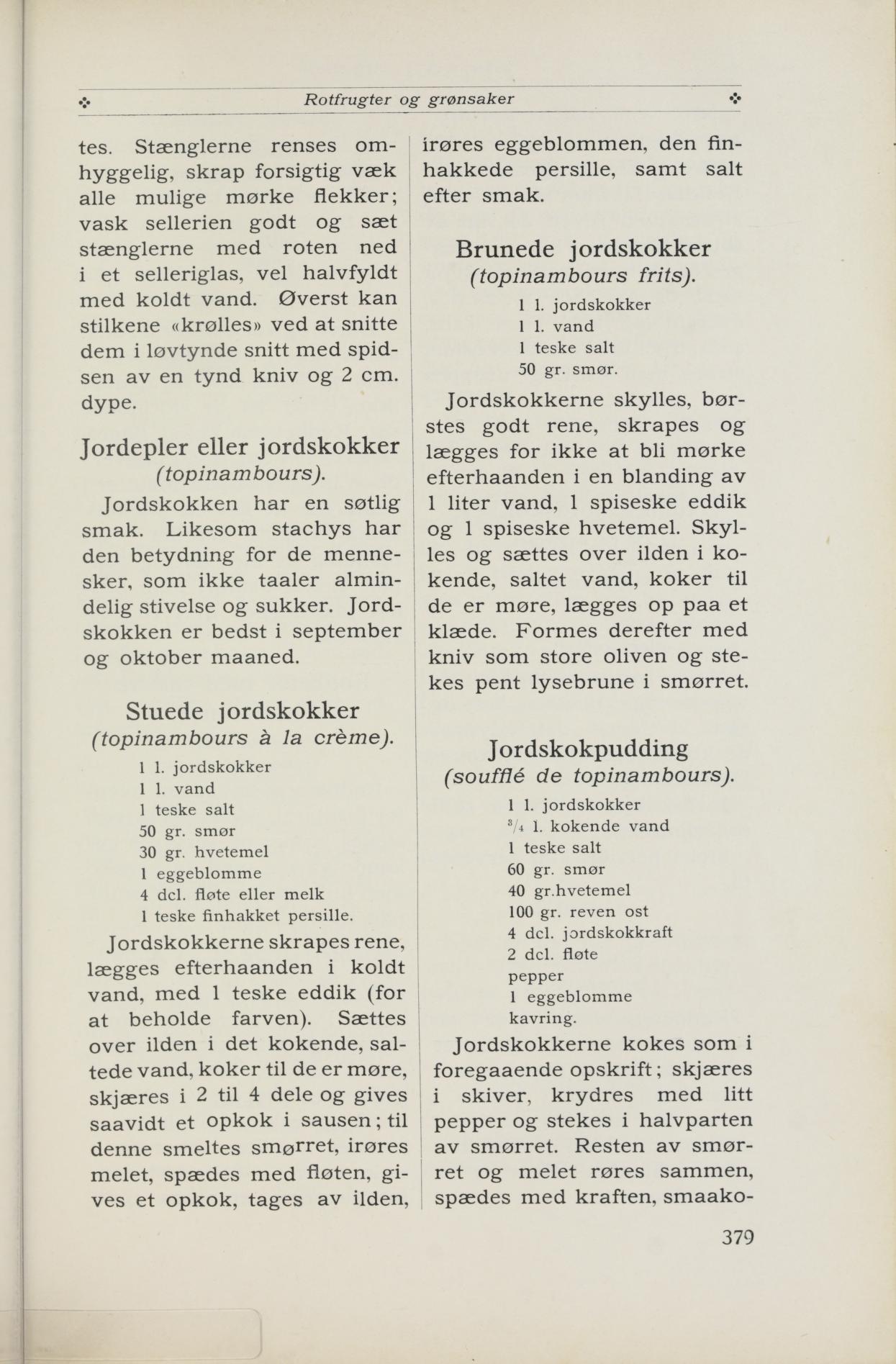
Erken's creamed Jerusalem artichokes from 1914: Jerusalem artichokes are scraped, boiled tender in salted water, and heated in a white sauce of butter, flour, and cream thickened with egg yolk and parsley.

Source: Henriette Schønberg Erken, Stor kokebok, 1914-utg. s. 379 (falt i det fri)

Be the first to rate

About the dish

The Jerusalem artichoke (topinambour) is described by Erken as a root with a sweetish flavor, especially valuable for those who cannot tolerate ordinary starch and sugar. Best in September and October.

How to make it

  1. 1

    Clean the artichokes

    Scrape the Jerusalem artichokes clean and place them, as you go, in cold water with 1 teaspoon vinegar added, so they keep their color.

  2. 2

    Boil until tender

    Bring 1 liter of water with 1 teaspoon salt to a boil, add the artichokes, and boil them until tender. Cut them into 2–4 pieces.

  3. 3

    Make the sauce

    Melt the butter, stir in the flour, thin with the cream (or milk), and bring the sauce to a boil.

  4. 4

    Thicken the sauce

    Take the pot off the heat and stir in the egg yolk, the finely chopped parsley, and salt to taste.

  5. 5

    Combine and serve

    Put the artichokes into the sauce and just bring it to a boil. Serve immediately.

Changes from the original

Measures are converted to modern units (deciliters/grams, teaspoon/tablespoon). The amount of Jerusalem artichokes is estimated at about 700 g for 1 liter. The method is divided into numbered steps in modern language.

In stores now

Clean, minimally processed groceries matched to the ingredients — approximate prices.

Product data and prices via Kassalapp. Prices are updated daily and may vary.

Time machine – what changed?

Pick two editions and see what Henriette Schønberg Erken added, removed or changed between them.

1914 (proofread, p. 379) → Modernised~86% of the text changedremovedadded
1 l. 700 g jordskokker (ca. 1 l. vand liter). 1 teske salt l vann (til koking). 1 ts salt. 1 ts eddik (i vannet jordskokkene legges i). 50 gr. smør g smør. 30 gr. hvetemel g hvetemel. 1 eggeblomme stk eggeplomme. 4 del. dl fløte eller melk melk. 1 teske ts finhakket persille. Jordskokkerne skrapes rene, lægges efterhaanden salt (etter smak). Skrap jordskokkene rene og legg dem etter hvert i koldt vand, med kaldt vann tilsatt 1 teske eddik (for teskje eddik, slik at beholde farven). Sættes over ilden de beholder fargen.. Kok opp 1 liter vann med 1 teskje salt, legg i det kokende, saltede vand, koker jordskokkene og kok dem til de er møre, skjæres i 2 til 4 dele og gives saavidt et opkok møre. Del dem i sausen; til denne smeltes smørret, irøres 2–4 deler.. Smelt smøret, rør inn melet, spædes spe med fløten, gives fløten (eller melken) og gi sausen et opkok, tages oppkok.. Ta kjelen av ilden, irøres eggeblommen, varmen og rør inn eggeplommen, den finhakkede persille, samt persillen og salt efter smak. etter smak.. Legg jordskokkene i sausen og gi det såvidt et oppkok. Server straks.

Note on Modernised

Mål er omregnet til moderne enheter (desiliter/gram, teskje/spiseskje). Mengden jordskokker er anslått til ca. 700 g for 1 liter. Fremgangsmåten er delt i nummererte trinn på moderne norsk.

Community interpretations

Be the first to share your own version.

See interpretations →

Frequently asked questions

Why are the Jerusalem artichokes placed in cold water with vinegar?
So they keep their color. After scraping, they are placed, as you go, in cold water with 1 teaspoon vinegar added, so they do not darken before boiling.
How long should the Jerusalem artichokes boil?
They are boiled in 1 liter of boiling salted water until tender – count on about 20–25 minutes depending on size. They are then cut into 2–4 pieces and just brought to a boil in the sauce.
How is the sauce made?
Melt 50 g butter, stir in 30 g wheat flour, thin with 4 dl cream or milk, and bring to a boil. Take the pot off the heat before stirring in 1 egg yolk, finely chopped parsley, and salt to taste – that way the egg yolk does not curdle.
Where does the recipe come from?
It is from Henriette Schønberg Erken's "Stor kokebok" (1914), page 379, where it goes by the name topinambours à la crème.

Related recipes

More dishes in the same category from the archive

Read also

Kommentarer

Ingen kommentarer ennå. Bli den første til å dele!