Skip to content

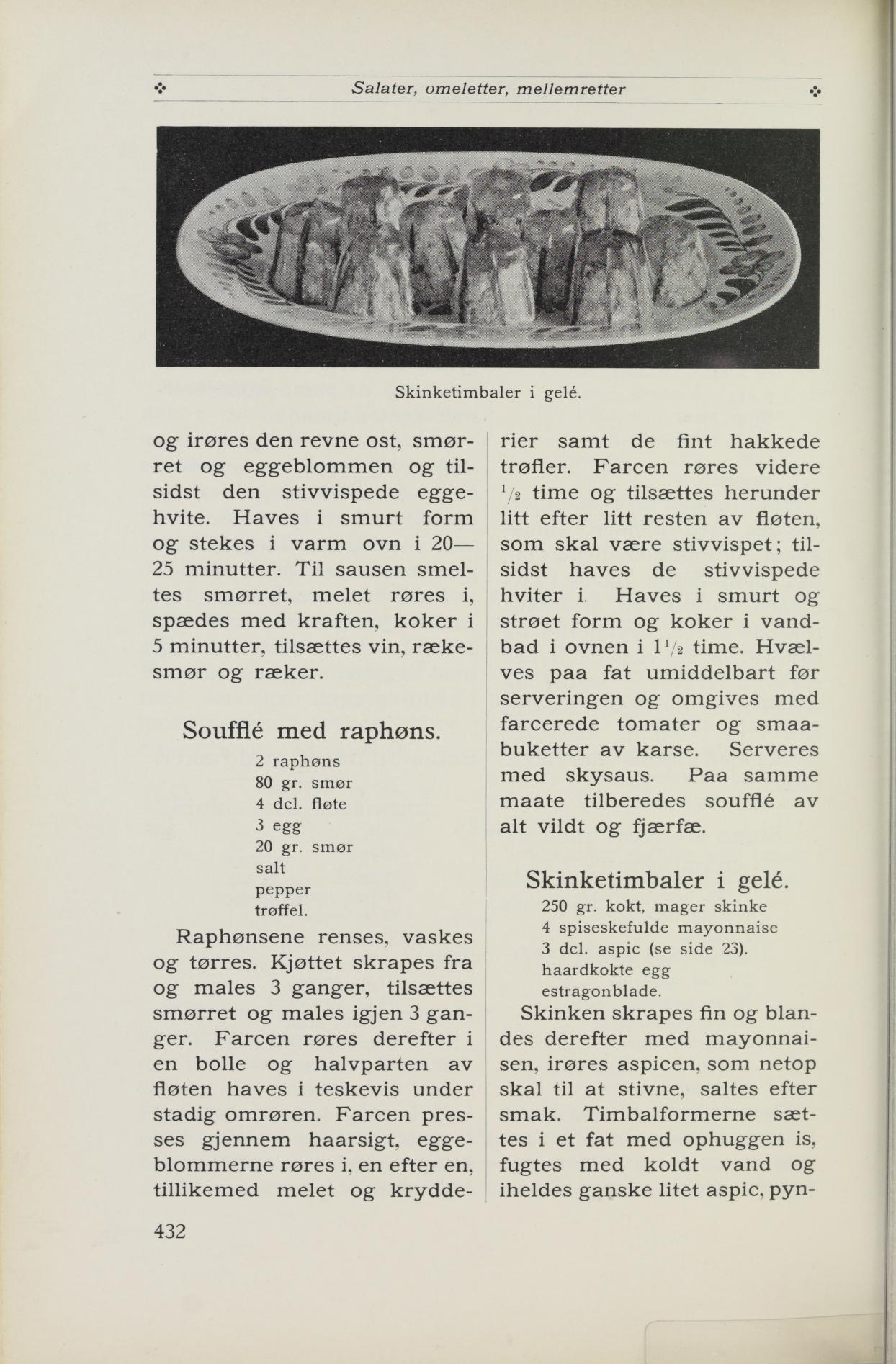
Ham Timbales in Aspic

Erken's ham timbales in aspic from 1914: finely scraped cooked ham mixed with mayonnaise and 3 dl aspic, filled into timbale molds first lined with a 1 cm thick layer of aspic decorated with tarragon leaves and chopped hard-boiled egg. Chilled until the next day, unmolded and served with coarsely cut salad and stuffed olives.

Source: Henriette Schønberg Erken, Stor kokebok, 1914-utg. s. 432 (falt i det fri)

Be the first to rate

About the dish

A cold entrée in the French tradition that Erken was fond of: small timbale molds lined inside with clear aspic and filled with ham filling. The dish is made the day before and unmolded only the next day, which made it practical for entertaining.

How to make it

  1. 1

    Make the ham filling

    Scrape or chop the ham completely fine and mix it with the mayonnaise. Stir in the aspic just as it begins to set, and season with salt.

  2. 2

    Chill the molds

    Set the timbale molds in a dish of crushed ice, moisten them with cold water and pour in quite a little aspic.

  3. 3

    Decorate the base

    Decorate with tarragon leaves and a little finely chopped hard-boiled egg.

  4. 4

    Line the molds

    Pour the aspic into the molds a little at a time while turning them around, so that a layer of aspic about 1 cm thick sets all around the mold.

  5. 5

    Fill and chill

    Fill the molds with the ham filling and let them stand in a cold place. They should not be unmolded until the next day.

  6. 6

    Assembly

    Unmold the timbales onto a platter and arrange them with coarsely cut salad and stuffed olives.

Changes from the original

Measurements are converted to modern units (dl, tablespoons). "Aspic" is called aspic/meat jelly, and the amount of hard-boiled egg and tarragon leaves is estimated as "for garnish" since the original does not give an amount. The method is split into numbered steps in modern Norwegian; crushed ice can be replaced by the refrigerator.

In stores now

Clean, minimally processed groceries matched to the ingredients — approximate prices.

Product data and prices via Kassalapp. Prices are updated daily and may vary.

Time machine – what changed?

Pick two editions and see what Henriette Schønberg Erken added, removed or changed between them.

Modernised → 1949 (proofread, p. 483)~81% of the text changedremovedadded
250 g gr. kokt, mager skinke (skrapt eller finhakket). 4 ss majones. spiseskjefulle majones 3 dl aspik (klar kjøttgelé, se Erkens grunnoppskrift). 1 stk hardkokt del. aspic hårdkokte egg (finhakket, til pynt). estragonblader (til pynt). salt (etter smak). grovskåret salat (til servering). fylte oliven (til servering). Skrap eller hakk skinken helt estragonblade. Skinken skrapes fin og bland den blan­des derefter med majonesen. Rør inn aspiken idet den så vidt begynner majonesen, irøres aspicen, som nettop skal til å stivne, og smak til med salt.. Sett timbalformene saltes efter smak. Timbalformene set­tes i et fat med oppknust ophuggen is, fukt dem fuktes med kaldt koldt vann og hell i ihelles ganske lite aspik.. Pynt aspic, pyn­tes med estragonblader estragonblade og litt finhakket hardkokt egg.. Hell aspiken i formene ganske lite hårdkokt, fin­hakket egg. Aspicen helles litt om efter litt mens du dreier dem rundt, slik at det legger seg et aspiklag på cirka i formene, som dreies rundt; når aspiclaget er ca. 1 cm rundt hele formen.. Fyll cm. omkring, fylles formene med skinkefarsen og la dem stå kaldt. De bør skinkefarsen. Bør ikke hvelves før neste dag.. Hvelv timbalene næste dag. Anrettes på fat og anrett dem med grovskåret grovskåren salat og fylte oliven.

Note on Modernised

Mål er omregnet til moderne enheter (dl, spiseskjeer). «Aspic» er kalt aspik/kjøttgelé, og mengden hardkokt egg og estragonblader er anslått som «til pynt» siden originalen ikke oppgir mengde. Fremgangsmåten er delt i nummererte trinn på moderne norsk; oppknust is kan erstattes av kjøleskap.

Community interpretations

Be the first to share your own version.

See interpretations →

Frequently asked questions

Why must the timbales stand until the next day?
The jelly layer (the aspic) and the ham filling must set completely before they are unmolded, otherwise they collapse. The recipe recommends that they not be unmolded until the next day – hence the long total time of around 13 hours.
How do I get an even jelly layer in the molds?
Set the timbale molds in a dish of crushed ice, moisten them with cold water and pour in a little aspic at a time while turning the molds around, until the layer is about 1 cm all around the mold. Decorate with tarragon leaf and a little finely chopped hard-boiled egg before you fill with the ham filling.
What does the filling consist of, and what is served with it?
The filling is 250 g cooked, lean ham that is scraped fine and mixed with 4 tablespoons mayonnaise and 3 deciliters aspic just about to set, salted to taste. Arranged on a platter with coarsely cut salad and stuffed olives.

Related recipes

More dishes in the same category from the archive

Read also

Kommentarer

Ingen kommentarer ennå. Bli den første til å dele!