Skip to content

Sweetbread Roulettes

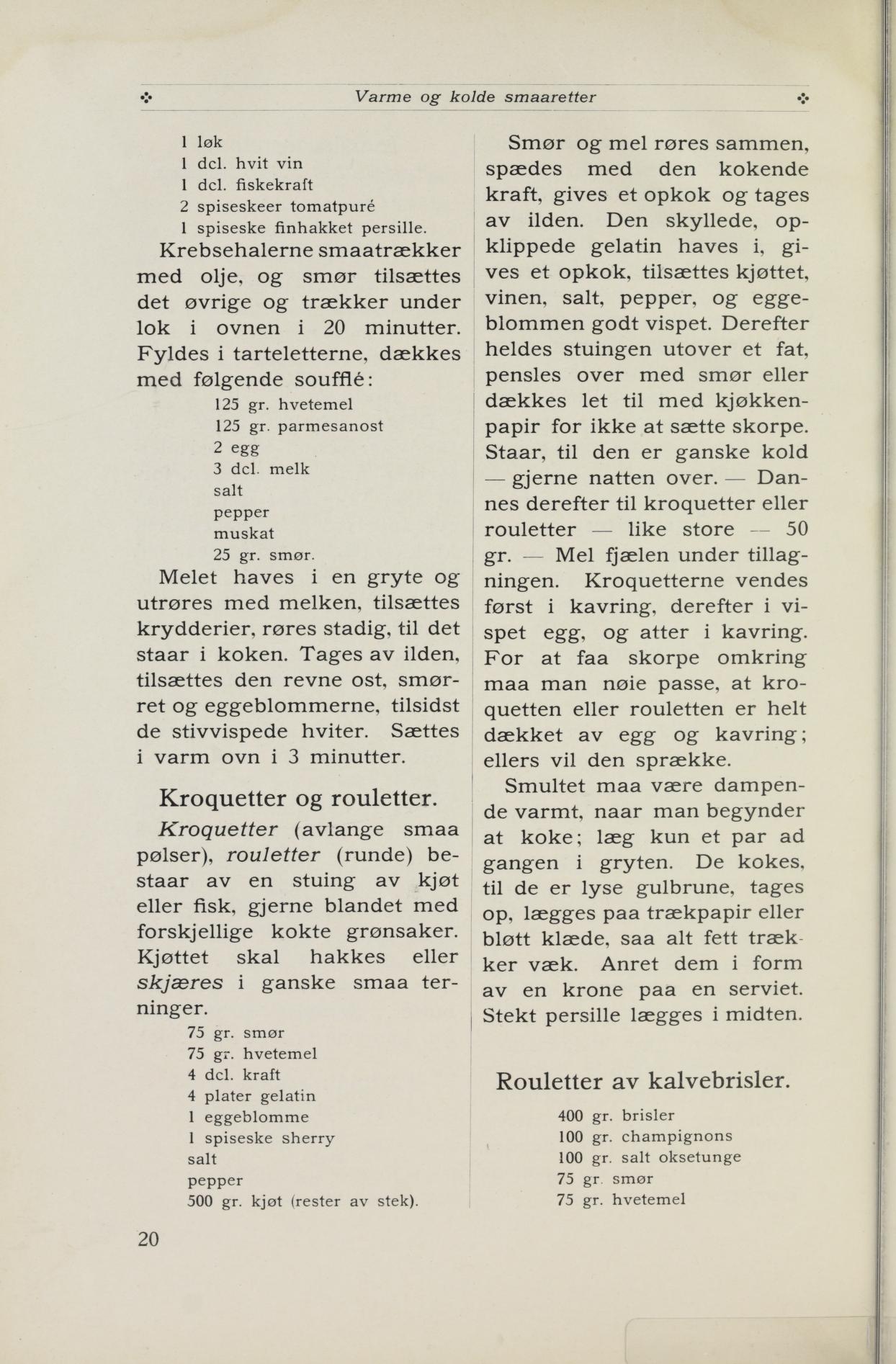
Sweetbread roulettes after Erken: boiled veal sweetbreads, mushroom and salted ox tongue in small dice are mixed into a gelatin-set roux sauce with stock and white wine, chilled completely, shaped into round roulettes, breaded in crumbs-egg-crumbs and deep-fried golden brown.

Source: Henriette Schønberg Erken, Stor kokebok, 1914-utg. s. 20 (falt i det fri)

Be the first to rate

About the dish

A finer variant of the roulettes, made from veal sweetbreads – a highly prized delicacy in bourgeois kitchens around 1914. Erken refers to the base recipe for croquettes and roulettes.

How to make it

  1. 1

    Prepare the sweetbreads

    Put the sweetbreads in cold water, clean off the membranes and boil them tender in lightly salted water. Save the stock. Cool and cut the sweetbreads into small dice.

  2. 2

    Mushroom and tongue

    Boil the mushrooms quickly and save the stock. Cut the mushroom and boiled salted ox tongue into small dice.

  3. 3

    Make the ragout

    Stir butter and flour together, thin with the boiling stock (meat stock mixed with sweetbread and mushroom stock) and bring to a boil.

  4. 4

    Gelatin and seasoning

    Rinse and cut up the gelatin, stir it into the sauce and boil until it is completely dissolved. Add the sweetbreads, mushroom, tongue, white wine, salt and pepper.

  5. 5

    Chill

    Spread the mixture out on a platter, cover loosely and let it become completely cold, preferably overnight.

  6. 6

    Shape and bread

    Shape round roulettes of about 50 g on a floured board. Roll in breadcrumbs, then in beaten egg and finally in breadcrumbs again, so they are completely coated.

  7. 7

    Fry and serve

    Deep-fry them golden brown in good hot oil (about 180 °C (355 °F)), a few at a time. Let them drain on absorbent paper and arrange in a ring, preferably with fried parsley.

Changes from the original

The method has been written out from the base recipe ("prepared as explained above"). Breading (egg and breadcrumbs) and frying fat have been listed as separate ingredients; lard has been replaced with neutral frying oil. The stock amount is noted as 1 dl as the original states, but is supplemented with a little more if the sauce becomes too thick.

In stores now

Clean, minimally processed groceries matched to the ingredients — approximate prices.

Product data and prices via Kassalapp. Prices are updated daily and may vary.

Time machine – what changed?

Pick two editions and see what Henriette Schønberg Erken added, removed or changed between them.

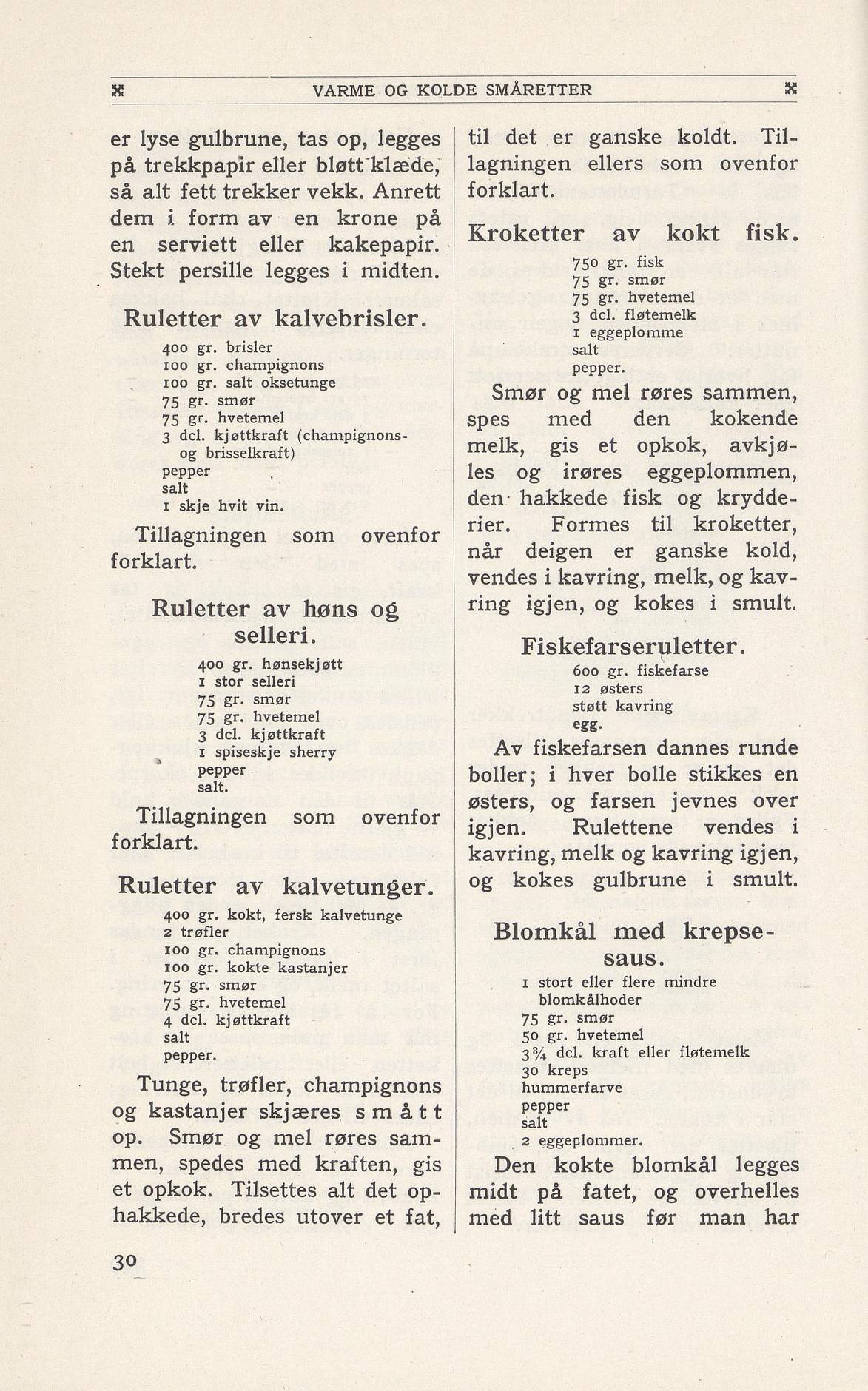
Modernised → 1949 (proofread, p. 30)~95% of the text changedremovedadded
400 g kalvebrisler. gr. brisler 100 g sjampinjong. gr. champignons 100 g saltet gr. salt oksetunge (kokt). 75 g smør. gr. smør 75 g hvetemel. 1 dl gr. hvetemel 3 del. kjøttkraft (med kraft fra sjampinjong (champignons- og brisler). 4 plater gelatin (ca. 8 g). 1 ss hvitvin. salt (etter smak). brisselkraft) pepper (etter smak). 2 stk egg (til panering). 3 dl griljermel (knuste kavringer, til panering). 1 l nøytral frityrolje (eller smult). Legg brislene i kaldt vann, rens av hinner og kok dem møre i lettsaltet vann. Ta vare på kraften. Avkjøl og skjær brislene i små terninger.. Kok sjampinjongene raskt og ta vare på kraften. Skjær sjampinjong og kokt saltet oksetunge i små terninger.. Rør sammen smør og mel, spe med den kokende kraften (kjøttkraft blandet med brissel- og sjampinjongkraft) og gi et oppkok.. Skyll og klipp opp gelatinen, rør den inn i sausen og kok til den er helt oppløst. Tilsett brisler, sjampinjong, tunge, hvitvin, salt og pepper.. Bre massen utover et fat, dekk løst til og la den bli helt kald, gjerne natten over.. Form runde ruletter på ca. 50 g på melet fjøl. Vend i griljermel, så i vispet egg og til sist i griljermel igjen, så de er helt dekket.. Friter dem gyllenbrune i godt varm olje (ca. 180 °C), noen få om gangen. La dem renne av på fettsugende papir og anrett i krans, gjerne med friteret persille. skje hvit vin Tillagningen som ovenfor forklart.

Note on Modernised

Fremgangsmåten er skrevet ut fra grunnoppskriften («tillagningen som ovenfor forklaret»). Panering (egg og griljermel) og frityrfett er ført opp som egne ingredienser; smult er erstattet med nøytral frityrolje. Kraftmengden er notert som 1 dl slik originalen angir, men suppleres med litt mer om sausen blir for tykk.

Community interpretations

Be the first to share your own version.

See interpretations →

Frequently asked questions

Why does the recipe take so long (up to 12 hours)?
The preparation itself is quick, but the roulette mixture must chill and set properly – the 4 sheets of gelatin help here – before it can be shaped into roulettes. So count on chilling overnight.
What does the filling consist of?
400 g veal sweetbreads, 100 g mushrooms and 100 g salted ox tongue, bound with a thick sauce of 75 g butter, 75 g wheat flour and 1 deciliter meat stock, seasoned with salt, pepper and a spoonful of white wine.
Which stock should be used?
The recipe calls for meat stock from the cooking water of the mushrooms and sweetbreads, so that all the flavor from the ingredients goes into the sauce.
Where does the recipe come from?
From Henriette Schønberg Erken's "Stor kokebok" (1914), page 20, in the chapter on hot and cold small dishes – croquettes and roulettes. It is meant for 6 servings.

Related recipes

More dishes in the same category from the archive

Read also

Kommentarer

Ingen kommentarer ennå. Bli den første til å dele!