Skip to content

Partridge (perdrix et perdreaux)

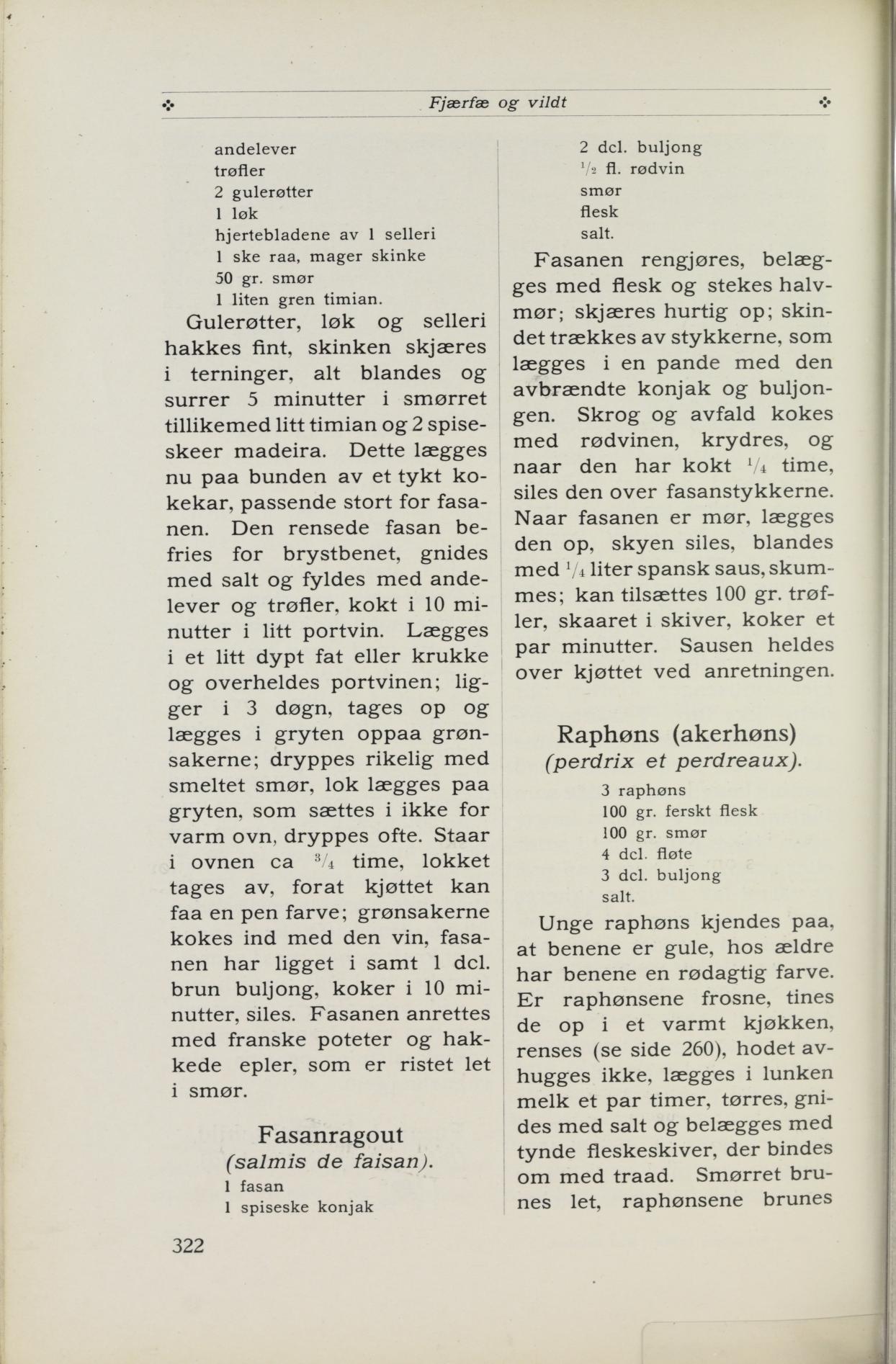
Partridge from Erken's Stor kokebok 1914: cleaned birds (frozen/older ones placed in lukewarm milk) salted, covered with slices of pork, browned in butter and braised covered about 1 hour in bouillon and cream; the sauce reduced, optionally with caramel color and mushrooms. Served split lengthwise with salad, cress, and Parisienne potatoes.

Source: Henriette Schønberg Erken, Stor kokebok, 1914-utg. s. 322 (falt i det fri)

Be the first to rate

About the dish

From the chapter "Poultry and game" in Henriette Schønberg Erken's "Stor kokebok" (1914). Erken first gives the marks of a young bird (yellow legs) and then explains braising under a lid with cream and bouillon – a typical Norwegian way of treating lean small game birds. The milk soaking is used only for frozen or older birds.

How to make it

  1. 1

    Choose the birds

    Young partridges can be recognized by their yellow legs; older birds have reddish legs. If the birds are frozen, thaw them slowly in a warm kitchen.

  2. 2

    Cleaning

    Clean the birds, but do not chop off the head.

  3. 3

    Milk soaking

    Place frozen or older birds in lukewarm milk for a couple of hours. Young, unfrozen birds are not placed in milk.

  4. 4

    Preparation

    Dry the birds, rub them with salt, lay thin slices of pork over the breast, and tie in place with string.

  5. 5

    Browning

    Lightly brown the butter in a pot and brown the partridges in it.

  6. 6

    Braising

    Pour over the bouillon and cream, put on the lid, and let the birds braise slowly for about 1 hour. Baste often with the pan juices.

  7. 7

    Sauce

    Take up the birds and reduce the sauce over high heat. Add a few drops of caramel color if it is too pale, and optionally mushrooms sautéed in butter.

  8. 8

    Plating

    Split the birds lengthwise through the breast and put the halves back together. Serve with salad, cress, and Parisienne potatoes.

Changes from the original

Measurements have been converted to modern units (del. = deciliters). "Pork" is specified as fresh, fatty pork in thin slices, "color" as caramel color. Mushrooms and milk soaking are listed as optional, as the original assumes.

In stores now

Clean, minimally processed groceries matched to the ingredients — approximate prices.

Product data and prices via Kassalapp. Prices are updated daily and may vary.

Time machine – what changed?

Pick two editions and see what Henriette Schønberg Erken added, removed or changed between them.

1914 (proofread, p. 322) → Modernised~85% of the text changedremovedadded
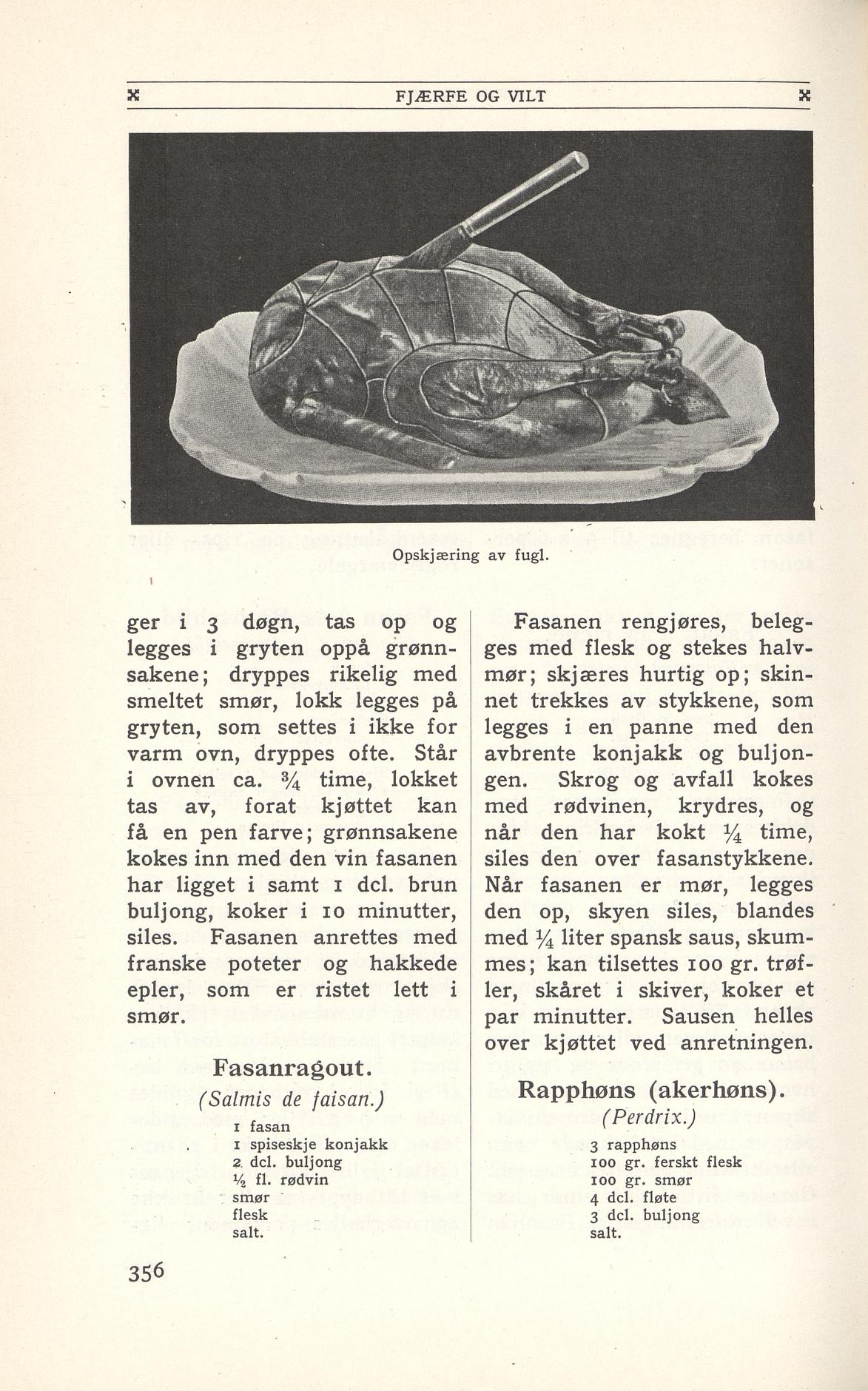
3 raphøns stk rapphøns (rensede, hodet beholdes på). 100 gr. g ferskt flesk (tynne skiver). 100 gr. smør g smør. 4 del. fløte dl fløte. 3 del. buljong salt. Unge raphøns kjendes paa at benene dl buljong. 1 ts salt (etter smak). 5 dl lunken melk (til legging av frossen eller eldre fugl, kan sløyfes). sukkerkulør (noen dråper hvis sausen er gule, hos ældre for lys). 150 g sjampinjong (valgfritt, surret i smør). Unge rapphøns kjennes på gule ben; eldre fugl har benene en rødagtig farve. rødlige ben. Er raphønsene fuglene frosne, tines de op langsomt opp i et varmt kjøkken, renses (se side 260), hodet avhugges ikke, lægges kjøkken.. Rens fuglene, men hugg ikke av hodet.. Legg frossen eller eldre fugl i lunken melk et par timer, tørres, gnides timer. Unge, ikke frosne fugler legges ikke i melk.. Tørk fuglene, gni dem med salt salt, legg tynne fleskeskiver over brystet og belægges med tynde fleskeskiver, der bindes om bind fast med traad. Smørret brunes let, raphønsene brunes heri, paaheldes tråd.. Brun smøret lett i en gryte og brun rapphønsene i det.. Hell over buljong og fløten, steker sagte under lok fløte, legg på lokk og la fuglene steke sakte i ca. 1 time, dryppes ofte; tages op, time. Drypp ofte med skyen.. Ta fuglene opp og kok sausen koker ind inn over rask ild; tilsættes ganske litt kulør, sterk varme. Tilsett noen få dråper sukkerkulør om den er for lys; champignons kan vannes i smør lys, og haves eventuelt sjampinjong surret i sausen. Raphønsene deles paa smør.. Del fuglene på langs gjennem brystet; skiverne lægges gjennom brystet og legg halvdelene sammen igjen; paa fatet serveres igjen. Server med salat, karse og pariserpoteter. Er raphønsene unge og ikke frosne, lægges de ikke i melk.
Note on Modernised

Mål er omregnet til moderne enheter (del. = desiliter). «Flesk» er angitt som ferskt, fet svineflesk i tynne skiver, «kulør» som sukkerkulør. Champignon og melkelegging er ført opp som valgfritt, slik originalen forutsetter.

Community interpretations

Be the first to share your own version.

See interpretations →

Frequently asked questions

How can I tell young and older partridges apart?
Young partridges have yellow legs, while older birds have legs with a reddish color.
Why are the partridges placed in lukewarm milk?
After cleaning, they are placed in lukewarm milk for a couple of hours (frozen birds are thawed first in a warm kitchen). Then they are dried, rubbed with salt, and tied up with thin slices of pork using string.
How long are they cooked, and how is the sauce made?
They are browned in lightly browned butter, given 3 dl bouillon and 4 dl cream, and braised slowly covered for about 1 hour with frequent basting. The birds are taken up and the sauce reduced over high heat; a little color can be added if it is too pale, and mushrooms turned in butter can be put in the sauce.
How are the partridges split and served?
They are split lengthwise through the breast, and the pieces are arranged. The recipe is calculated for 6 servings from 3 partridges, from Schønberg Erken's "Stor kokebok" (1914), p. 322.

Related recipes

More dishes in the same category from the archive

Read also

Kommentarer

Ingen kommentarer ennå. Bli den første til å dele!