Skip to content

Punch à la romaine

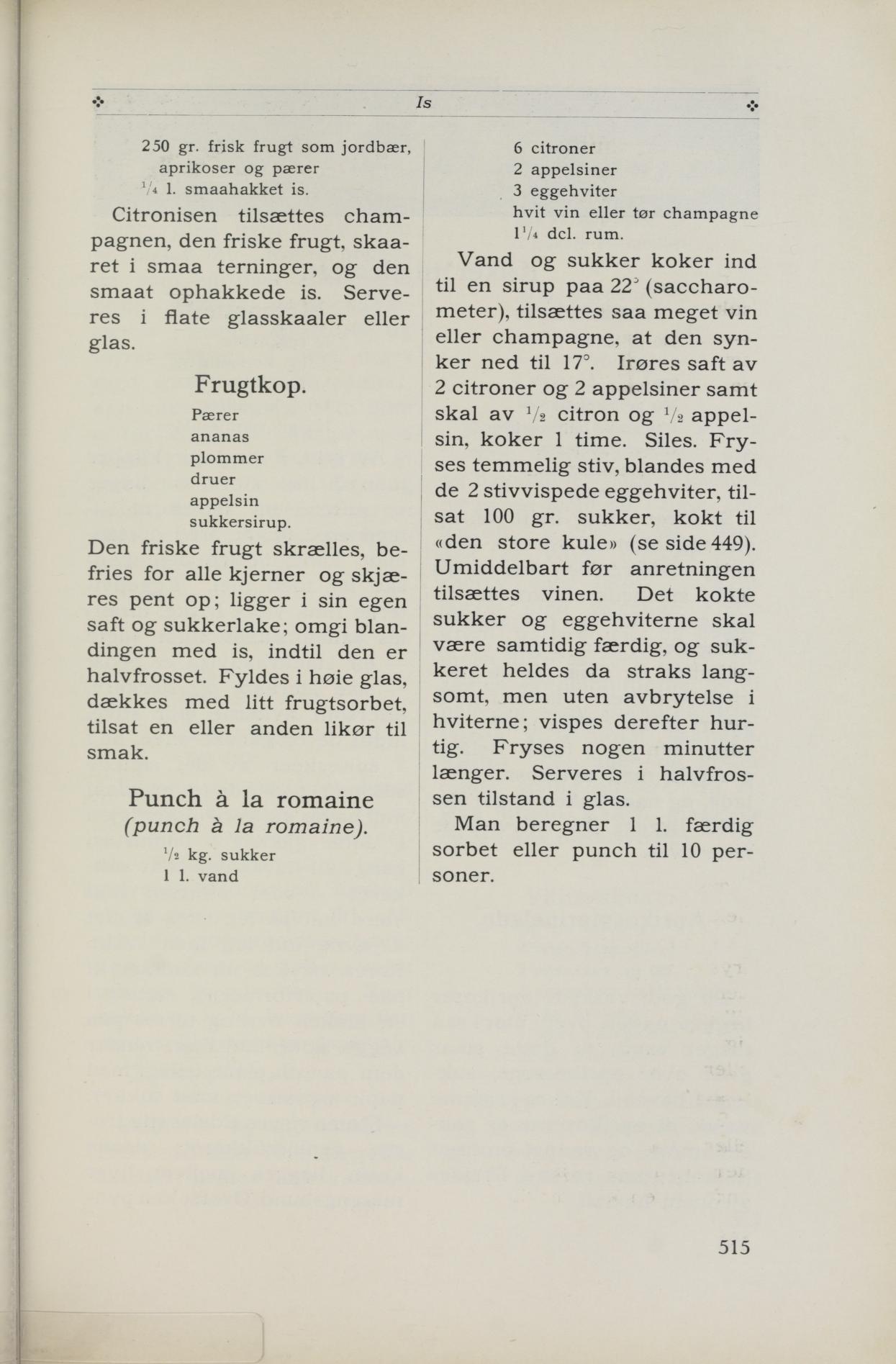
Punch à la romaine from Erken's "Stor kokebok" 1914: a half-frozen alcoholic sorbet — sugar syrup mixed with white wine/champagne and citrus, half-frozen and combined with cooked meringue (Italian meringue), spiked with rum and served half-frozen in glasses; 1 liter for 10 people.

Source: Henriette Schønberg Erken, Stor kokebok, 1914-utg. s. 515 (falt i det fri)

Be the first to rate

About the dish

Punch à la romaine was a classic half-frozen wine punch served in the middle of a festive meal, often between roast and fish, to refresh the palate. Erken uses a saccharometer to measure the sugar strength of the syrup – a tool found in well-equipped kitchens around 1914.

How to make it

  1. 1

    Boil the syrup

    Boil water and sugar down to a syrup (about 20° on a saccharometer). Add enough white wine or champagne to bring the strength down to about 17° – in practice roughly 3–4 dl.

  2. 2

    Flavor

    Stir in the juice of 2 lemons and 2 oranges plus finely grated zest of ¼ lemon and ½ orange. Bring it to a boil for one minute and strain the mixture.

  3. 3

    Freeze

    Cool and freeze the mixture until fairly stiff, in an ice-cream maker or in the freezer with stirring.

  4. 4

    Cook the meringue

    Cook 100 g sugar with a little water to the "hard ball" stage. At the same time, beat 2 egg whites completely stiff. The sugar syrup and the whites must be ready at the same time; pour the sugar at once, slowly and without interruption, into the whites and beat quickly to a firm meringue.

  5. 5

    Mix and re-freeze

    Gently mix the cooked meringue into the half-frozen ice and freeze a few minutes more.

  6. 6

    Serving

    Add rum and a little wine just before serving. Serve half-frozen in glasses. Count 1 liter of finished sorbet or punch for 10 people.

Changes from the original

The sugar quantity ("½ kg") and the rum quantity ("1½ dl") are interpreted from unclear OCR, and the syrup's degree is set at 20° (the number is missing in the OCR). The saccharometer is replaced with a guideline amount of wine in the modern method. The ingredient list gives 3 egg whites while the text uses 2; both are kept so that 2–3 can be used. Measurements are given in modern units, and freezing is done in a freezer/ice-cream maker instead of an ice tub with salt.

Tidsmaskin – hva endret seg?

Velg to utgaver og se hva Henriette Schønberg Erken la til, fjernet eller endret mellom dem.

1914 (korrekturlest, s. 515)1949 (korrekturlest, s. 594)~43% av teksten endretfjernetlagt til
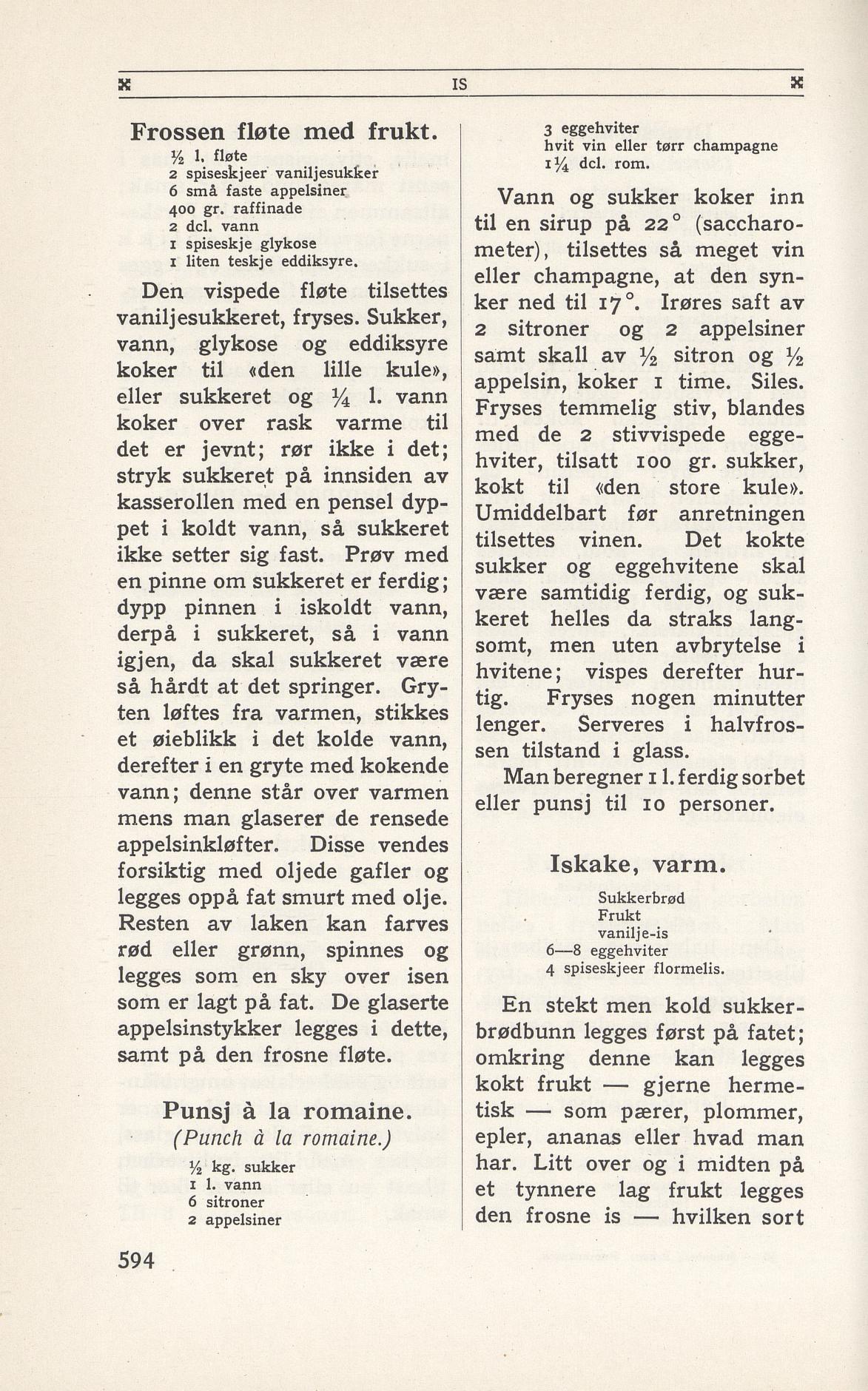
1 l. vand ½ 1/2 kg. sukker 1 l. vann 6 citroner sitroner 2 appelsiner 3 eggehviter hvit 1/2 l. vin eller tør tørr champagne 1/4 dl. rum. Vand rom. Vann og sukker koker ind inn til en sirup paa 20° på 22° (saccharometer), tilsættes saa tilsettes så meget vin eller champagne, at den synker ned til 17°. Irøres Røres saft av 2 citroner sitroner og 2 appelsiner samt skal skall av ¼ citron 1/2 sitron og ½ 1/2 appelsin, koker 1 minut. time. Siles. Fryses temmelig stiv, blandes med de 2 stivvispede eggehviter, tilsat tilsatt 100 gr. sukker, kokt til «den store kule» (se side 449). kule». Umiddelbart før anretningen tilsættes tilsettes vinen. Det kokte sukker og eggehviterne eggehvitene skal være samtidig færdig, ferdig, og sukkeret heldes helles da straks langsomt, men uten avbrytelse i hviterne; hvitene; vispes derefter hurtig. Fryses nogen minutter længer. lenger. Serveres i halvfrossen halvfrossten tilstand i glas. glass. Man beregner 1 l. færdig ferdig sorbet eller punch punsj til 10 personer.

Community interpretations

Be the first to share your own version.

See interpretations

Frequently asked questions

What is punch à la romaine?
A half-frozen, alcoholic sorbet dessert from Schønberg Erken's "Stor kokebok" (1914, p. 515). It is made of sugar syrup with lemon and orange juice, frozen fairly stiff and mixed with stiffly beaten egg whites cooked with sugar (meringue), before wine and rum are stirred in just before serving.
How strong should the syrup be?
Water and sugar are boiled down to a syrup of 20° measured with a saccharometer. Then white wine or dry champagne is added until it drops to 17°.
Why should the wine be added at the very end?
Alcohol prevents freezing, so the wine (and the rum) is stirred in immediately before serving. The mass is frozen only a few minutes more, so it stays half-frozen and does not melt out.
What must I watch out for with the egg whites?
The cooked sugar (100 g cooked to the "hard ball") and the stiffly beaten egg whites must be ready at the same time. The sugar is poured at once, slowly but without interruption, into the whites, and the mass is then beaten quickly.

Related recipes

More dishes in the same category from the archive

Read also

Kommentarer

Ingen kommentarer ennå. Bli den første til å dele!