Skip to content

Plums, Green (Brandied Preserved)

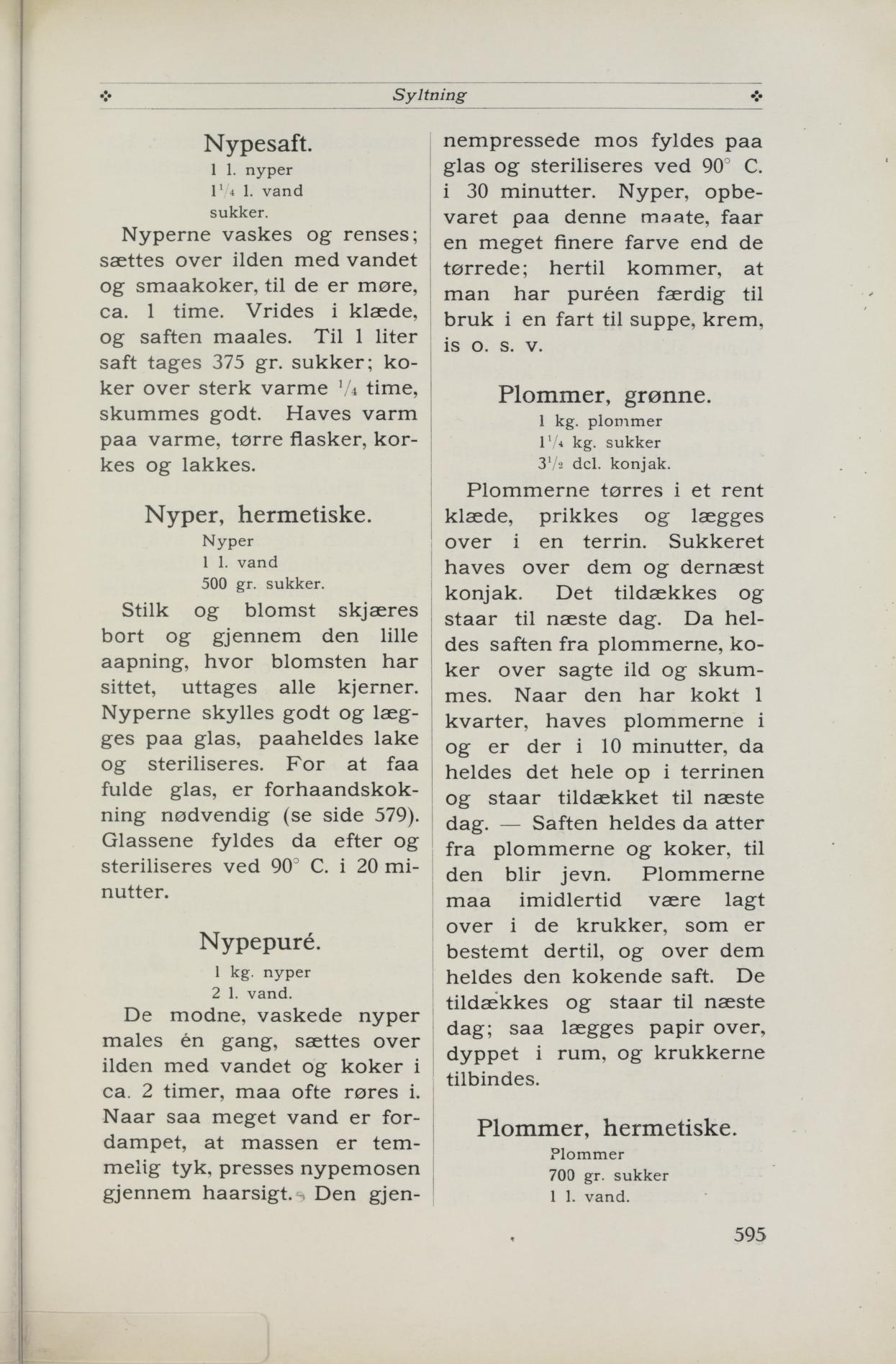
Green preserved plums (Erken 1914): 1 kg plums steeped with 1.5 kg sugar and 3/4 dl brandy overnight, the juice boiled and the plums steeped in it, repeated over several days before jarring with boiling juice and sealing with rum-dipped paper.

Source: Henriette Schønberg Erken, Stor kokebok, 1914-utg. s. 595 (falt i det fri)

Be the first to rate

About the dish

A festive preserving of green plums over several days, in which the fruit alternately steeps in sugar syrup and rests. Erken uses brandy in the syrup and rum-dipped paper as a seal — a common method before patent jars became commonplace.

How to make it

  1. 1

    Day 1: Layer with sugar

    Dry the plums in a clean cloth, prick them and place them in a tureen or bowl. Sprinkle the sugar over and pour on the brandy. Cover and let stand until the next day.

  2. 2

    Day 2: Boil the juice

    Pour off the juice from the plums, boil it over low heat and skim it well.

  3. 3

    Day 2: Steep the plums

    Once the juice has boiled for a quarter of an hour, add the plums and let them steep for 10 minutes. Then pour everything back into the tureen, cover and let stand until the next day.

  4. 4

    Day 3: Boil the juice smooth

    Pour the juice off the plums again and boil it until it turns smooth. Transfer the plums into the jars and pour the boiling juice over.

  5. 5

    Day 4: Seal

    Let the jars stand covered until the next day. Then lay rum-dipped paper over and seal the jars.

Changes from the original

"3/4 del." is interpreted as 3/4 dl brandy, and "IV*" as 1 1/2 kg sugar. The tureen is retained but can be replaced with a bowl. The steps are numbered and distributed across days.

Time machine – what changed?

Pick two editions and see what Henriette Schønberg Erken added, removed or changed between them.

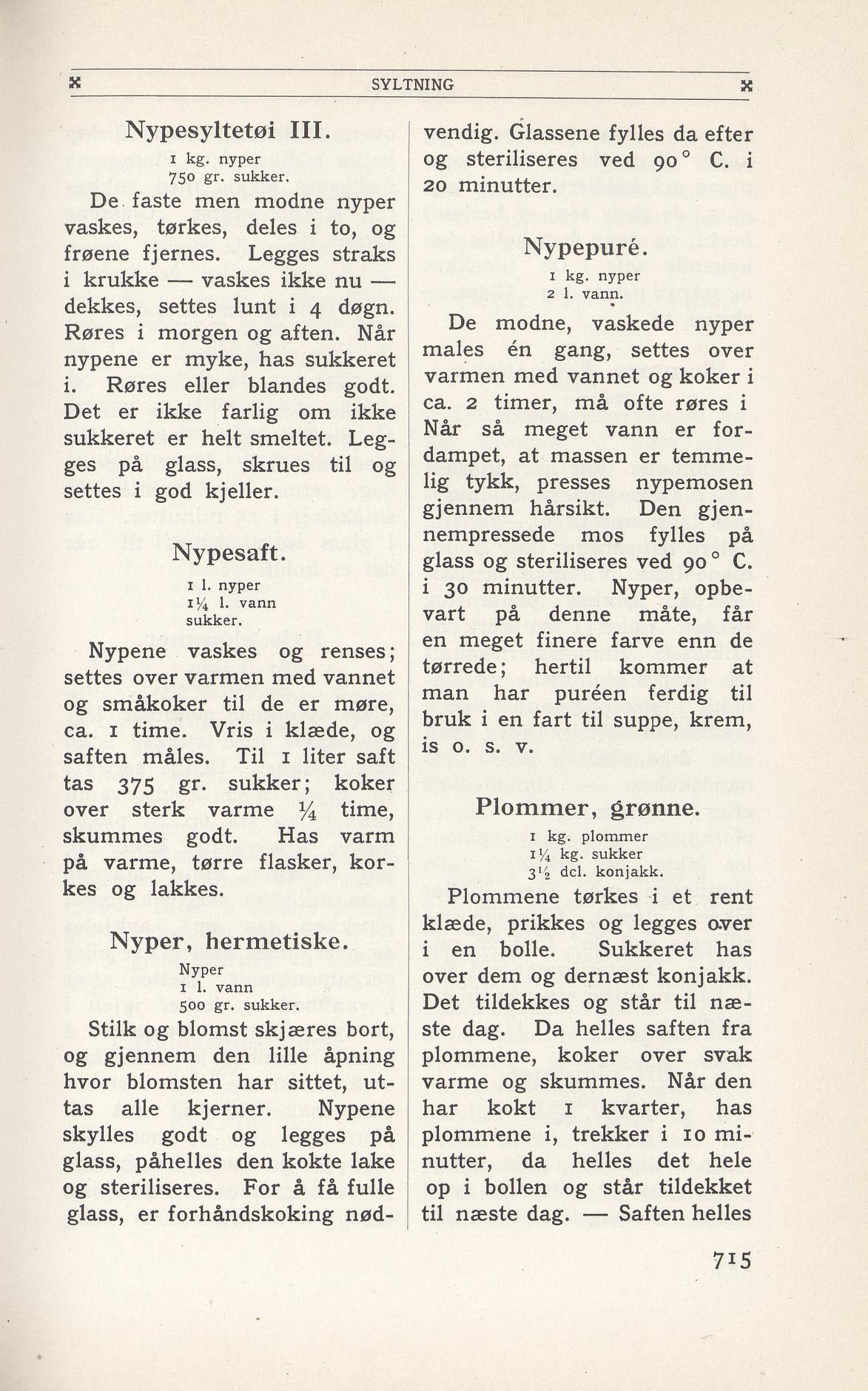
Modernised → 1949 (proofread, p. 715)~77% of the text changedremovedadded
1 kg kg. plommer (grønne). 1,5 kg sukker. 0,75 dl 1¼ kg. sukker 3½ del. konjakk. rom (til papiret over krukkene). Tørk plommene Plommene tørkes i et rent klede, prikk dem klæde, prikkes og legg dem legges over i en terrin eller bolle. Strø sukkeret Sukkeret has over dem og hell over konjakken. Dekk til dernæst konjakk. Det tildekkes og la stå står til neste dag.. Hell næste dag. Da helles saften fra plommene, kok den koker over svak varme og skum den godt.. skummes. Når saften den har kokt et 1 kvarter, legges has plommene i, trekker i og får ligge 10 minutter. Hell så alt tilbake minutter, da helles det hele op i terrinen, dekk til bollen og la stå står tildekket til neste dag.. Hell saften næste dag. — Saften helles da atter fra plommene igjen og kok den koker til den blir jevn. Legg plommene Plommene må imidlertid være lagt over i krukkene de glass som er bestemt hertil, og hell over dem helles den kokende saften over.. La krukkene stå tildekket saft. De tildekkes og står til neste næste dag. Legg så papir dyppet i rom over, og bind krukkene Glassene skrues til.

Note on Modernised

«3/4 del.» er tolket som 3/4 dl konjakk, og «IV*» som 1 1/2 kg sukker. Terrin er beholdt, men kan erstattes med bolle. Trinnene er nummerert og fordelt på dager.

Community interpretations

Be the first to share your own version.

See interpretations →

Frequently asked questions

Why does the recipe take three days?
The plums draw in sugar and brandy overnight, the juice is boiled and poured over again the next day, and on the last day the juice is boiled until smooth and poured boiling over the plums in the jars. Altogether they stand covered for three days (about 72 hours) before being sealed.
How much sugar and brandy do I need?
For 1 kg plums: 1½ kg sugar and 3/4 deciliter brandy.
Why are the plums pricked?
The plums are dried in a clean cloth and pricked so the sugar syrup and brandy can penetrate, and so they do not burst uncontrollably during cooking. They should boil only 10 minutes in the juice.
How are the finished plums stored?
The plums are placed in jars, the boiling juice poured over, and they stand covered until the next day. Then rum-dipped paper is laid over and the jars are sealed. The recipe is from Henriette Schønberg Erken's "Stor kokebok" (1914), p. 595.

Related recipes

More dishes in the same category from the archive

Read also

Kommentarer

Ingen kommentarer ennå. Bli den første til å dele!