Original 1914 recipe
Verbatim from the first edition of the Big Cookbook.
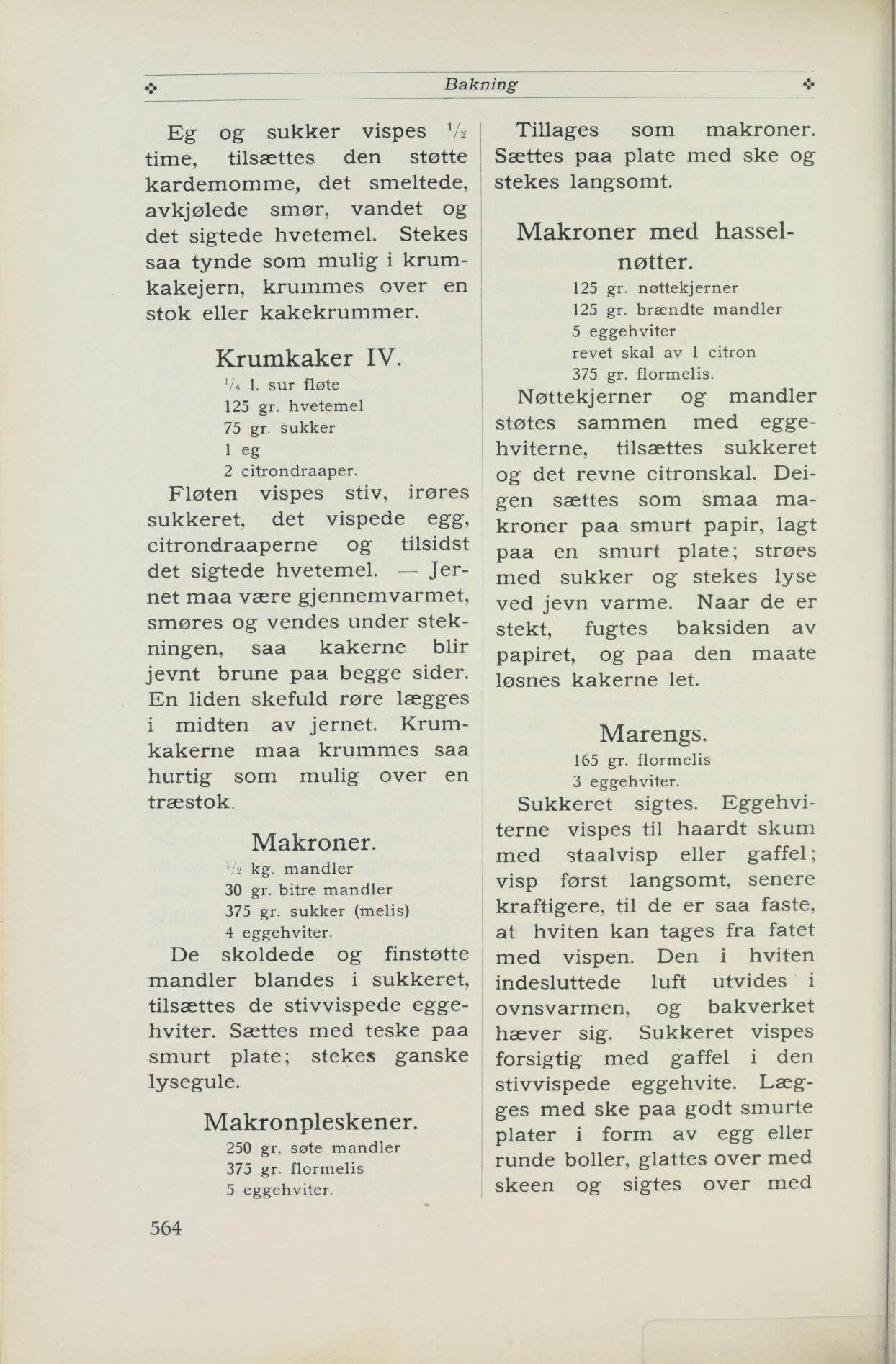
Meringue from Erken 1914: 3 egg whites whipped stiff, 165 g sifted confectioners' sugar gently folded in, spooned onto a sheet, dusted with sugar and baked at low heat into half-dry meringue shells shaped over an egg and filled with ice cream or whipped cream.
Source: Henriette Schønberg Erken, Stor kokebok, 1914-utg. s. 564 (falt i det fri)
Erken's basic meringue recipe, with a detailed explanation of why meringue rises: the air whipped into the egg white expands in the oven's heat. The meringue shells are shaped over an egg while still warm and filled with ice cream or whipped cream.
Sift the sugar
Sift the confectioners' sugar.
Whip the egg whites
Whip the egg whites to a stiff foam with a wire whisk or fork; whip slowly at first, then more vigorously, until the whites are firm enough to be lifted from the bowl with the whisk.
Fold in the sugar
Gently fold the sugar into the stiffly beaten egg whites with a fork.
Shape
Spoon the mixture onto a well-greased sheet or parchment paper, shaped as eggs or round mounds. Smooth them over with the spoon and dust sugar on top.
Bake
Bake at low heat (about 100–120 °C (250 °F)) until the meringues are half-dry and release from the sheet.
Shape and fill
Take them out, shape them over an egg into shells and let them cool. Fill with ice cream or Chantilly cream and serve.
Measurements are kept in grams/pieces. A guideline baking temperature (about 100–120 °C (250 °F)) has been added, and parchment paper is mentioned as an alternative to a well-greased sheet. The method has been divided into steps.
Original 1914 recipe
Verbatim from the first edition of the Big Cookbook.

Note til Modernisert
Mål er beholdt i gram/stk. Veiledende steketemperatur (ca. 100–120 °C) er lagt til, og bakepapir er nevnt som alternativ til godt smurt plate. Fremgangsmåten er delt i trinn.
Be the first to share your own version.
More dishes in the same category from the archive
Ingen kommentarer ennå. Bli den første til å dele!