Erken's halibut à la régence (1914): two 2 cm thick halibut slices are marinated in oil, lemon juice, and salt, layered together with butter- and rusk-breaded oysters between them, and baked for 30–40 minutes in a hot oven. Finished by gratinating with rusk crumbs and butter and served on salad with lemon, parsley, and scooped potatoes, with oyster sauce or hollandaise. The oysters can be swapped for lobster, shrimp, or crayfish.
Source: Henriette Schønberg Erken, Stor kokebok, 1914-utg. s. 91 (falt i det fri)
Be the first to rate
About the dish
A fine party dish from the fish chapter, where two halibut slices are baked as a "sandwich" with breaded oysters in between. Erken notes that lobster, shrimp, or crayfish can be used instead of oysters.
How to make it
1
Cut and marinate the fish
Use the middle cut if possible. Cut the fish into two 2 cm slices and remove the skin. Drizzle oil over, sprinkle with lemon juice and salt, and let the fish sit in the marinade for 1–2 hours.
2
Assemble the fish
Place one of the fish slices in a well-greased pan or ovenproof dish. Dip the oysters in melted butter, then in rusk crumbs, and place them on the fish slice. Lay the other slice on top.
3
Bake
Set the dish in a hot oven, about 200 °C (390 °F), and bake the fish for 30–40 minutes. Baste often with the pan juices or with butter melted in hot water.
4
Gratinate
Ten minutes before serving, cover the surface with 1 dl finely ground, sifted rusk crumbs stirred together with 0.5 dl melted butter. Let it brown lightly.
5
Plating
Place finely cut endive salad on a fish platter, set the fish on top, and garnish with lemon slices, parsley, and scooped, cooked potatoes. Serve oyster sauce or hollandaise alongside.
Changes from the original
Measurements have been modernized (dl, tablespoons), an oven temperature is given (about 200 °C (390 °F)) since the original only says "hot oven," and "crushed, sifted rusk" is translated as finely ground rusk crumbs. The method has been divided into steps.
📖1914
Original 1914 recipe
Verbatim from the first edition of the Big Cookbook.
Foto: Faksimile: Nasjonalbiblioteket
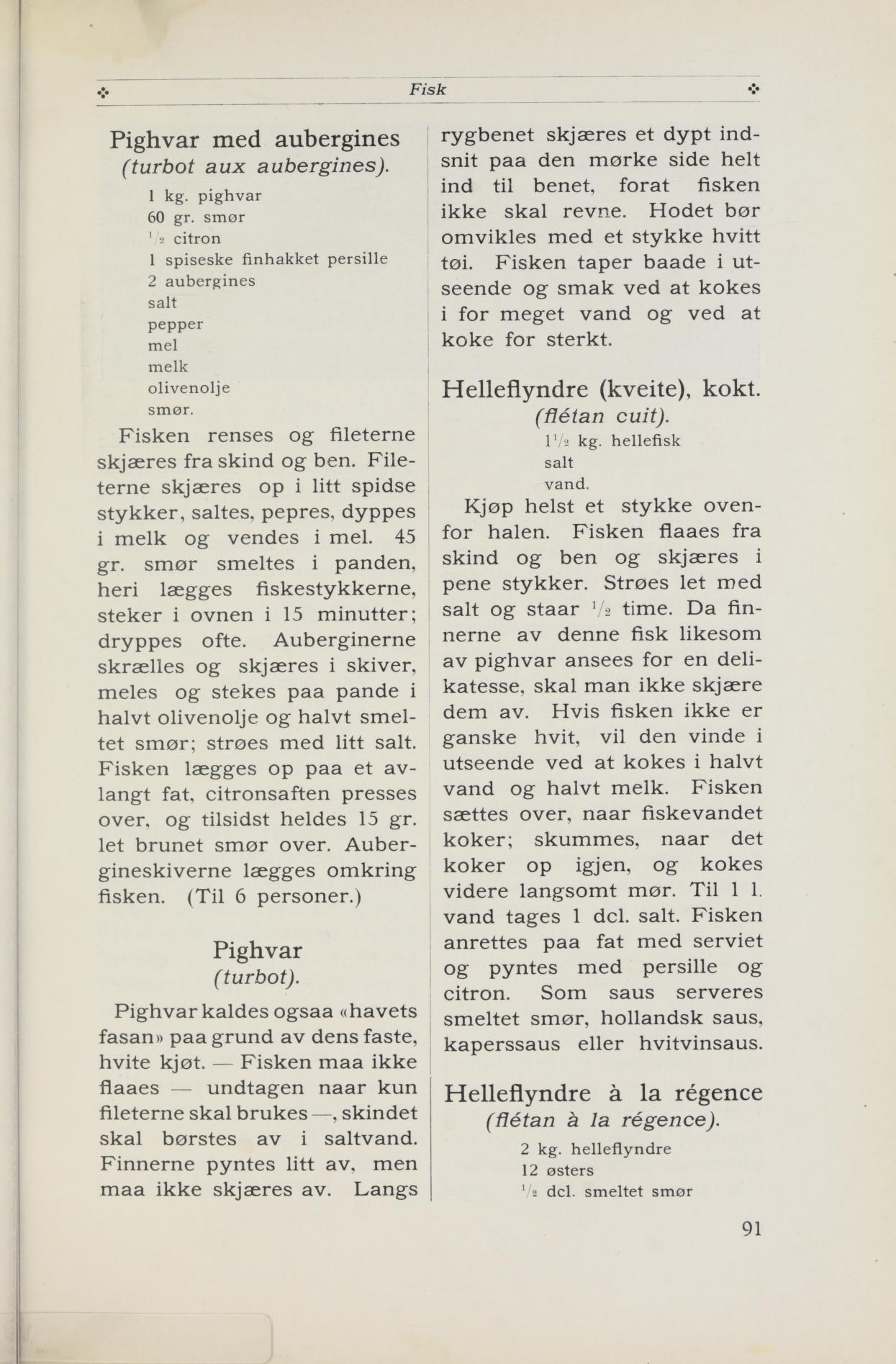
ProofreadPage 91
2 kg. helleflyndre
12 østers
1 del. smeltet smør
1 del. kavring
2 spiseskeer matolje
salt
1 citron.
Midtstykket av helleflyndren egner sig bedst. Fisken skjæres i to 2 cm. tykke skiver, som befries for skind. Fisken dryppes over med olje, dynkes med citronsaft, saltes, staar i denne marinade i 1 à 2 timer. Det ene fiskestykke lægges i en godt smurt pande. Østers dyppes i smeltet smør, derpaa i støtt kavring og lægges paa fiskeskiven; den anden fiskeskive lægges herover. — Panden sættes i varm ovn, og fisken stekes i 30—40 minutter, idet den ofte dryppes over med kraften i panden eller med smør, som er smeltet i varmt vand. 10 minutter, før fisken skal serveres, dækkes overflaten med 1 del. støtt, sigtet kavring, rørt sammen med 1/2 del. smeltet smør. Brunes svakt. Anrettes paa fiskefat, hvorpaa er lagt en diviesalat eller anden finskaaren salat, citronskiver med persille og uthulede runde poteter. Serveres med østerssaus eller hollandsk saus.
NB. Istedenfor østers kan man lægge kokt hummer, ræker, krebs mellem fiskeskiverne.
📖1949
Revised 1949 recipe
From the revised edition of the Big Cookbook.
Foto: Faksimile: Nasjonalbiblioteket
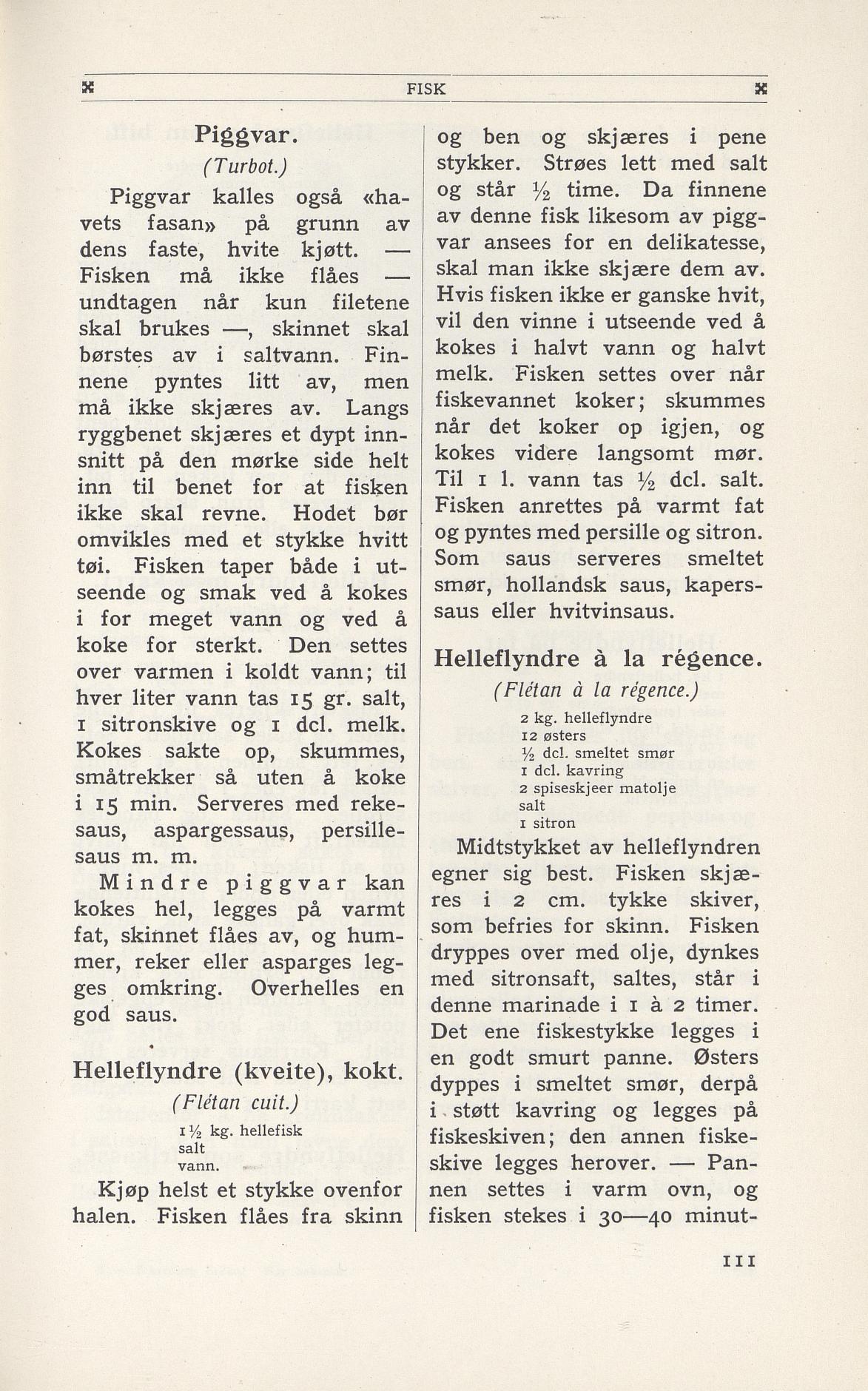
ProofreadPage 111
2 kg. helleflyndre
12 østers
½ del. smeltet smør
i del. kavring
2 spiseskjeer matolje
salt
i sitron
Midtstykket av helleflyndren egner sig best. Fisken skjæres i 2 cm. tykke skiver, som befries for skinn. Fisken dryppes over med olje, dynkes med sitronsaft, saltes, står i denne marinade i 1 å 2 timer. Det ene fiskestykke legges i en godt smurt panne. Østers dyppes i smeltet smør, derpå i støtt kavring og legges på fiskeskiven; den annen fiskeskive legges herover. — Pannen settes i varm ovn, og fisken stekes i 30—40 minutter, idet den ofte dryppes over med kraften i pannen eller med smør som er smeltet i varmt vann. — 10 minutter før fisken skal serveres, dekkes overflaten med i del. støtt, siktet kavring, rørt sammen med ½ del. smeltet smør. Brunes svakt. Anrettes på fiskefat, hvorpå er lagt en diviesalat eller annen finskåren salat, sitronskiver med persille og uthulte runde poteter. Serveres med østersaus eller hollandsk saus.
NB. Istedenfor østers kan man legge kokt hummer, reker, kreps mellem fiskeskivene.
In stores now
Clean, minimally processed groceries matched to the ingredients — approximate prices.
Modernised → 1949 (proofread, p. 111)~81% of the text changedremovedadded
2 kg kveite (hellefyndre) (helst midtstykket). kg. helleflyndre 12 stk østers (kan erstattes med kokt hummer, reker eller kreps). 1,5 dl ½ del. smeltet smør (1 dl til østers og drypping, 0,5 dl til gratineringen). 2 dl kavringsmel (finmalt og siktet; 1 dl til østers og 1 dl til gratineringen). i del. kavring 2 ss spiseskjeer matolje (til marinaden). 1 ts salt (etter smak). 1 stk i sitron (saften til marinaden, skiver til pynt). 1 porsjon finskåren salat (endivie eller annen salat, til anretning). 1 bunt persille (til pynt). 600 g poteter (uthulede runde poteter, kokt). Bruk helst midtstykket. Skjær fisken Midtstykket av helleflyndren egner sig best. Fisken skjæres i to skiver på 2 cm og fjern skinnet. Drypp olje over, dynk cm. tykke skiver, som befries for skinn. Fisken dryppes over med sitronsaft og salt, og la fisken ligge olje, dynkes med sitronsaft, saltes, står i marinaden denne marinade i 1–2 timer.. Legg den 1 å 2 timer. Det ene fiskeskiven fiskestykke legges i en godt smurt panne eller ildfast form. Dypp østersene panne. Østers dyppes i smeltet smør, deretter derpå i kavringsmel, støtt kavring og legg dem legges på fiskeskiven. Legg fiskeskiven; den andre skiven over.. Sett formen annen fiskeskive legges herover. — Pannen settes i varm ovn, ca. 200 °C, og stek fisken stekes i 30–40 minutter. Drypp 30—40 minutter, idet den ofte dryppes over med kraften i pannen eller med smør som er smeltet i varmt vann.. Ti vann. — 10 minutter før servering fisken skal serveres, dekkes overflaten med 1 dl finmalt, i del. støtt, siktet kavring kavring, rørt sammen med 0,5 dl ½ del. smeltet smør. La det brunes svakt.. Legg finskåren endiviesalat Brunes svakt. Anrettes på et fiskefat, sett fisken over og pynt hvorpå er lagt en diviesalat eller annen finskåren salat, sitronskiver med sitronskiver, persille og uthulede, kokte uthulte runde poteter. Server østerssaus Serveres med østersaus eller hollandaise til. hollandsk saus. NB. Istedenfor østers kan man legge kokt hummer, reker, kreps mellem fiskeskivene.
Note on Modernised
Mål er modernisert (dl, spiseskjeer), ovnstemperatur er angitt (ca. 200 °C) siden originalen bare sier «varm ovn», og «støtt, sigtet kavring» er oversatt til finmalt kavringsmel. Fremgangsmåten er delt i trinn.
The middle cut of the halibut is best suited. It is cut into two slices about 2 cm thick, which are skinned.
How long should the fish be marinated and baked?
The fish is drizzled with cooking oil and lemon juice, salted, and left in the marinade for 1–2 hours. Then it is baked in a hot oven for 30–40 minutes, basting frequently with the pan juices or melted butter.
How are the oysters used in the dish?
The 12 oysters are first dipped in melted butter, then in crushed rusk, and placed on one of the fish slices. The other slice is laid over, so the oysters sit as a filling between the fish slices.
Where does the recipe come from?
From Henriette Schønberg Erken's Stor kokebok (1914), page 91. Calculated for 6 servings with 2 kg of halibut.