Skip to content

Veal Chops à la Victoria (côtes de veau à la Victoria)

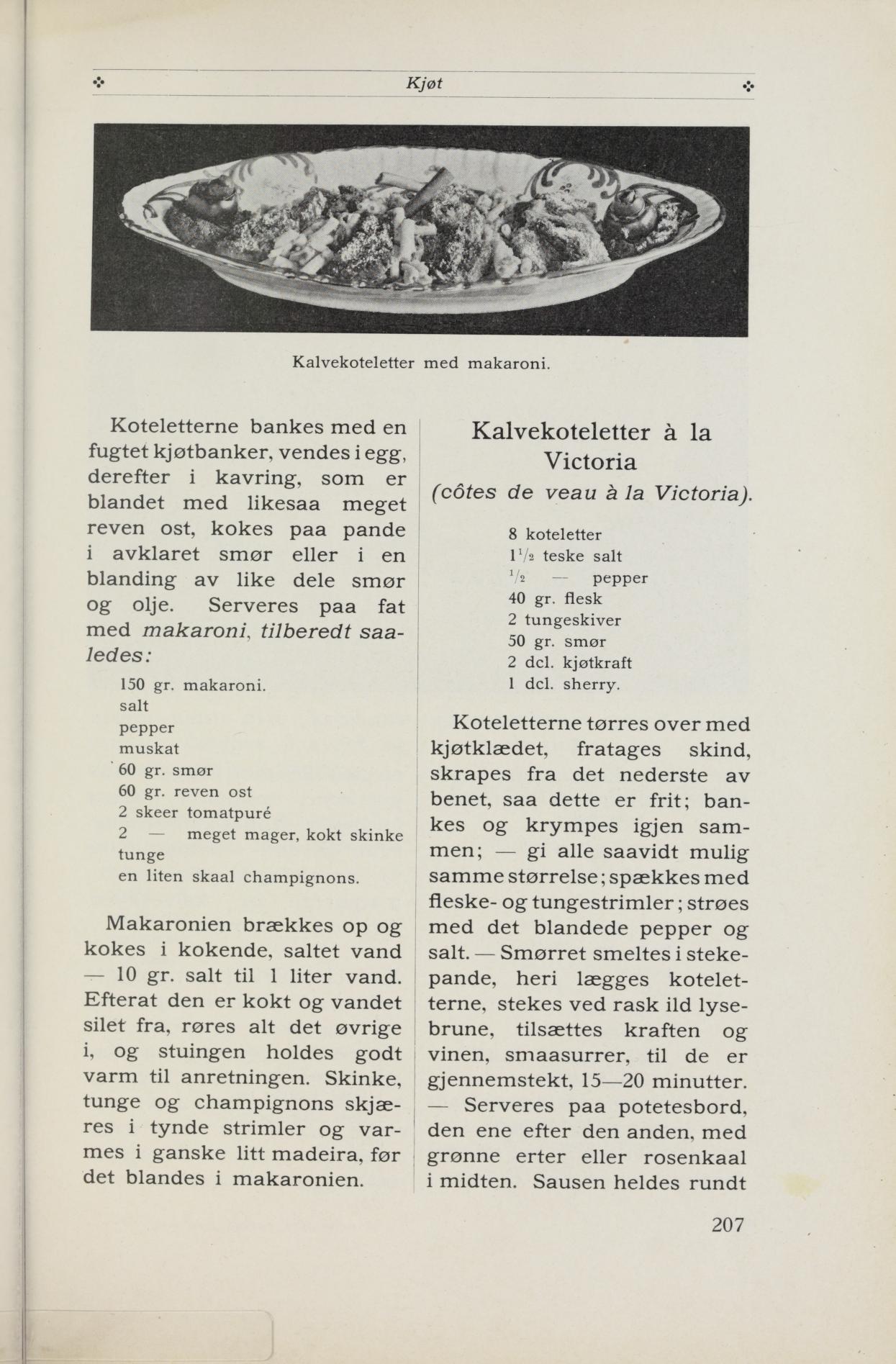
Veal chops à la Victoria from Erken's Stor kokebok (1914): 8 chops are trimmed and larded with strips of pork and cooked tongue, seasoned, browned in butter and finished by simmering 15–20 minutes in meat stock and sherry. Served inside a border of mashed potato with green peas or Brussels sprouts in the center, sauce around and a paper frill on the bone.

Source: Henriette Schønberg Erken, Stor kokebok, 1914-utg. s. 207 (falt i det fri)

Be the first to rate

About the dish

The recipe appears in the meat chapter, among veal chops in the French style. A "potato border" is a rim of mashed potato piped or laid around the platter, a typical way of arranging festive food in older Norwegian cooking.

How to make it

  1. 1

    Prepare the chops

    Wipe the chops with a clean meat cloth, remove membranes and skin, and scrape the meat off the lower part of the bone so it is bared.

  2. 2

    Pound and shape

    Pound the chops lightly and press them back together, so they all become as even in size as possible.

  3. 3

    Lard and season

    Lard the chops with strips of pork and cooked tongue. Mix salt and pepper and sprinkle it over.

  4. 4

    Brown in butter

    Melt the butter in a frying pan, lay in the chops and fry them light brown over brisk heat.

  5. 5

    Finish by simmering

    Add meat stock and sherry, and let the chops simmer gently until cooked through, 15–20 minutes.

  6. 6

    Arrange

    Lay the chops in a row, one after another, inside a border of mashed potato. Fill the center with green peas or Brussels sprouts, and pour the sauce around on the platter.

  7. 7

    Garnish

    Put a cut-out paper frill on the chop bone before serving.

Changes from the original

Measures are modernized (del. → dl, gr. → g, teske → tsp). "Flesk" is given as fresh side pork/fatback for larding, "tungeskiver" as cooked ox tongue. The frying time is kept. The arrangement with a mashed-potato border and paper frill is described in modern language.

In stores now

Clean, minimally processed groceries matched to the ingredients — approximate prices.

Product data and prices via Kassalapp. Prices are updated daily and may vary.

Time machine – what changed?

Pick two editions and see what Henriette Schønberg Erken added, removed or changed between them.

Modernised → 1914 (proofread, p. 207)~87% of the text changedremovedadded
8 stk kalvekoteletter (med ben). 0,25 ts salt. koteletter ¼ teske salt pepper (etter smak, blandes med saltet). 40 g sideflesk eller spekk (til spekking, skåret i strimler). gr. flesk 2 skiver kokt oksetunge (skåret i strimler). tungeskiver 50 g smør. gr. smør 2 dl kjøttkraft. del. kjøtkraft 1 dl del. sherry. potetstappe (til potetkant rundt fatet). grønne erter eller rosenkål (til servering). Tørk kotelettene Koteletterne tørres over med et rent kjøttklede, fjern hinner og skinn, og skrap kjøttet av den kjøtklædet, fratages skind, skrapes fra det nederste delen av benet slik at det blir fritt.. Bank kotelettene lett benet, saa dette er frit; bankes og klem dem sammen igjen, slik at krympes igjen sammen; — gi alle blir så jevnstore som mulig.. Spekk kotelettene saavidt mulig samme størrelse; spækkes med strimler av flesk og kokt tunge. Bland salt fleske- og tungestrimler; strøes med det blandede pepper og strø det over.. Smelt smøret salt. — Smørret smeltes i en stekepanne, legg inn kotelettene og stek dem lysebrune stekepande, heri lægges koteletterne, stekes ved rask varme.. Tilsett kjøttkraft og sherry, ild lysebrune, tilsættes kraften og la kotelettene småputre vinen, smaasurrer, til de er gjennomstekte, 15–20 minutter.. Legg kotelettene i en rekke, gjennemstekt, 15—20 minutter. — Serveres paa potetesbord, den ene etter efter den andre, innenfor en kant av potetstappe. Fyll midten anden, med grønne erter eller rosenkål, og hell sausen rosenkaal i midten. Sausen heldes rundt på fatet.. Sett en paa fatet. Koteletbenet pyntes med utklippet papirmansjett på kotelettbenet før servering. papirmansjet.

Note on Modernised

Mål er modernisert (del. → dl, gr. → g, teske → ts). «Flesk» er angitt som fersk sideflesk/spekk til spekking, «tungeskiver» som kokt oksetunge. Steketiden er beholdt. Anretning med potetstappekant og papirmansjett er beskrevet i moderne språk.

Community interpretations

Be the first to share your own version.

See interpretations →

Frequently asked questions

How long should the chop cook?
The chops are browned light brown in butter over brisk heat, then meat stock and sherry are added, and they simmer gently until cooked through – 15–20 minutes.
What are the chops larded with?
With strips of pork (40 g) and tongue (2 slices of tongue). The chops are wiped dry, the skin is removed, the bone is scraped clean at the bottom, and they are pounded and pressed together so they become as even in size as possible.
How is the dish served?
On a potato border, the chops laid one after another, with green peas or Brussels sprouts in the center. The sauce is poured around on the platter, and the chop bone is garnished with cut-out paper (a paper frill).
Where does the recipe come from?
From Henriette Schønberg Erken's "Stor kokebok" (1914), page 207. It serves 4 with 8 chops.

Related recipes

More dishes in the same category from the archive

Read also

Kommentarer

Ingen kommentarer ennå. Bli den første til å dele!