Skip to content

Jena Timbales

Small timbales (jenapasteier, baked in the then-modern ovenproof "Jena" molds) of chopped cooked veal, smoked ham or tongue and celery, bound with cream and egg, layered with mashed potato in buttered porcelain molds and cooked in a water bath about 20 minutes. Served with olive sauce or brown wine sauce.

Source: Henriette Schønberg Erken, Stor kokebok, 1914-utg. s. 22 (falt i det fri)

Be the first to rate

About the dish

A small hot dish from Erken's chapter "Warm and cold small dishes." The dish is a good way to use up leftovers of boiled or roasted veal, and is baked in small porcelain molds in a water bath – "Jena" refers to the then-modern ovenproof molds.

How to make it

  1. 1

    Make the mashed potato

    Boil the potatoes tender, mash them well and stir in the melted butter. Season with a little salt.

  2. 2

    Prepare the molds

    Grease small porcelain molds well with butter and coat them with crushed rusk crumbs. Place a layer of mashed potato in the bottom of each mold.

  3. 3

    Stir the filling

    Mix the finely chopped boiled or roasted veal with the chopped ham or tongue. Add boiled chopped celery, salt, the cream and the egg yolks.

  4. 4

    Fold in the egg whites

    Whip the egg whites stiff and fold them gently into the filling at the end.

  5. 5

    Fill the molds

    Distribute the filling among the molds and cover with a layer of mashed potato.

  6. 6

    Cook in a water bath

    Set the molds in a pan with water that just reaches partway up the sides of the molds, and let the timbales cook about 20 minutes until they have set.

  7. 7

    Serving

    Unmold the timbales onto a platter, or serve them in the molds set in small serving holders. Serve with olive sauce or a sharp brown wine sauce.

Changes from the original

Amounts are converted to modern measures (tablespoon/teaspoon, grams, deciliters). "Crushed rusk" is rendered as crushed rusk crumbs/breadcrumbs. The cooking in a "pan of water" is described as a water bath in the oven or on the stovetop. The salt amount is estimated, as the original only says "salt."

In stores now

Clean, minimally processed groceries matched to the ingredients — approximate prices.

Product data and prices via Kassalapp. Prices are updated daily and may vary.

Time machine – what changed?

Pick two editions and see what Henriette Schønberg Erken added, removed or changed between them.

Modernised → 1914 (proofread, p. 22)~81% of the text changedremovedadded
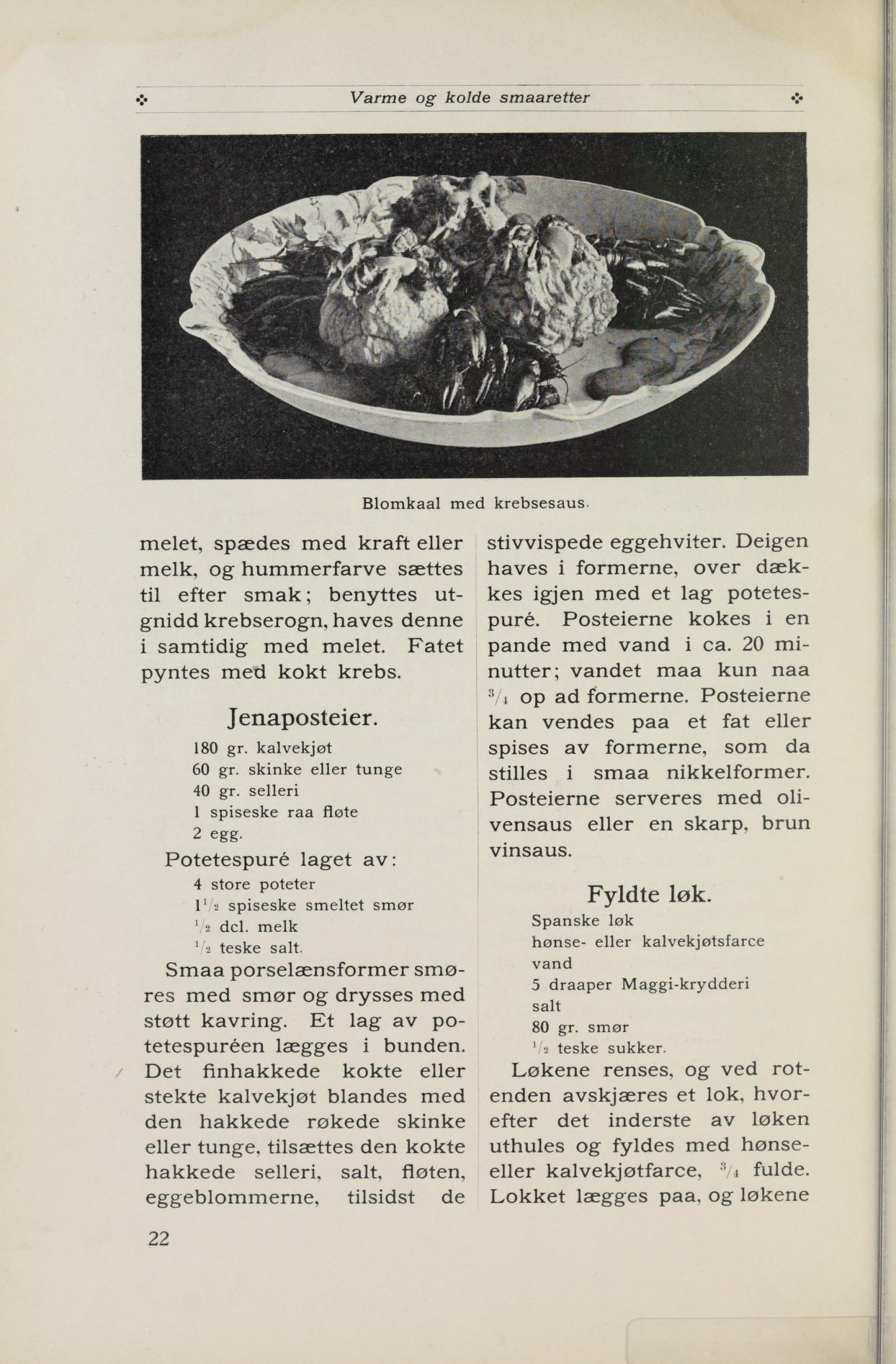
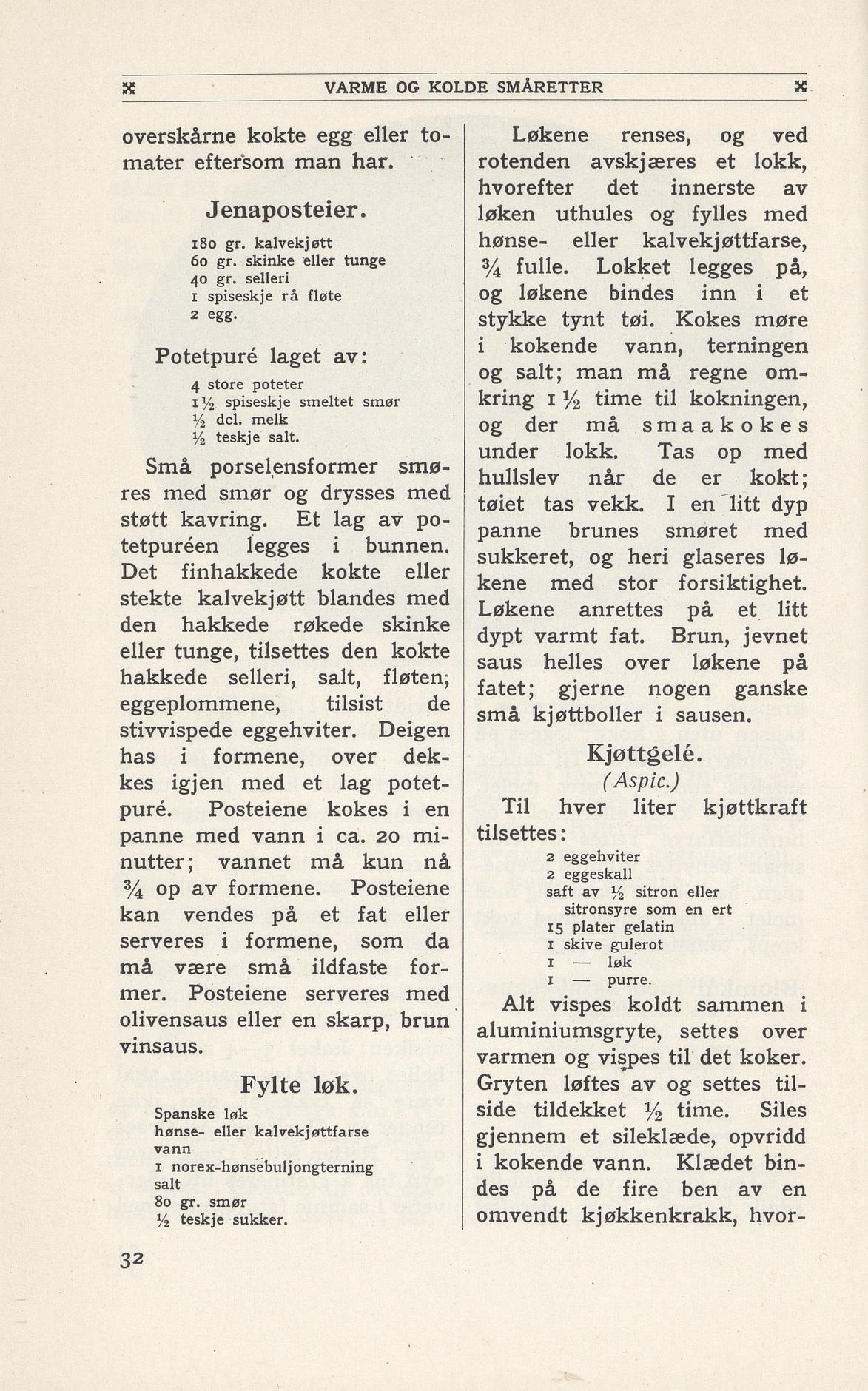
180 g kalvekjøtt (kokt eller stekt, finhakket). gr. kalvekjøt 60 g røkt gr. skinke eller tunge (hakket). 40 g gr. selleri (kokt og hakket). 1 ss spiseske raa fløte (rå). 2 stk egg (deles i plomme og hvite). 0,5 ts salt (etter smak). egg. Potetespuré laget av: 4 stk store poteter (til potetpuré). 1,5 ss 1½ spiseske smeltet smør (til potetpuréen). 1 ss smør (til smøring av formene). 2 ss kavringsmuler (støtt kavring, til drysset i formene). Kok potetene møre, mos dem godt og rør inn det smeltede smøret. Smak til med litt salt.. Smør små porselensformer godt Smaa porselænsformer smøres med smør og dryss dem drysses med støtte kavringsmuler. Legg et støtt kavring. Et lag potetpuré i bunnen av hver form.. Bland det potetespuréen lægges i bunden. Det finhakkede kokte eller stekte kalvekjøttet kalvekjøt blandes med den hakkede skinken røkede skinke eller tungen. Tilsett kokt hakket tunge, tilsættes den kokte hakkede selleri, salt, fløten og eggeplommene.. Visp eggehvitene stive og vend dem forsiktig inn i farsen til slutt.. Fordel farsen fløten, eggeblommerne, tilsidst de stivvispede eggehviter. Deigen haves i formene og dekk formerne, over dækkes igjen med et lag potetpuré.. Sett formene potetespuré. Posteierne kokes i en panne pande med vann som bare når et stykke opp langs formene, og la pasteiene koke vand i ca. 20 minutter til de har stivnet.. Hvelv pasteiene på minutter; vandet maa kun naa op ad formerne. Posteierne kan vendes paa et fat, fat eller server dem i formene satt spises av formerne, som da stilles i små serveringsformer. Serveres smaa nikkelformer. Posteierne serveres med olivensaus eller en skarp, brun vinsaus.
Note on Modernised

Mengder er omregnet til moderne mål (spiseskje/teskje, gram, desiliter). «Støtt kavring» er gjengitt som knuste kavringsmuler/griljermel. Kokingen i «pande med vand» er beskrevet som vannbad i ovn eller på platen. Saltmengde er anslått, da originalen bare sier «salt».

Community interpretations

Be the first to share your own version.

See interpretations →

Frequently asked questions

How are the Jena timbales prepared?
They are filled into small buttered porcelain molds coated with crushed rusk: a layer of mashed potato in the bottom, the meat filling in the middle and mashed potato on top. The molds are cooked in a water bath in a pan for about 20 minutes – the water should only reach partway up the sides of the molds.
What meat is used?
180 g boiled or roasted veal, finely chopped, mixed with 60 g chopped smoked ham or tongue. Plus 40 g boiled, chopped celery, salt, 1 tablespoon raw cream, the egg yolks and finally stiffly whipped egg white.
How are they served?
They can be turned out onto a platter, or eaten straight from the molds, which are then set in small napkins/holders. The recipe is from Henriette Schønberg Erken's "Stor kokebok" (Grand Cookbook, 1914), p. 22, and serves 4.

Related recipes

More dishes in the same category from the archive

Read also

Kommentarer

Ingen kommentarer ennå. Bli den første til å dele!