Skip to content

Indian tartlets (tartelettes à l'indienne)

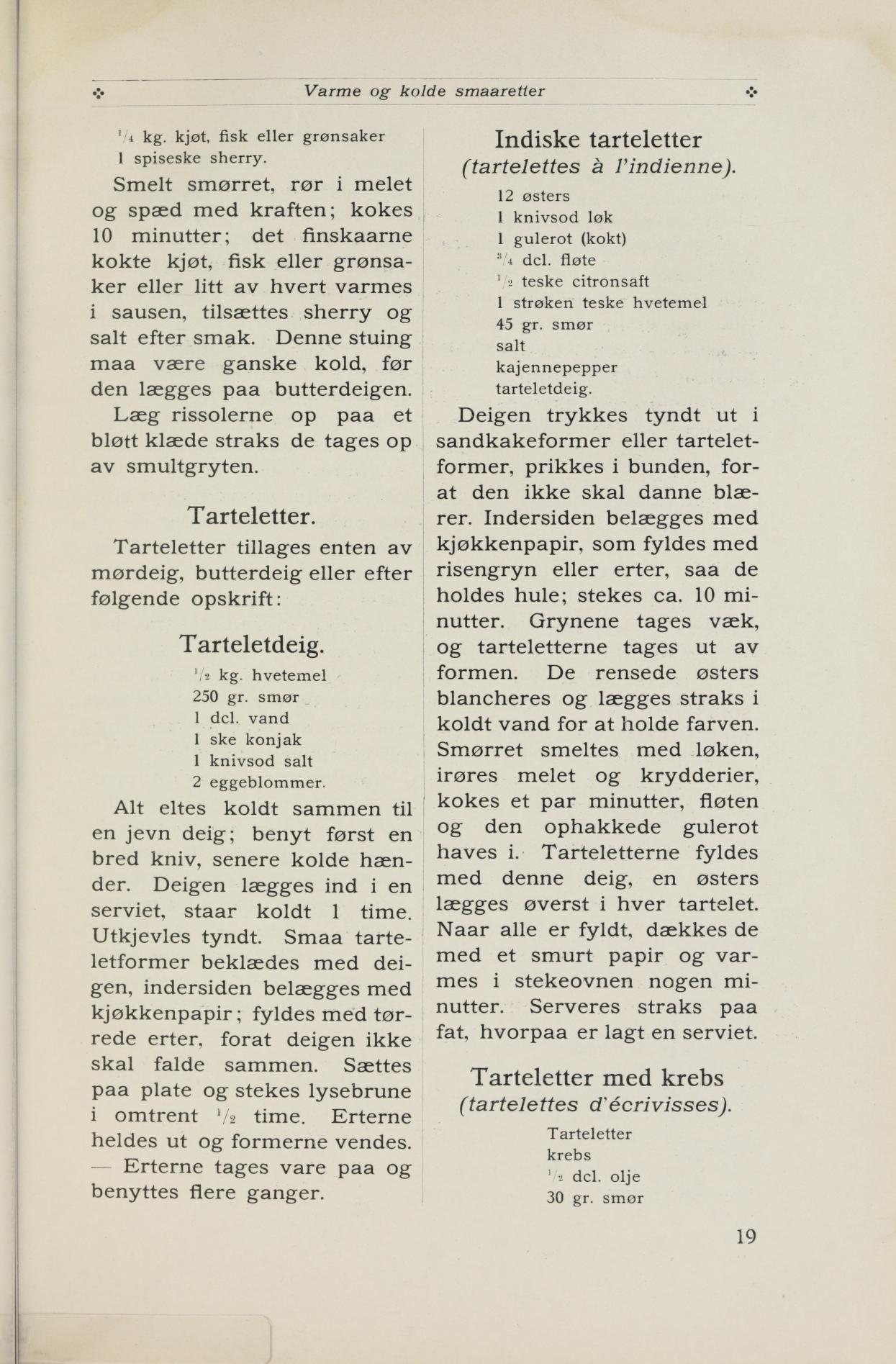
Indian tartlets from Erken 1914: blind-baked tartlet shells filled with a thick mixture of butter, onion, flour, cayenne pepper, lemon, cream and boiled carrot, with one blanched oyster on top, warmed briefly in the oven and served at once.

Source: Henriette Schønberg Erken, Stor kokebok, 1914-utg. s. 19 (falt i det fri)

Be the first to rate

About the dish

An 'Indian' starter in the French-inspired style of the time, where curry-like seasoning with cayenne pepper gave the name. Oysters were a common party delicacy in Norwegian bourgeois homes around 1914. The dishes were served hot on a platter with a napkin underneath.

How to make it

  1. 1

    Line the molds

    Press the tartlet dough thinly into small sandcake molds or tartlet molds and prick the bottom so the dough doesn't form blisters.

  2. 2

    Blind bake

    Place parchment paper in the molds and fill with rice or dried peas so the dough holds its shape. Bake about 10 minutes, remove the grains and take the tartlets out of the molds.

  3. 3

    Blanch the oysters

    Blanch the cleaned oysters quickly and put them straight into cold water to preserve the color.

  4. 4

    Make the filling

    Melt the butter with the onion, stir in the flour, salt, cayenne pepper and lemon juice and cook a couple of minutes. Add the cream and the chopped carrot to a thick mixture.

  5. 5

    Fill and warm

    Fill the tartlets with the mixture and place an oyster on top of each. Cover with a greased paper and warm them a few minutes in the oven.

  6. 6

    Serving

    Serve at once on a platter with a napkin underneath.

Changes from the original

Amounts converted to modern units; 'knife tip of onion' interpreted as finely chopped onion (about 1 tsp). 1/4 dl cream is reconstructed where the OCR gave '4 del.'. 'Vannes' is modernized to 'warmed'. Tartlet dough is given as ready-made dough per its own recipe.

In stores now

Clean, minimally processed groceries matched to the ingredients — approximate prices.

Product data and prices via Kassalapp. Prices are updated daily and may vary.

Time machine – what changed?

Pick two editions and see what Henriette Schønberg Erken added, removed or changed between them.

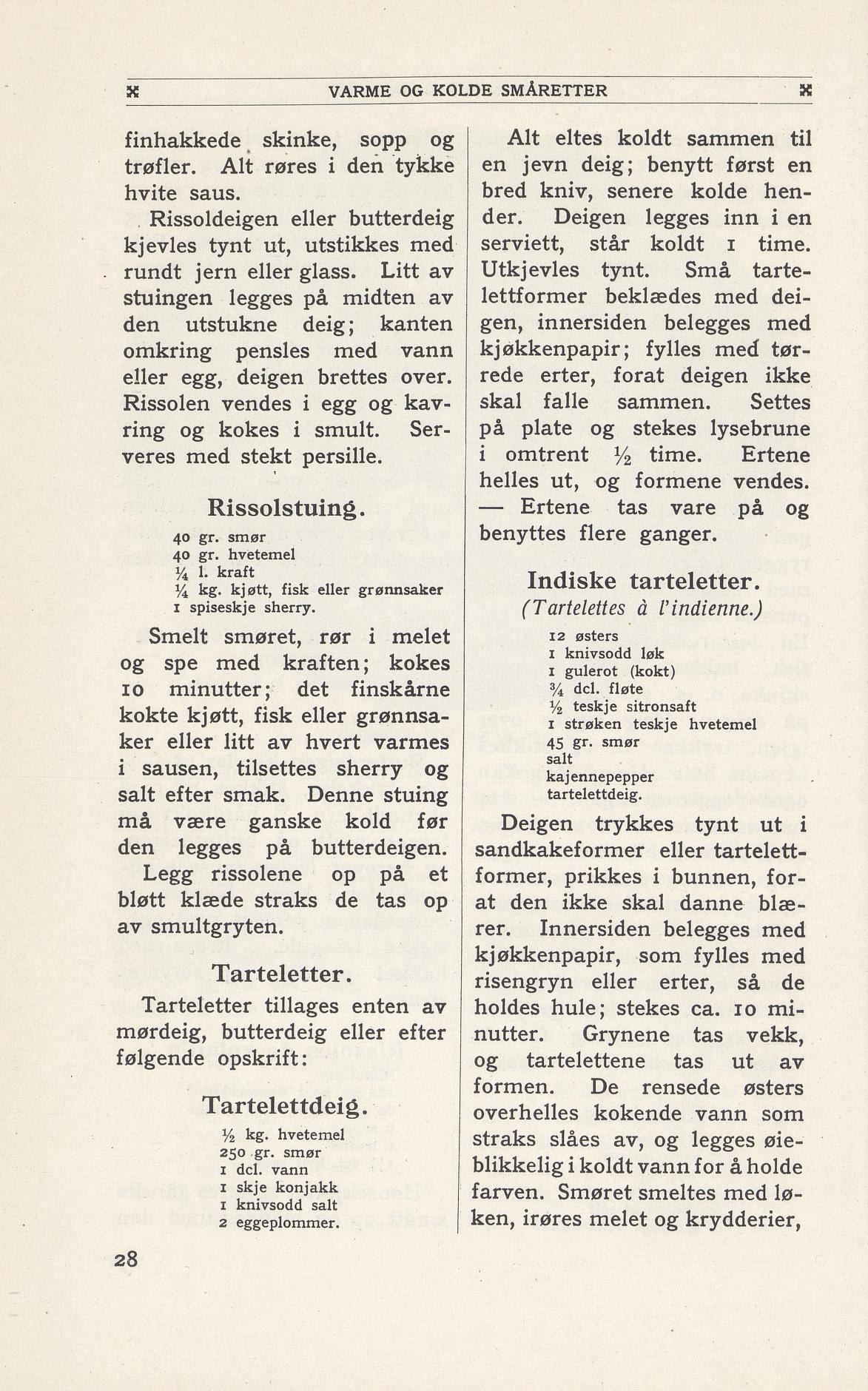
1914 (proofread, p. 19) → Modernised~81% of the text changedremovedadded
12 stk østers (rensede). 1 knivsod ts løk (finhakket, knivsodd). 1 gulerot (kokt) ¼ del. fløte ½ teske citronsaft stk gulrot (kokt og hakket). 0,25 dl fløte. 0,5 ts sitronsaft. 1 strøken teske ts hvetemel (strøken). 45 gr. smør salt kajennepepper tarteletdeig. Deigen trykkes tyndt g smør. 1 klype salt. 1 klype kajennepepper. 1 porsjon tarelettdeig (se egen oppskrift). Trykk tarelettdeigen tynt ut i små sandkakeformer eller tarteletformer, prikkes i bunden, forat den tarelettformer og prikk bunnen så deigen ikke skal danne blærer. Indersiden belægges med kjøkkenpapir, som fyldes danner blærer.. Legg bakepapir i formene og fyll med risengryn ris eller erter, saa de holdes huie; stekes tørkede erter så deigen holder formen. Stek ca. 10 minutter. Grynene tages væk, minutter, fjern grynene og tarteletterne tages ta tarelettene ut av formen. De formene.. Blancher de rensede østers blancheres østersene raskt og lægges legg dem straks i koldt vand kaldt vann for at holde farven. Smørret smeltes å bevare fargen.. Smelt smøret med løken, irøres melet rør inn melet, salt, kajennepepper og krydderier, kokes sitronsaft og kok et par minutter, minutter. Tilsett fløten og den ophakkede gulerot haves i. Tarteletterne fyldes hakkede gulroten til en tykk masse.. Fyll tarelettene med denne deig, massen og legg en østers lægges øverst i hver tartelet. Naar alle er fyldt, dækkes de hver. Dekk med et smurt papir og vannes varm dem noen minutter i stekeovnen nogen minutter. stekeovnen.. Serveres straks paa fat, hvorpaa er lagt en serviet. på fat med serviett under.
Note on Modernised

Mengder omregnet til moderne enheter; «knivsod løk» tolket som finhakket løk (ca. 1 ts). ¼ dl fløte er rekonstruert der OCR ga «4 del.». «Vannes» er modernisert til «varmes». Tarelettdeig oppgis som ferdig deig etter egen oppskrift.

Community interpretations

Be the first to share your own version.

See interpretations →

Frequently asked questions

Why should the tartlet dough be pricked and filled with grains or peas during baking?
The pricking prevents the bottom from forming blisters, and the rice or peas (placed in kitchen paper inside the mold) hold the dough in place so the shells keep their shape. Bake about 10 minutes, then take out the grains and loosen the tartlet from the mold.
Why are the oysters put in cold water after blanching?
The recipe states that the cleaned oysters are blanched and put straight into cold water to keep their color.
What does the filling consist of?
Butter (45 g) is melted with a little onion, wheat flour and seasonings (salt and cayenne pepper) are stirred in and cooked a couple of minutes, then 1/4 dl cream and chopped boiled carrot are added. A little lemon juice (1/2 teaspoon) also belongs. One oyster is placed on top of each tartlet.
Where does the recipe come from?
From Henriette Schønberg Erken's 'Stor kokebok' (1914), page 19, among the hot and cold small dishes. It is calculated for 6 servings with 12 oysters and takes around 50 minutes in all.

Related recipes

More dishes in the same category from the archive

Read also

Kommentarer

Ingen kommentarer ennå. Bli den første til å dele!