Skip to content

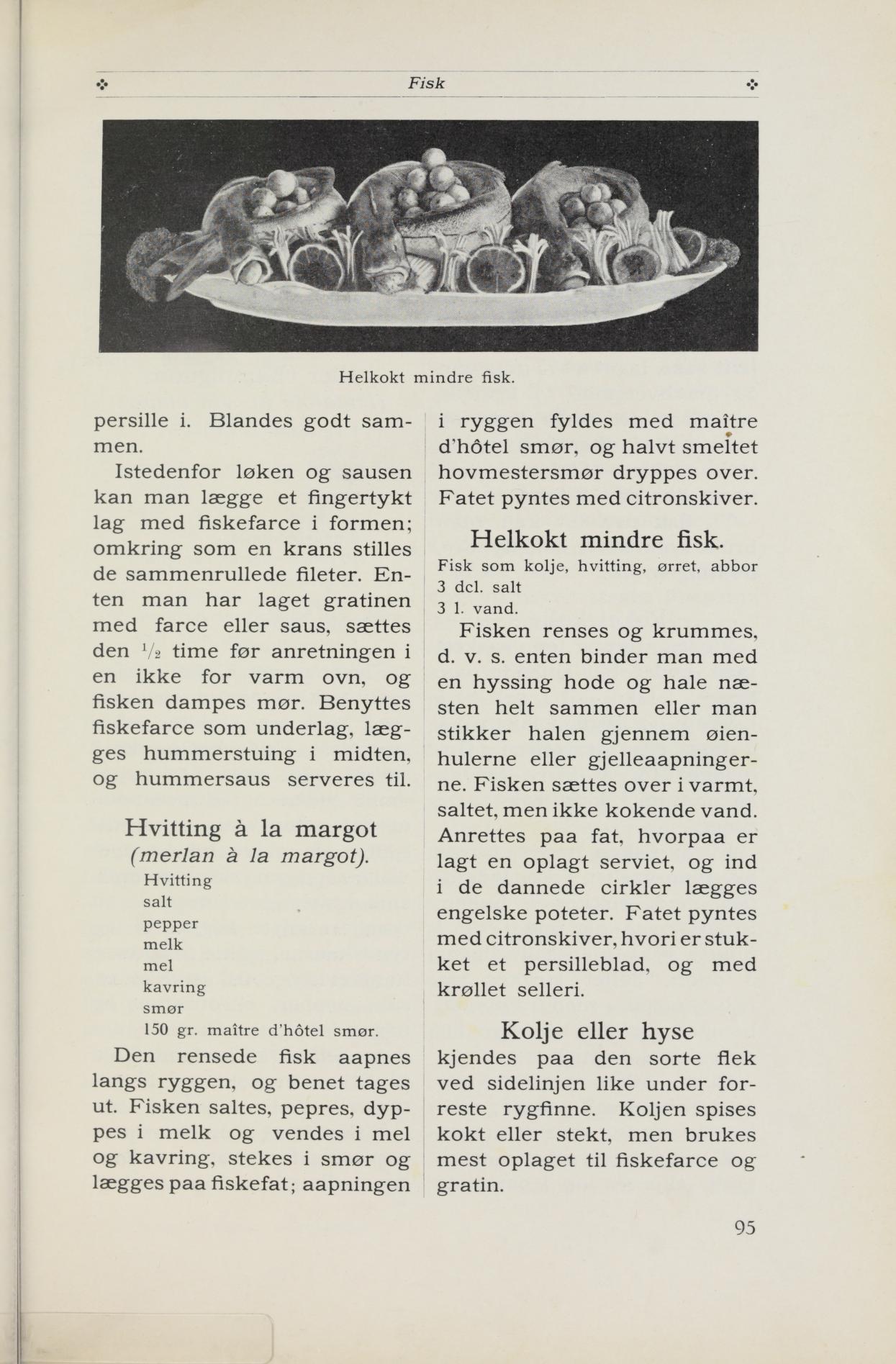
Whole Poached Small Fish

Basic recipe from Erken 1914 for whole poached small fish (haddock, whiting, trout, perch): the fish is cleaned and "curved" by tying the head and tail together or threading the tail through the eye sockets, then poached in hot salted water (3 dl salt to 3 l water) that must not boil. Arranged on a folded napkin with boiled potatoes in the rings, garnished with lemon slices, parsley and celery leaves.

Source: Henriette Schønberg Erken, Stor kokebok, 1914-utg. s. 95 (falt i det fri)

Be the first to rate

About the dish

A basic recipe from the fish chapter of "Stor kokebok" (1914). To "curve" the fish — bending it into a ring by tying the head and tail together or threading the tail through the eye sockets — was a classic way of presenting whole poached small fish, served on a folded napkin with plain (boiled, peeled) potatoes in the rings.

How to make it

  1. 1

    Clean the fish

    Clean the fish well and rinse it.

  2. 2

    Curve the fish

    Curve the fish: tie the head and tail almost all the way together with kitchen string, or thread the tail through the eye sockets or gill openings, so the fish forms a ring.

  3. 3

    Poach the fish

    Mix salt into the water and heat it. Put the fish in the hot, salted water — it must not boil (about 80–85 °C (185 °F)). Let the fish finish poaching, about 10–15 minutes depending on size.

  4. 4

    Arrange

    Place a folded napkin on a platter and lay the fish on it. Place boiled, peeled potatoes inside the rings the fish forms.

  5. 5

    Garnish

    Garnish the platter with lemon slices with a parsley leaf tucked in, and with curly celery leaves.

Changes from the original

The quantities are converted to modern measures: 3 deciliters salt to 3 liters water. Specified that the water should hold about 80–85 °C (185 °F) ("hot, but not boiling"). "Curly celery" is explained as celery leaves/parsley. Otherwise the method is kept.

In stores now

Clean, minimally processed groceries matched to the ingredients — approximate prices.

Product data and prices via Kassalapp. Prices are updated daily and may vary.

Tidsmaskin – hva endret seg?

Velg to utgaver og se hva Henriette Schønberg Erken la til, fjernet eller endret mellom dem.

1914 (korrekturlest, s. 95)1949 (korrekturlest, s. 114)~55% av teksten endretfjernetlagt til
Fisk som kolje, hvitting, ørret, abbor 3 2 del. salt 3 l. vand. 1. vann. Fisken renses og krummes, d. v. s. enten binder man med en hyssing hode og hale næsten næ sten helt sammen sammen, eller man stikker halen gjennem øienhulerne øien hulene eller gjelleaapningerne. gjelleåpningene. Fisken sættes settes over i varmt, saltet, men ikke kokende vand. vann. Anrettes paa på varmt fat, hvorpaa er lagt en oplagt serviet, og ind i de dannede cirkler lægges engelske poteter. Fatet pyntes serveres med citronskiver, hvori er stukket et persilleblad, «engelske» pote ter, sitronskiver og med krøllet selleri. forskjellige grønnsaker.

Community interpretations

Be the first to share your own version.

See interpretations

Frequently asked questions

Which types of fish suit this recipe?
The recipe mentions small fish such as haddock, whiting, trout and perch, cooked whole.
What does it mean to "curve" the fish?
It means to bend the fish into a ring: either you tie the head and tail almost all the way together with string, or you thread the tail through the eye sockets or gill openings.
What should the cooking water be like?
The fish is put into hot, salted water that does not boil – the recipe reckons 3 del. salt to 3 liters water. Total time is around 40 minutes.
How is the dish arranged?
On a platter with a folded napkin; plain boiled potatoes are placed in the circles that form. The platter is garnished with lemon slices with a parsley leaf tucked in, and with curly celery. From Henriette Schønberg Erken's "Stor kokebok" (1914), p. 95.

Related recipes

More dishes in the same category from the archive

Read also

Kommentarer

Ingen kommentarer ennå. Bli den første til å dele!