Skip to content

Hare Pate (pate de lievre)

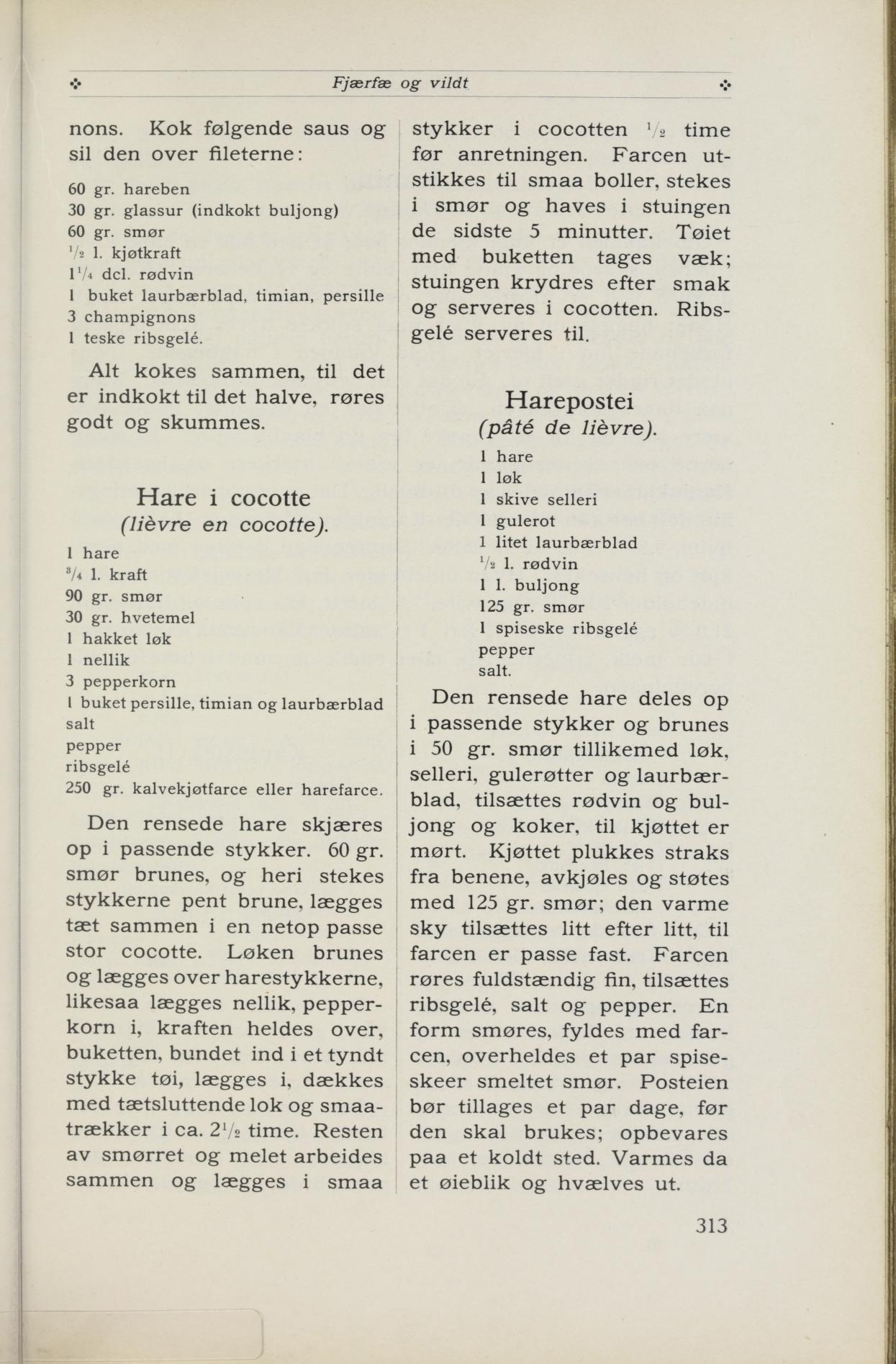
Erken's hare pate from 1914: hare is browned with onion, celery, carrot, and bay, cooked tender in red wine and bouillon, the meat is picked off the bones and pureed with 125 g butter, thinned with hot stock and seasoned with red currant jelly, salt, and pepper. Filled into a greased mold, covered with melted butter, and aged cold for a couple of days before it is turned out.

Source: Henriette Schønberg Erken, Stor kokebok, 1914-utg. s. 313 (falt i det fri)

Be the first to rate

About the dish

From the chapter "Poultry and Game" in Henriette Schonberg Erken's "Stor kokebok" (1914). Cold game pates belonged to the finer cold table, and Erken stresses that the pate must be made a couple of days in advance and stored cold - the era's answer to a refrigerator was the cellar or the storehouse.

How to make it

  1. 1

    Brown the hare

    Cut the cleaned hare into suitable pieces and brown them in 50 g butter together with the onion, celery, carrot, and bay leaf.

  2. 2

    Cook tender

    Add the red wine and bouillon, and let it cook until the meat is tender.

  3. 3

    Pick the meat

    Pick the meat off the bones right away, let it cool, and crush/puree it together with 125 g butter (mortar or food processor).

  4. 4

    Thin with the juices

    Add the hot stock a little at a time until the forcemeat is suitably firm. Stir the forcemeat completely smooth.

  5. 5

    Season

    Season with red currant jelly, salt, and pepper.

  6. 6

    Fill the mold

    Grease a mold, fill it with the forcemeat, and pour a couple of tablespoons of melted butter over.

  7. 7

    Aging

    The pate should be made a couple of days before use and kept cold. Dip the mold in water for a moment and turn the pate out before serving.

Changes from the original

Measurements are converted to modern units (g, dl). "Pounded" is modernized to crushed/pureed in a mortar or run in a food processor. Note that the original lists 50 g butter for browning in addition to the 125 g in the ingredient list; this is kept as a separate quantity. The method is divided into numbered steps.

In stores now

Clean, minimally processed groceries matched to the ingredients — approximate prices.

Product data and prices via Kassalapp. Prices are updated daily and may vary.

Time machine – what changed?

Pick two editions and see what Henriette Schønberg Erken added, removed or changed between them.

1914 (proofread, p. 313) → Modernised~78% of the text changedremovedadded
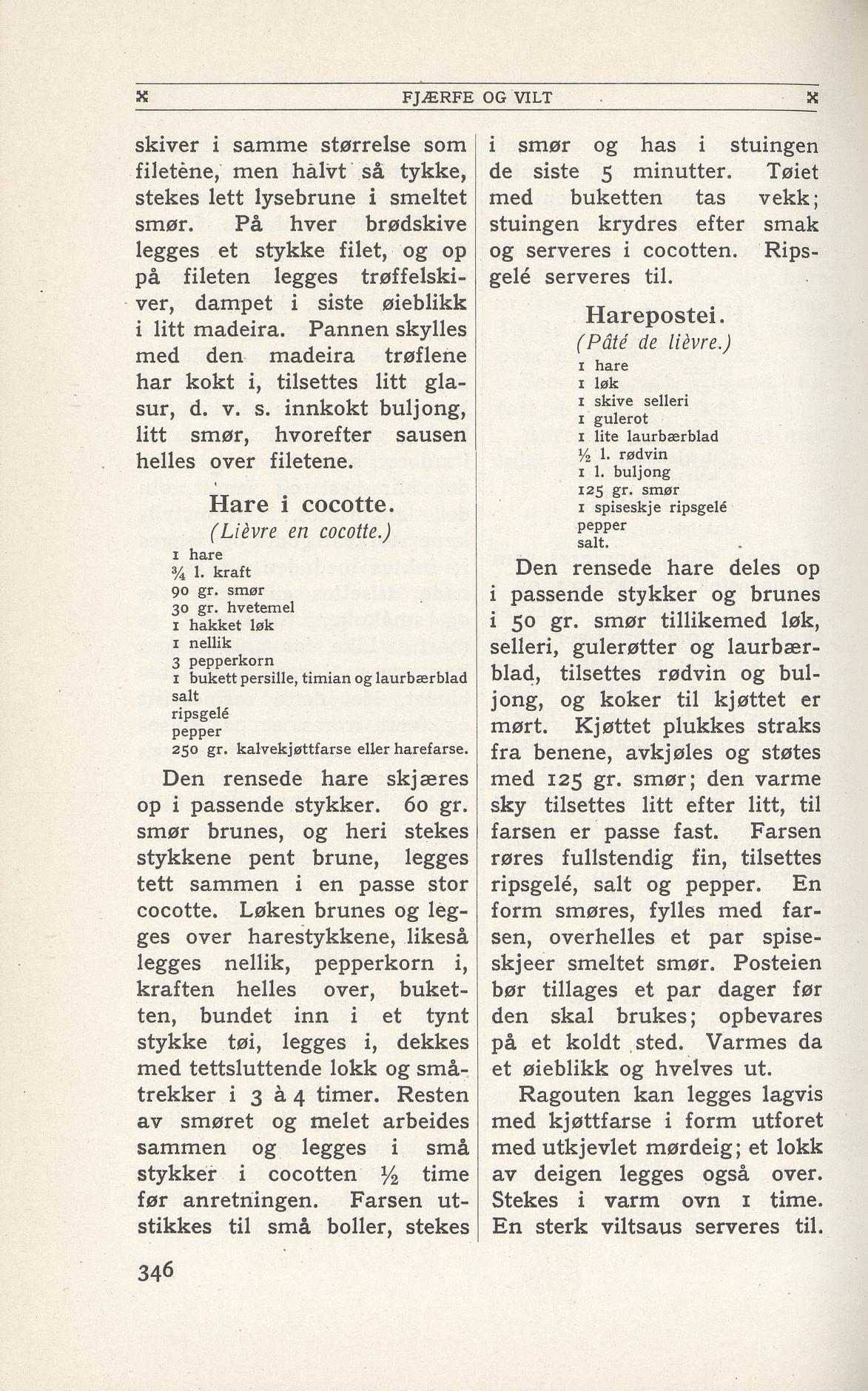
1 stk hare (renset og delt i stykker). 1 løk stk løk. 1 skive selleri (sellerirot). 1 gulerot stk gulrot. 1 litet stk laurbærblad 1/2 l. rødvin (lite). 5 dl rødvin. 1 l. buljong l buljong. 50 g smør (til bruning). 125 gr. g smør (til farsen). 1 spiseske ribsgelé ss ripsgelé. salt (etter smak). pepper salt. Den (etter smak). 2 ss smeltet smør (til å helle over posteien). Del den rensede hare deles op haren i passende stykker og brunes brun dem i 50 gr. g smør tillikemed sammen med løk, selleri, gulerøtter gulrot og laurbærblad, tilsættes laurbærblad.. Tilsett rødvin og buljong buljong, og koker, la det koke til kjøttet er mørt. Kjøttet plukkes straks fra benene, avkjøles mørt.. Plukk kjøttet av beina med det samme, la det avkjøle, og støtes knus/mos det sammen med 125 gr. smør; g smør (morter eller foodprosessor).. Tilsett den varme sky tilsættes kraften litt efter litt, etter litt til farcen farsen er passe fast. Farcen røres fuldstændig fin, tilsættes ribsgelé, Rør farsen helt fin.. Smak til med ripsgelé, salt og pepper. En form smøres, fyldes pepper.. Smør en form, fyll den med farcen, overheldes farsen og hell et par spiseskeer spiseskjeer smeltet smør. smør over.. Posteien bør tillages lages et par dage, dager før den skal brukes; opbevares paa et koldt sted. Vandes da bruk og oppbevares kaldt. Dypp formen et øieblik øyeblikk i vann og hvælves ut. hvelv posteien ut før servering.

Note on Modernised

Mål er omregnet til moderne enheter (g, dl). «Støtes» er modernisert til å knuses/moses i morter eller kjøres i foodprosessor. Merk at originalen oppgir 50 g smør til bruning i tillegg til de 125 g i ingredienslisten; dette er beholdt som egen mengde. Fremgangsmåten er delt i nummererte trinn.

Community interpretations

Be the first to share your own version.

See interpretations →

Frequently asked questions

Why should the pate be made a couple of days before serving?
The recipe recommends making the pate a couple of days before use, so that it can set and the flavor develop. It is kept cold, and the mold is dipped in water for a moment before the pate is turned out.
How do I get the forcemeat suitably firm?
The meat is picked from the bones right after cooking, cooled, and pounded with 125 g butter. Then the hot stock (the juices) is added a little at a time until the forcemeat is suitably firm, and stirred completely smooth.
What gives the pate its flavor?
The hare is browned in butter together with onion, celery, carrot, and a small bay leaf, and cooked tender in 1/2 l red wine and 1 l bouillon. Finally the forcemeat is seasoned with a tablespoon of red currant jelly, salt, and pepper.
How long does the recipe take?
Count on about 3 hours in total (source: Stor kokebok 1914, p. 313), serving 8 - plus the couple of days the pate should stand cold.

Equipment for this dish

Advertisement

We may earn a commission if you buy through these links. It does not affect the price.

Related recipes

More dishes in the same category from the archive

Read also

Kommentarer

Ingen kommentarer ennå. Bli den første til å dele!