Skip to content

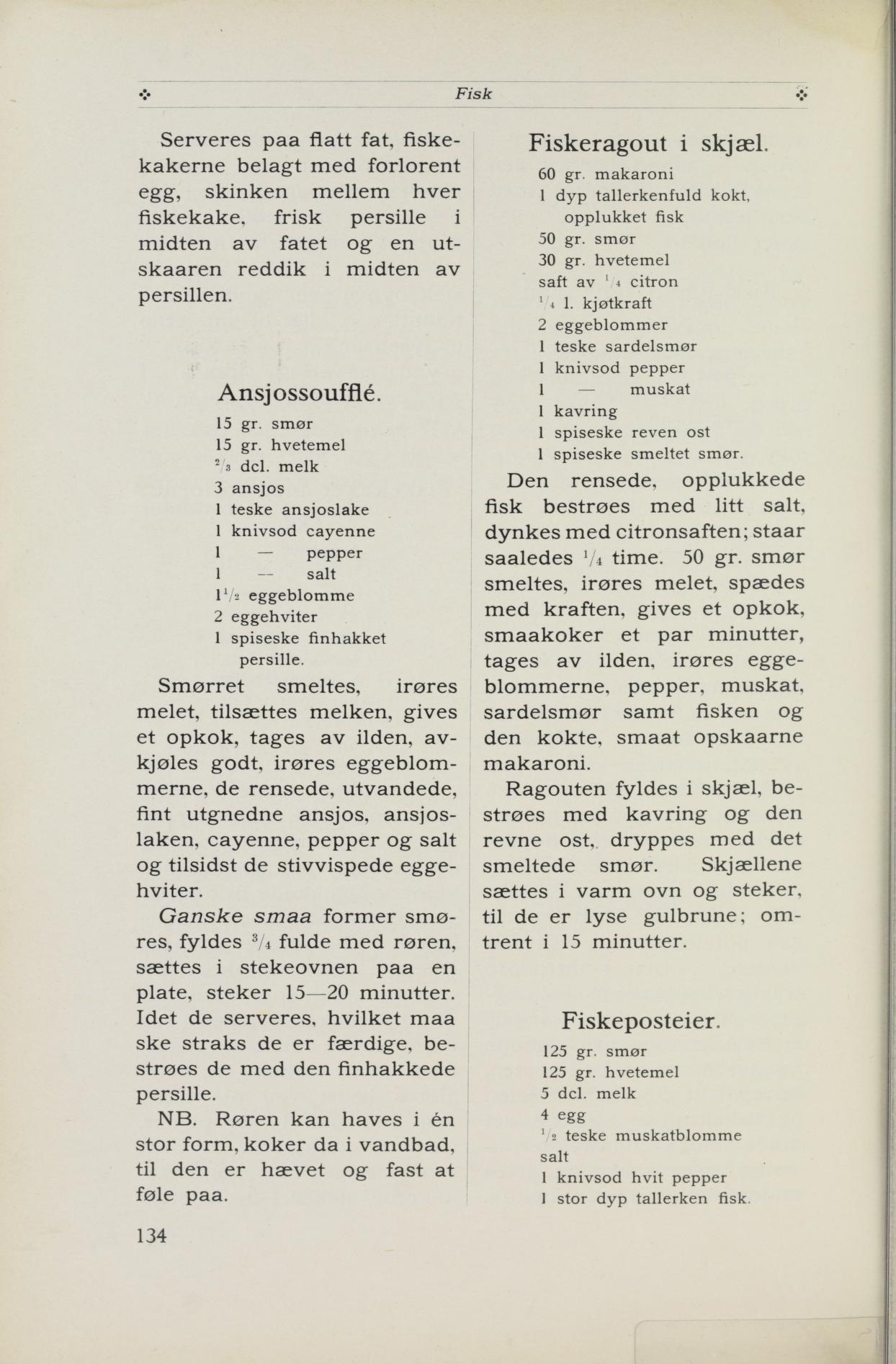
Fish Ragout in Shells

Erken's fish ragout in shells from 1914: boiled fish seasoned with lemon and salt, folded into a butter sauce of 50 g butter, 30 g flour and 2.5 dl meat stock with egg yolks, nutmeg, pepper and anchovy butter, plus cooked macaroni. Filled into shells, sprinkled with rusk crumbs and cheese, drizzled with butter and gratinated for 15 minutes.

Source: Henriette Schønberg Erken, Stor kokebok, 1914-utg. s. 134 (falt i det fri)

Be the first to rate

About the dish

Erken's fish chapter is full of dishes that make use of boiled fish from the day before. Here, real scallop shells or small gratin dishes are filled with a rich fish ragout with macaroni, gratinated to a golden surface — a typically "finer" everyday dish from 1914.

How to make it

  1. 1

    Season the fish

    Clean the boiled fish of skin and bones and pick it into pieces. Sprinkle with a little salt and drizzle with the lemon juice. Let it stand this way for 15 minutes.

  2. 2

    Boil the macaroni

    Boil the macaroni in salted water until tender, drain off the water and cut it into small pieces.

  3. 3

    Make the sauce

    Melt 50 g butter, stir in the flour and thin with the meat stock. Bring the sauce to a boil and let it simmer for a couple of minutes.

  4. 4

    Mix the ragout

    Take the pan off the heat and stir in the egg yolks, pepper, nutmeg and anchovy butter. Then fold in the fish and the macaroni.

  5. 5

    Fill and gratinate

    Fill the ragout into shells or small gratin dishes, sprinkle with rusk crumbs and grated cheese and drizzle with the melted butter. Bake in a hot oven, 200 °C (390 °F), for about 15 minutes until the surface is light golden brown. Serve immediately.

Changes from the original

Measurements have been converted to modern units (dl, tbsp, tsp). "Kavring" (rusk) is given as crushed rusks/breadcrumbs. Sardine butter can be replaced with anchovy butter or anchovy paste. The amount of meat stock was unclear in the original print and has been interpreted as 2.5 dl. Baking settings are given for an electric oven.

In stores now

Clean, minimally processed groceries matched to the ingredients — approximate prices.

Product data and prices via Kassalapp. Prices are updated daily and may vary.

Time machine – what changed?

Pick two editions and see what Henriette Schønberg Erken added, removed or changed between them.

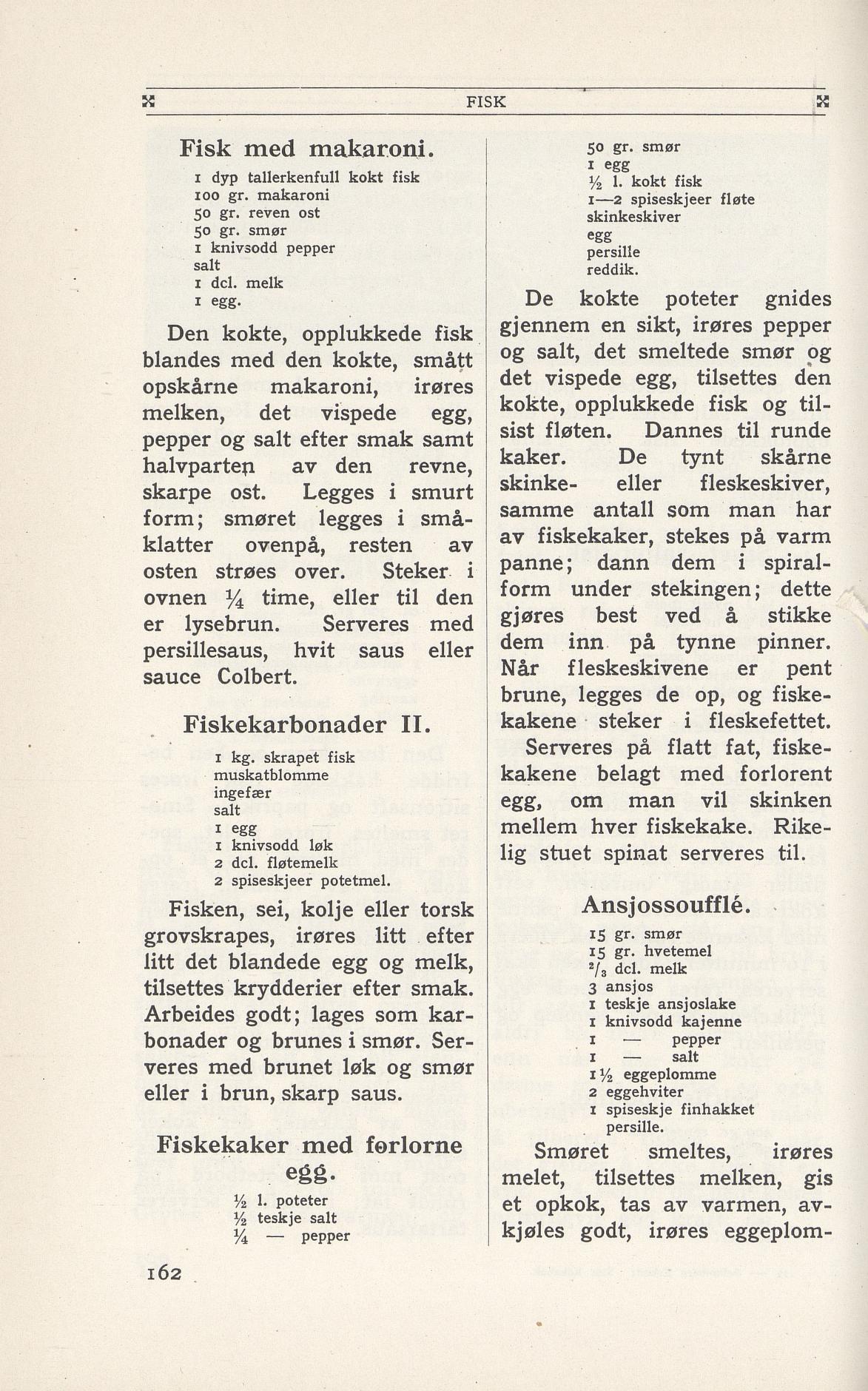
Modernised → 1949 (proofread, p. 162)~89% of the text changedremovedadded
60 g gr. makaroni (kokes og skjæres i små biter). 400 g 1 dyp tallerkenfull kokt opplukket fisk (1 dyp tallerken, plukket i biter). 50 g gr. smør (til sausen). 30 g hvetemel. 0,25 stk gr. hvetemel saft av ½ sitron (saften). 2,5 dl kjøttkraft. ¼ l. kjøttkraft 2 stk eggeplommer. eggeplommer 1 ts teskje sardellsmør (eller ansjossmør). 1 knivsspiss pepper. knivsodd pepper 1 knivsspiss muskat. 2 ss knuste kavringer (griljermel). — muskat 1 ss revet ost. kavring 1 ss spiseskje reven ost 1 spiseskje smeltet smør (til dryppning). salt (til fisken). Rens den kokte fisken for skinn og bein og plukk den i biter. Strø over smør. Den rensede, opplukkede fisk bestrøes med litt salt og dryp over sitronsaften. La den stå slik i 15 minutter.. Kok makaronien i saltet vann til den er mør, hell av vannet og skjær den i små biter.. Smelt salt, dynkes med sitronsaften; står således ½ time. 50 g smør, rør inn melet og spe gr. smør smeltes, irøres melet, spedes med kjøttkraften. Gi sausen kraften, gis et oppkok og la den småkoke opkok, småkoker et par minutter.. Ta gryten minutter, tas av platen og rør inn varmen, irøres eggeplommene, pepper, muskat og sardellsmør. Vend deretter inn muskat, sardellsmør samt fisken og makaronien.. Fyll ragouten i skjell eller små gratinformer, strø over kavringsmuler og revet ost og dryp over det smeltede smøret. Stek i varm ovn, 200 °C, i ca. 15 minutter til overflaten er lyst gyllenbrun. Serveres straks. den kokte, smått opskårne makaroni.

Note on Modernised

Mål er omregnet til moderne enheter (dl, ss, ts). «Kavring» er angitt som knuste kavringer/griljermel. Sardelsmør kan erstattes med ansjossmør eller ansjospuré. Mengden kjøttkraft var utydelig i originaltrykket og er tolket som 2,5 dl. Bakemål er angitt for elektrisk stekeovn.

Community interpretations

Be the first to share your own version.

See interpretations →

Frequently asked questions

What kind of fish can I use?
The recipe uses boiled, picked fish – that is, leftovers of boiled fish cleaned of skin and bones. Count on about one deep plateful, which corresponds to roughly 400–500 g of fish meat.
Why should the fish stand in lemon juice?
The fish is lightly salted and moistened with the juice of 1/4 lemon and left for 15 minutes. This adds flavor and freshness to the already-boiled fish before it is mixed into the white sauce.
How do I make the ragout sauce itself?
Melt 50 g butter, stir in 30 g wheat flour, thin with 1/4 liter meat stock, bring to a boil and let simmer for a couple of minutes. Take the pan off the heat before stirring in 2 egg yolks, pepper, nutmeg and anchovy butter – that way the eggs won't curdle.
Do I have to use scallop shells as the dish?
The ragout is traditionally filled into shells, sprinkled with rusk crumbs and grated cheese and drizzled with melted butter before gratinating in a hot oven. If you don't have shells, you can use small ovenproof individual dishes.

Equipment for this dish

Advertisement

We may earn a commission if you buy through these links. It does not affect the price.

Related recipes

More dishes in the same category from the archive

Read also

Kommentarer

Ingen kommentarer ennå. Bli den første til å dele!