Skip to content

Sheep's Tongues (langues de mouton braisées)

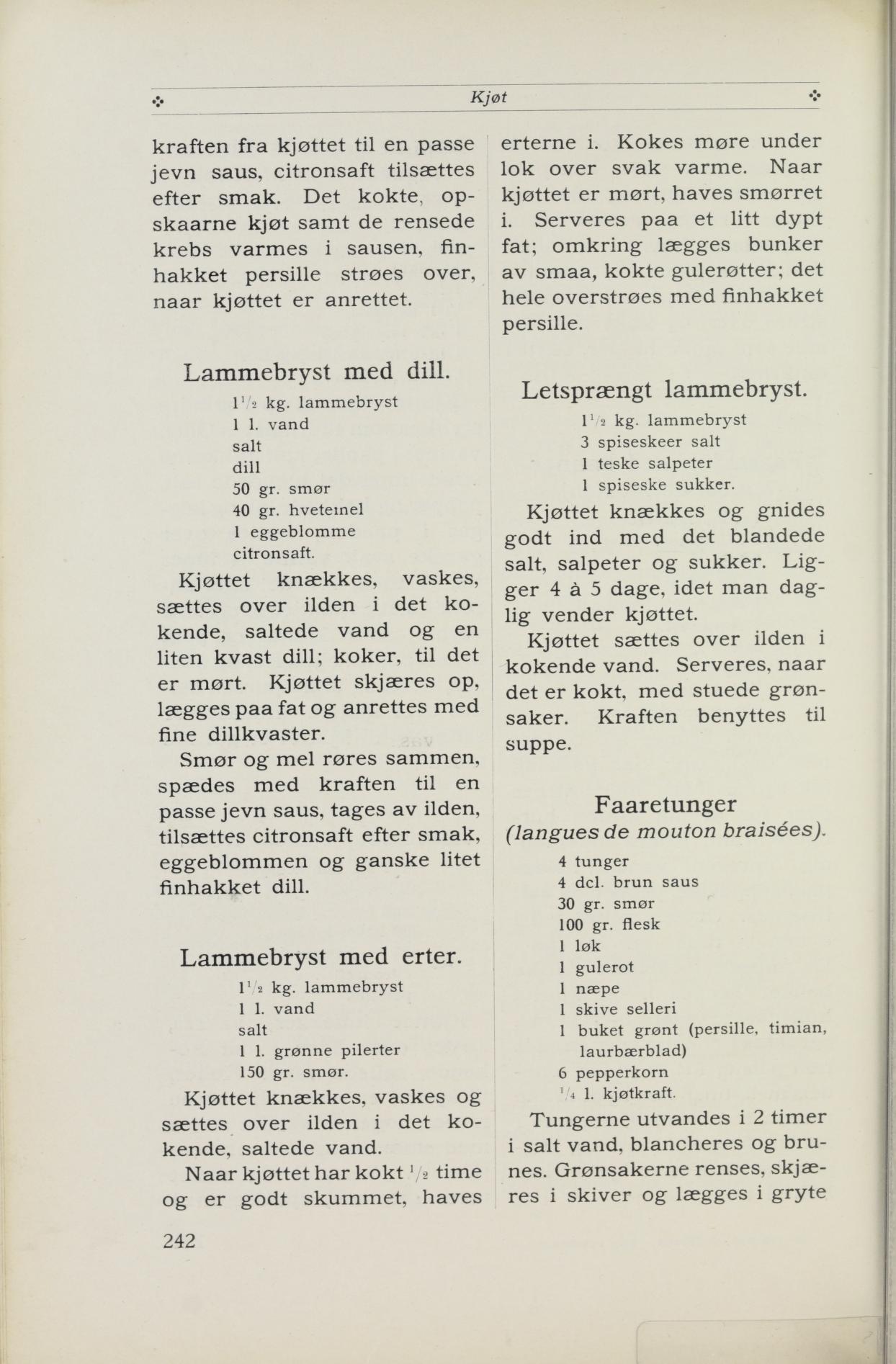
Braised sheep's tongues (langues de mouton braisées) from Erken's Stor kokebok 1914: the tongues are soaked, blanched, browned, and braised tender on root vegetables with pork and meat stock, skinned, split lengthwise, glazed in a hot oven, and served on creamed spinach with brown sauce.

Source: Henriette Schønberg Erken, Stor kokebok, 1914-utg. s. 242 (falt i det fri)

Be the first to rate

About the dish

Here Erken shows the finer French kitchen's braising technique applied to a cheap raw material: sheep's tongues are browned and simmered tender on a bed of root vegetables, glazed, and arranged on creamed spinach. Such dishes belonged to the bourgeois party table around 1914.

How to make it

  1. 1

    Soak the tongues

    Place the sheep's tongues in salted water for 2 hours.

  2. 2

    Blanch and brown

    Blanch the tongues, dry them, and brown them.

  3. 3

    Set up the pot

    Clean the vegetables and cut them into slices. Place them in a pot with the butter, the herb bunch, and the peppercorns, and lay the tongues on top. Let it simmer, covered, for 20 minutes.

  4. 4

    Braise

    Pour on the boiling meat stock, lay the pork slices on top, cover the tongues with a piece of buttered paper, and let them simmer, covered, until tender, 2–3 hours.

  5. 5

    Clean and glaze

    Peel off the skin, split the tongues in two lengthwise, brush them with meat glaze, and place them on buttered paper on a tray. Set them for 5 minutes in a hot oven (about 225 °C (435 °F)).

  6. 6

    Plate

    Arrange the tongues in two rows on a mound of creamed spinach and serve brown sauce alongside.

Changes from the original

Measurements have been converted to modern units (dl, grams). "Næpe" has been kept as turnip, and "flesk" given as fatty pork belly. Meat glaze and creamed spinach have been listed in the ingredient list, and parchment paper may be used instead of buttered paper. The oven temperature has been estimated.

In stores now

Clean, minimally processed groceries matched to the ingredients — approximate prices.

Product data and prices via Kassalapp. Prices are updated daily and may vary.

Time machine – what changed?

Pick two editions and see what Henriette Schønberg Erken added, removed or changed between them.

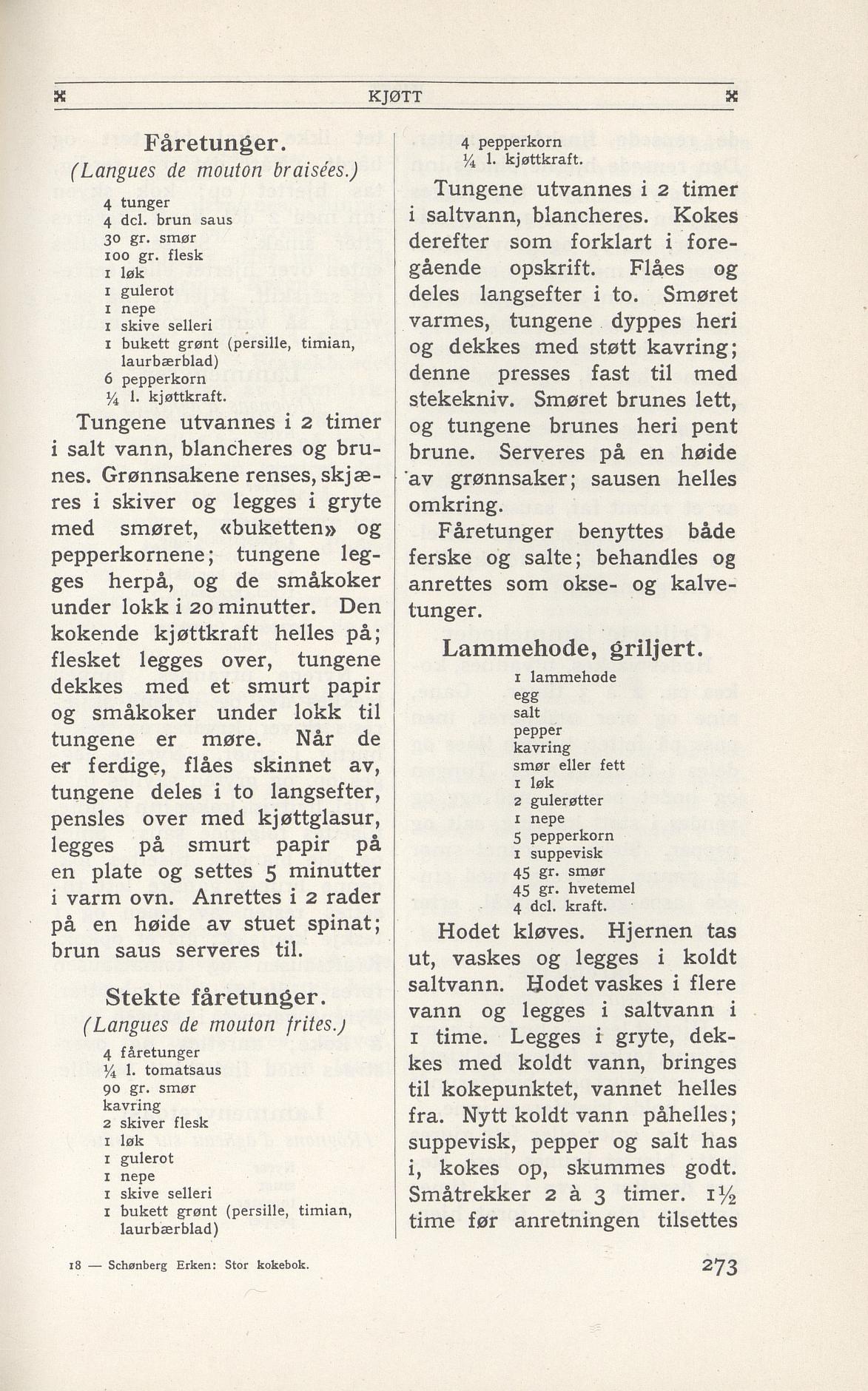
1949 (proofread, p. 273) → Modernised~93% of the text changedremovedadded
Tungene utvannes 4 stk fåretunger. 4 dl brun saus (serveres til). 30 g smør. 100 g flesk (fett svinesideflesk i skiver). 1 stk løk. 1 stk gulrot. 1 stk nepe. 1 skive sellerirot. 1 bukett friske urter (persille, timian og laurbærblad). 6 stk pepperkorn. 2,5 dl kjøttkraft (kokende). 1 ss kjøttglasur (til pensling). 500 g spinat (til stuet spinat). salt (til utvanningen). Legg fåretungene i saltvann i 2 timer timer.. Blanchér tungene, tørk dem og brun dem.. Rens grønnsakene og skjær dem i saltvann, blancheres. Kokes derefter som forklart skiver. Legg dem i foregående opskrift. Flåes en gryte med smøret, urtebuketten og deles langsefter pepperkornene, og legg tungene over. La det småkoke under lokk i to. Smøret varmes, 20 minutter.. Hell på den kokende kjøttkraften, legg fleskeskivene over, dekk tungene dyppes heri og dekkes med støtt kavring; denne presses fast et smurt papir og la dem småkoke under lokk til de er møre, 2–3 timer.. Flå av skinnet, del tungene i to på langs, pensle dem med stekekniv. Smøret brunes lett, kjøttglasur og legg dem på smurt papir på en plate. Sett dem 5 minutter i varm ovn (ca. 225 °C).. Legg tungene brunes heri pent brune. Serveres i to rader på en høide høyde av grønnsaker; sausen helles omkring. 4 tunger 4 del. stuet spinat og server brun saus 30 gr. smør 100 gr. flesk 1 løk 1 gulerot 1 nepe 1 skive selleri 1 bukett grønt (persille, timian, laurbærblad) 6 pepperkorn ¼ l. kjøttkraft. til.

Note on Modernised

Mål er omregnet til moderne enheter (dl, gram). «Næpe» er beholdt som nepe, «flesk» oppgitt som fett svinesideflesk. Kjøttglasur og stuet spinat er ført opp i ingredienslisten, og bakepapir kan brukes i stedet for smurt papir. Ovnstemperatur er anslått.

Community interpretations

Be the first to share your own version.

See interpretations →

Frequently asked questions

How long does it take, and why must the tongues soak in water first?
Figure about 4.5 hours in all. The tongues are soaked for 2 hours in salted water to draw out blood and give a cleaner flavor, then blanched and browned before they simmer tender in the pot.
When should the skin be removed from the tongues?
Only after they are fully cooked and tender. Then the skin is peeled off, the tongues are split in two lengthwise, brushed with meat glaze, and set for 5 minutes in a hot oven.
What goes in the pot with the tongues?
Butter, onion, carrot, turnip, and celery in slices, a bunch of herbs (parsley, thyme, bay leaf), and 6 peppercorns. The tongues are laid over the vegetables and simmer, covered, for 20 minutes before ¼ l of boiling meat stock is poured on, the pork is laid on top, and everything is covered with buttered paper.
What is served alongside?
The recipe uses 4 dl of brown sauce, served with the glazed tongues. The recipe is from Henriette Schønberg Erken's Stor kokebok (1914), p. 242, and is intended for 4 servings.

Related recipes

More dishes in the same category from the archive

Read also

Kommentarer

Ingen kommentarer ennå. Bli den første til å dele!