Erken's basic guide to sugar boiling: 1 kg sugar is dissolved in 1 liter of water, boiled over high heat without stirring, skimmed, and the edge of the pot kept clean. The boiling stages are determined with a finger test: thin thread 101.5 °C, thick thread 105.5 °C, small pearl 113.5 °C, large pearl 120 °C, small blow 125 °C, further large blow 129 °C, small ball 131 °C, large ball 137 °C, soft crack 161 °C, hard crack 171 °C, and caramel 195 °C.
Source: Henriette Schønberg Erken, Stor kokebok, 1914-utg. s. 448 (falt i det fri)
Be the first to rate
About the dish
Erken's introduction to sugar work in the dessert chapter. The recipe is really a basic technique: one sugar syrup of 1 kg sugar and 1 liter water is boiled further and further, and the various boiling stages are determined with finger and slotted-spoon tests (or with a thermometer). The stages from "the thin thread" to "the small blow" begin on this page; the higher stages (large blow, balls, crack, caramel) follow on the next page.
How to make it
1
Pot and equipment
Preferably use an untinned copper pot scoured bright with acetic acid and ashes or scouring powder before each use, otherwise a heavy-bottomed pot. Have a linen cloth or small brush and a bowl of cold water ready, along with a sugar thermometer if possible.
2
Dissolve the sugar
Put the sugar in the pot with the water and let the sugar dissolve completely before the pot is set over the heat. With hard water, add 15 g of glucose per 0.5 kg of sugar.
3
Bring to a boil
Boil over rapid heat. Skim off as soon as it boils, and do not stir the sugar during boiling. Wipe the edge of the pot clean of sugar with the cloth dipped in cold water, otherwise the sugar is easily ruined.
4
The thin thread (about 101.5 °C)
Boil a few minutes. Dip your index finger in the syrup (first dip your finger in cold water for safety), press it together with your thumb, and part your fingers at once: if the sugar draws out into a fine thread that breaks at a short distance, it is boiled to the thin thread.
5
The thick thread (about 105.5 °C)
Boil the syrup a little longer and do the same test. If the thread can be drawn further without breaking, the syrup is boiled to the thick thread.
6
The small pearl (about 113.5 °C)
Continue boiling for a moment and test as before. When the fingers can be moved a little far apart without the thread breaking, the sugar is boiled to the small pearl.
7
The large pearl (about 120 °C)
Boil a little longer, dip your index finger again, and stretch your thumb and index finger as far apart as possible. If the thread holds whole, the sugar is boiled to the large pearl.
8
The small blow (about 125 °C)
Boil a little longer. Dip a slotted spoon in the syrup, pass it lightly over the pot, and blow through the holes. If small bubbles appear on the other side, the sugar is boiled to the small blow.
9
Further stages
If you want higher stages, the sugar is boiled further: the large blow 129 °C (265 °F), the small ball 131 °C (270 °F), the large ball 137 °C (280 °F), the soft crack 161 °C (320 °F), the hard crack 171 °C (340 °F), and caramel 195 °C (385 °F). At the high stages the pot must be taken off the heat at once, as a few seconds more of boiling turns the sugar to caramel.
Changes from the original
Modernized spelling in the steps, "loaf sugar" explained as refined/good-quality sugar, amounts given in modern units (kg, liter, grams). The finger tests have been kept, but a reference to a sugar thermometer has been added for safety. The untinned copper pot is mentioned as the original's recommendation, with a heavy-bottomed pot as an alternative.
📖1914
Original 1914 recipe
Verbatim from the first edition of the Big Cookbook.
Foto: Faksimile: Nasjonalbiblioteket
ProofreadPage 448
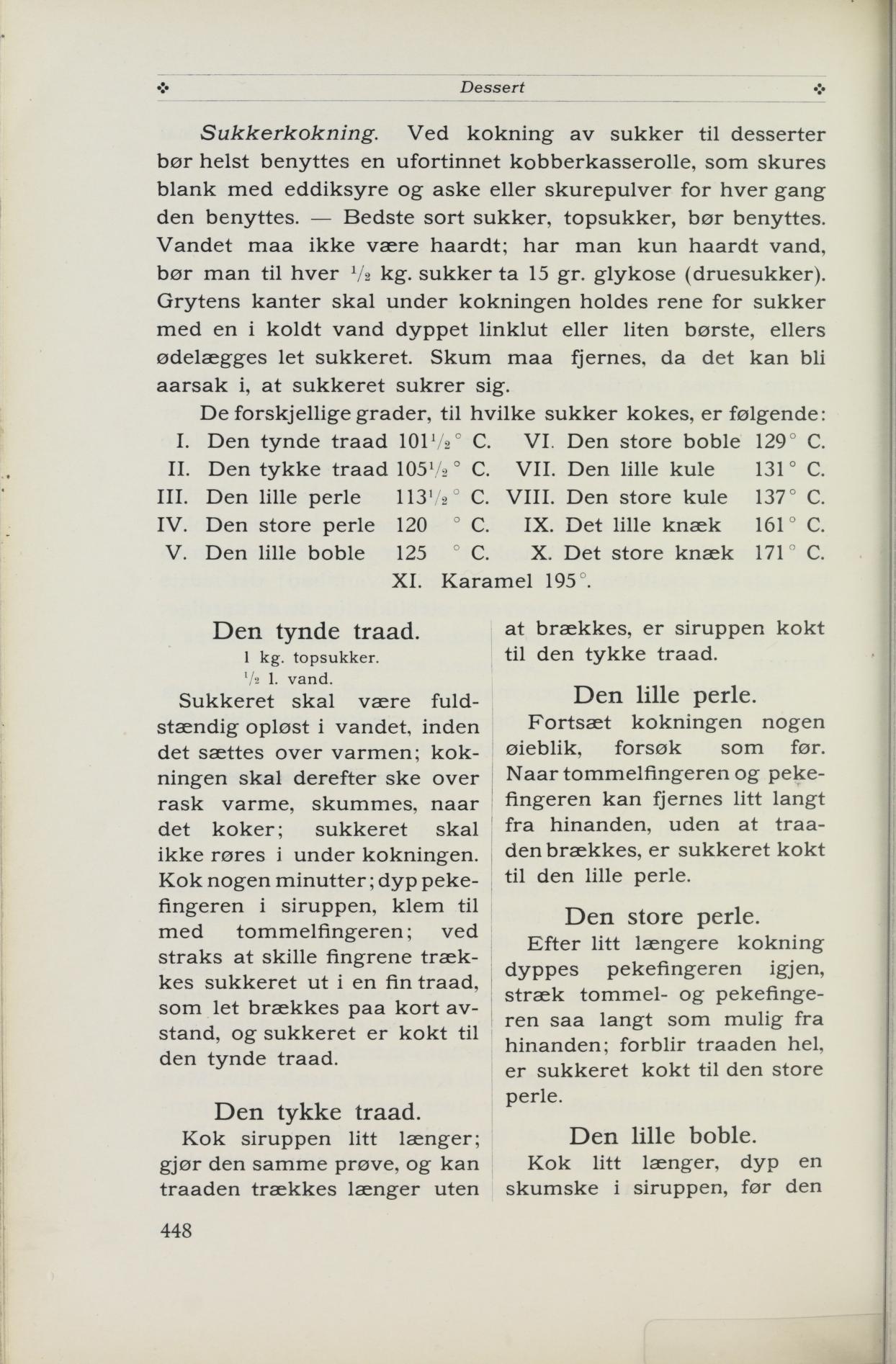
Den tynde traad.
1 kg. topsukker.
1 l. vand.
Sukkerkokning. Ved kokning av sukker til desserter bør helst benyttes en ufortinnet kobberkasserolle, som skures blank med eddiksyre og aske eller skurepulver for hver gang den benyttes. — Bedste sort sukker, topsukker, bør benyttes. Vandet maa ikke være haardt; har man kun haardt vand, bør man til hver ½ kg. sukker ta 15 gr. glykose (druesukker). Grytens kanter skal under kokningen holdes rene for sukker med en i koldt vand dyppet linklut eller liten børste, ellers ødelægges let sukkeret. Skum maa fjernes, da det kan bli aarsak i, at sukkeret sukrer sig.
De forskjellige grader, til hvilke sukker kokes, er følgende:
I. Den tynde traad 101½° C. II. Den tykke traad 105½° C. III. Den lille perle 113½° C. IV. Den store perle 120° C. V. Den lille boble 125° C. VI. Den store boble 129° C. VII. Den lille kule 131° C. VIII. Den store kule 137° C. IX. Det lille knæk 161° C. X. Det store knæk 171° C. XI. Karamel 195° C.
Sukkeret skal være fuldstændig opløst i vandet, inden det sættes over varmen; kokningen skal derefter ske over rask varme, skummes, naar det koker; sukkeret skal ikke røres i under kokningen.
Den tynde traad: Kok nogen minutter; dyp pekefingeren i siruppen, klem til med tommelfingeren; ved straks at skille fingrene trækkes sukkeret ut i en fin traad, som let brækkes paa kort avstand, og sukkeret er kokt til den tynde traad.
Den tykke traad: Kok siruppen litt længer; gjør den samme prøve, og kan traaden trækkes længer uten at brækkes, er siruppen kokt til den tykke traad.
Den lille perle: Fortsæt kokningen nogen øieblik, forsøk som før. Naar tommelfingeren og pekefingeren kan fjernes litt langt fra hinanden, uden at traaden brækkes, er sukkeret kokt til den lille perle.
Den store perle: Efter litt længere kokning dyppes pekefingeren igjen, stræk tommel- og pekefingeren saa langt som mulig fra hinanden; forblir traaden hel, er sukkeret kokt til den store perle.
Den lille boble: Kok litt længer, dyp en skumske i siruppen, før den let over gryten og blæs gjennem hullerne. Hvis der viser sig smaa bobler paa den anden side, er sukkeret kokt til den lille boble.
📖1949
Revised 1949 recipe
From the revised edition of the Big Cookbook.
Foto: Faksimile: Nasjonalbiblioteket
ProofreadPage 510
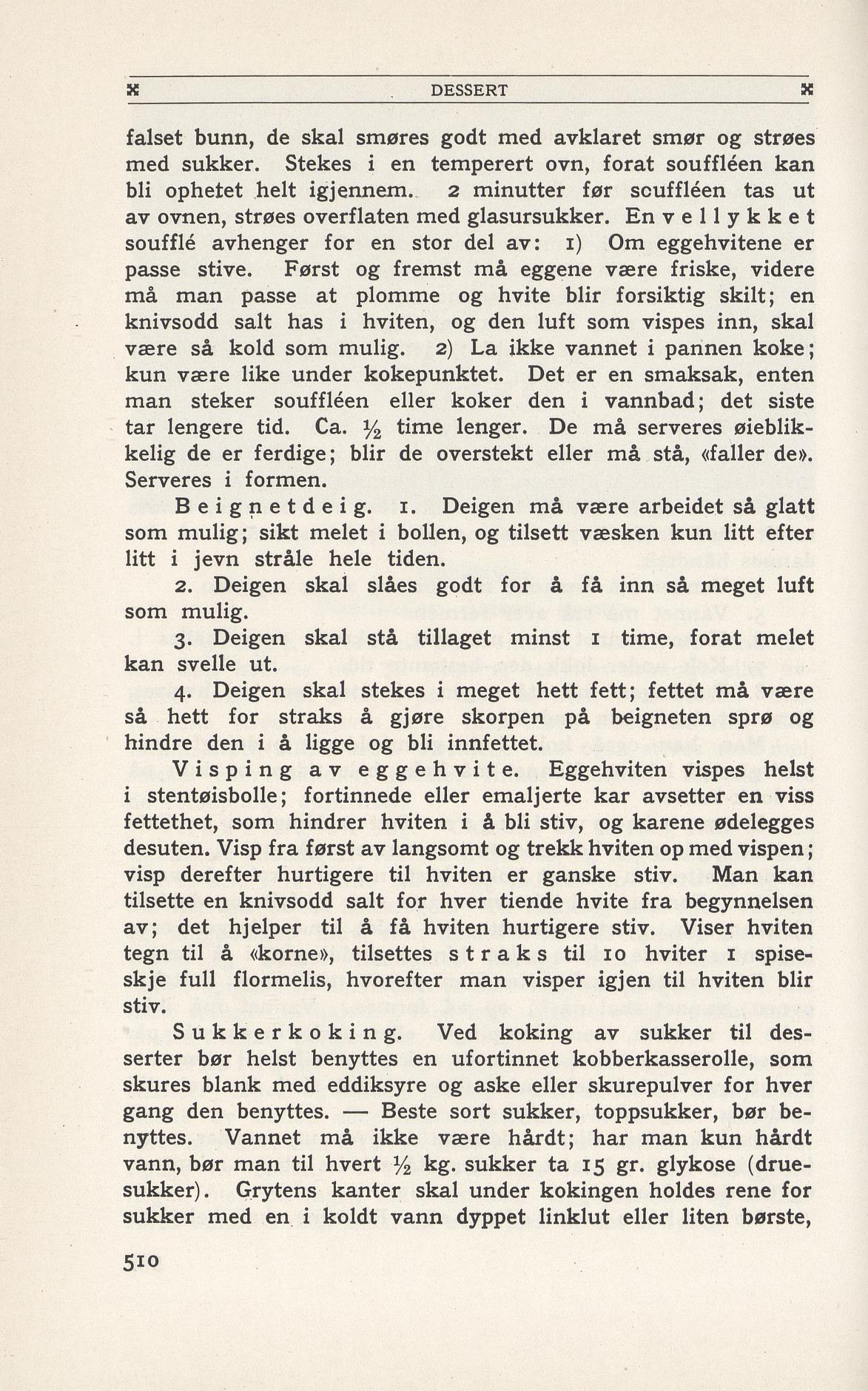
Sukkerkoking. Ved koking av sukker til dessert bør helst benyttes en ufortinnet kobberkasserolle, som skures blank med eddiksyre og aske eller skurepulver for hver gang den benyttes. — Beste sort sukker, toppsukker, bør benyttes. Vannet må ikke være hårdt; har man kun hårdt vann, bør man til hvert ½ kg. sukker ta 15 gr. glykose (druesukker). Grytens kanter skal under kokingen holdes rene for sukker med en i koldt vann dyppet linklut eller liten børste, ellers ødelegges lett sukkeret. Skum må fjernes, da det kan bli årsak i at sukkeret sukrer sig.
De forskjellige grader til hvilke sukker kokes, er følgende:
I. Den tynne tråd 101½° C. II. Den tykke tråd 105½° C. III. Den lille perle 113½° C. IV. Den store perle 120° C. V. Den lille boble 125° C. VI. Den store boble 129° C. VII. Den lille kule 131° C. VIII. Den store kule 137° C. IX. Det lille knekk 161° C. X. Det store knekk 171° C. XI. Karamell 195° C.
Time machine – what changed?
Pick two editions and see what Henriette Schønberg Erken added, removed or changed between them.
1949 (proofread, p. 510) → 1914 (proofread, p. 448)~64% of the text changedremovedadded
Sukkerkoking. Den tynde traad. 1 kg. topsukker. 1 l. vand. Sukkerkokning. Ved koking kokning av sukker til dessert desserter bør helst benyttes en ufortinnet kobberkasserolle, som skures blank med eddiksyre og aske eller skurepulver for hver gang den benyttes. — Beste Bedste sort sukker, toppsukker, topsukker, bør benyttes. Vannet må Vandet maa ikke være hårdt; haardt; har man kun hårdt vann, haardt vand, bør man til hvert hver ½ kg. sukker ta 15 gr. glykose (druesukker). Grytens kanter skal under kokingen kokningen holdes rene for sukker med en i koldt vann vand dyppet linklut eller liten børste, ellers ødelegges lett ødelægges let sukkeret. Skum må maa fjernes, da det kan bli årsak i aarsak i, at sukkeret sukrer sig. De forskjellige grader grader, til hvilke sukker kokes, er følgende: I. Den tynne tråd tynde traad 101½° C. II. Den tykke tråd traad 105½° C. III. Den lille perle 113½° C. IV. Den store perle 120° C. V. Den lille boble 125° C. VI. Den store boble 129° C. VII. Den lille kule 131° C. VIII. Den store kule 137° C. IX. Det lille knekk knæk 161° C. X. Det store knekk knæk 171° C. XI. Karamell Karamel 195° C. Sukkeret skal være fuldstændig opløst i vandet, inden det sættes over varmen; kokningen skal derefter ske over rask varme, skummes, naar det koker; sukkeret skal ikke røres i under kokningen. Den tynde traad: Kok nogen minutter; dyp pekefingeren i siruppen, klem til med tommelfingeren; ved straks at skille fingrene trækkes sukkeret ut i en fin traad, som let brækkes paa kort avstand, og sukkeret er kokt til den tynde traad. Den tykke traad: Kok siruppen litt længer; gjør den samme prøve, og kan traaden trækkes længer uten at brækkes, er siruppen kokt til den tykke traad. Den lille perle: Fortsæt kokningen nogen øieblik, forsøk som før. Naar tommelfingeren og pekefingeren kan fjernes litt langt fra hinanden, uden at traaden brækkes, er sukkeret kokt til den lille perle. Den store perle: Efter litt længere kokning dyppes pekefingeren igjen, stræk tommel- og pekefingeren saa langt som mulig fra hinanden; forblir traaden hel, er sukkeret kokt til den store perle. Den lille boble: Kok litt længer, dyp en skumske i siruppen, før den let over gryten og blæs gjennem hullerne. Hvis der viser sig smaa bobler paa den anden side, er sukkeret kokt til den lille boble.
Preferably an untinned copper pan. It is scoured bright with acetic acid and ashes or scouring powder every time before use.
What do I do if I only have hard water?
The book recommends adding 15 g of glucose (grape sugar) per 1/2 kg of sugar when the water is hard. For "the thin thread," 1 kg of loaf sugar and 1 liter of water are used.
Why must the pot edges and the foam be kept clean?
The edges are wiped with a linen cloth dipped in cold water (or a small brush), otherwise the sugar is easily ruined. Foam must be removed, because it can cause the sugar to "sugar itself" (crystallize).
What temperature is "the thin thread"?
101 1/2 °C — the first and lowest of the sugar stages in Schønberg Erken's "Stor kokebok" of 1914 (p. 448).