Skip to content

Oyster Soup (potage aux huîtres)

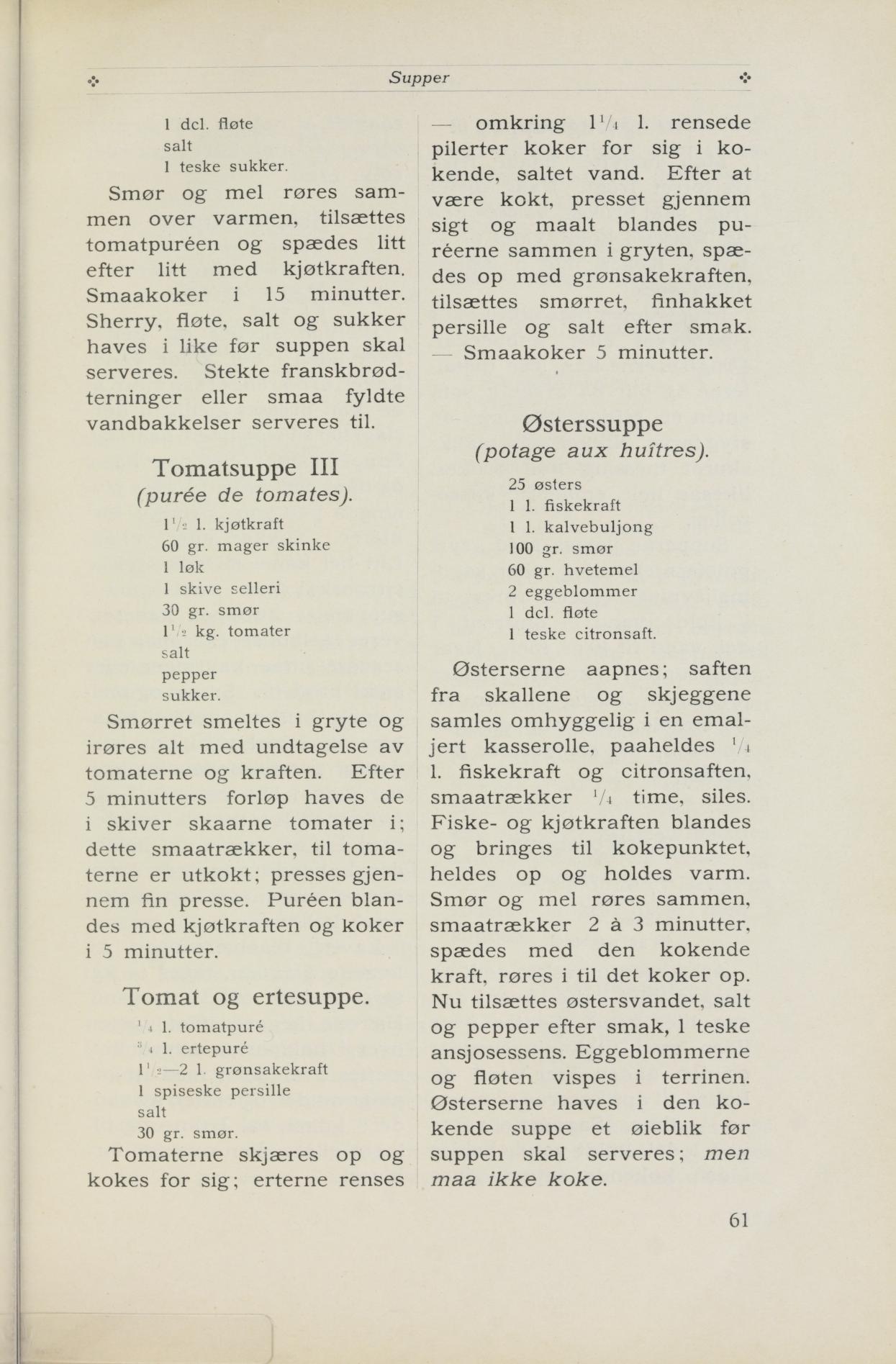
Oyster soup (potage aux huîtres) from Erken's Stor kokebok (1914): oyster liquor is steeped with fish stock and lemon juice, fish and veal stock is thickened with butter and flour, seasoned with the oyster liquor, salt, pepper and anchovy essence, finished with egg yolks and cream in the tureen, and 25 oysters are added just before serving without cooking them.

Source: Henriette Schønberg Erken, Stor kokebok, 1914-utg. s. 61 (falt i det fri)

Be the first to rate

About the dish

A festive French-inspired soup from the soup chapter of Stor kokebok (1914). At the time oysters were an accessible delicacy along the Norwegian coast, and Erken makes use of both the animal and the liquor from its shells.

How to make it

  1. 1

    Shuck the oysters

    Shuck the oysters and carefully collect the liquor from the shells and beards in an enameled saucepan.

  2. 2

    Steep the oyster liquor

    Pour over ½ liter of fish stock and the lemon juice, let it steep gently for a quarter of an hour, and strain.

  3. 3

    Heat the stock

    Combine the rest of the fish stock with the veal stock, bring to a boil, pour off, and keep warm.

  4. 4

    Make the roux

    Stir the butter and flour together, let it cook gently for 2–3 minutes, thin with the boiling stock, and stir until the soup comes to a boil.

  5. 5

    Season

    Add the oyster liquor, salt and pepper to taste, and 1 teaspoon of anchovy essence.

  6. 6

    Finish in the tureen

    Whisk the egg yolks and cream together in the soup tureen and pour the soup over them while stirring.

  7. 7

    Add the oysters

    Add the oysters to the boiling soup for just a moment before serving – they must not cook.

Changes from the original

Quantities have been converted to modern units (liter, deciliter, gram, teaspoon). "Veal broth" is called veal stock, and "anchovy essence" is kept as anchovy essence. The method has been divided into numbered steps.

In stores now

Clean, minimally processed groceries matched to the ingredients — approximate prices.

Product data and prices via Kassalapp. Prices are updated daily and may vary.

Time machine – what changed?

Pick two editions and see what Henriette Schønberg Erken added, removed or changed between them.

Modernised → 1949 (proofread, p. 73)~79% of the text changedremovedadded
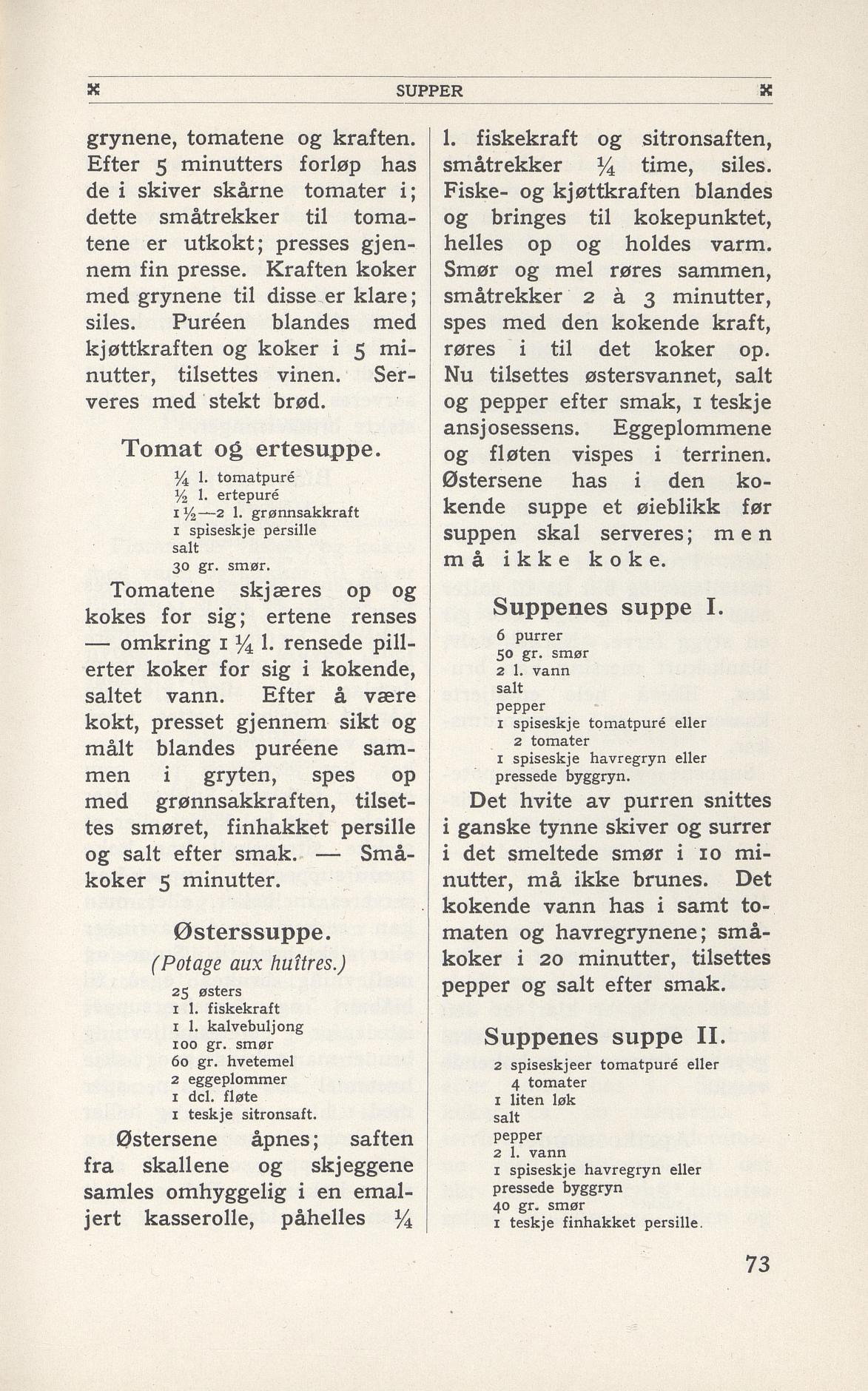
(P ot age aux huttres.) 25 stk østers. østers 1 l 1. fiskekraft (½ l brukes til østersvannet). 1 l kalvekraft (kalvebuljong). x 1. kalvebuljong 100 g smør. gr. smør 60 g hvetemel. gr. hvetemel 2 stk eggeplommer. eggeplommer 1 dl fløte. del. fløte 1 ts teskje sitronsaft. 1 ts ansjosessens. salt (etter smak). pepper (etter smak). Åpne østersene og samle Østersene åpnes; saften fra skjellene skallene og skjeggene skj eggene samles omhyggelig i en emaljert kasserolle.. Hell over ½ liter emal­jert kasserolle, påhelles 34 1. fiskekraft og sitronsaften, la det småtrekke i et kvarter småtrekker 34 time, siles. Fiske- og sil av.. Bland resten av fiskekraften kjøttkraften blandes og kalvekraften, kok opp, hell av bringes til kokepunktet, helles op og hold varmt.. Rør smør holdes varm. Smør og mel røres sammen, la det småtrekke 2–3 småtrekker 2 å 3 minutter, spe spes med den kokende kraften og rør kraft, røres i til suppen det koker opp.. Tilsett op. Nu tilsettes østersvannet, salt og pepper etter smak og efter smak, 1 teskje ansjosessens.. Visp eggeplommene ansjosessens. Eggeplommene og fløten sammen vispes i suppeterrinen og hell suppen over under omrøring.. Legg østersene terrinen. Østersene has i den kokende suppen ko­kende suppe et øyeblikk øieblikk før servering – de suppen skal serveres; men må ikke koke.

Note on Modernised

Mengder er omregnet til moderne enheter (liter, desiliter, gram, teskje). «Kalvebuljong» er kalt kalvekraft, «ansjosessens» beholdt som ansjosessens. Fremgangsmåten er delt i nummererte trinn.

Community interpretations

Be the first to share your own version.

See interpretations →

Frequently asked questions

Why must the oysters not cook in the soup?
Oysters turn tough and shrink when boiled. They are therefore added to the boiling soup only for a moment right before serving, so they warm through without cooking.
What do I do with the liquor from the oyster shells?
The liquor from the shells and beards is carefully collected in an enameled saucepan, combined with ½ liter of fish stock and 1 teaspoon of lemon juice, steeped gently for a quarter of an hour, and strained. This oyster stock is added to the soup after the roux base is made.
How is the soup base itself made?
1 liter of fish stock and 1 liter of veal broth are combined and brought to a boil. 100 g of butter and 60 g of wheat flour are stirred together, cooked for 2–3 minutes, and thinned with the boiling stock while stirring until it boils. Then add the oyster liquor, salt, pepper, and 1 teaspoon of anchovy essence. 2 egg yolks and 1 deciliter of cream are whisked in the tureen before the soup is poured over.
Where does the recipe come from?
From Henriette Schønberg Erken's Stor kokebok (1914), page 61. It serves 8 and takes about 70 minutes.

Equipment for this dish

Advertisement

We may earn a commission if you buy through these links. It does not affect the price.

Related recipes

More dishes in the same category from the archive

Read also

Kommentarer

Ingen kommentarer ennå. Bli den første til å dele!