Skip to content

Duck Fillet (filets de canard)

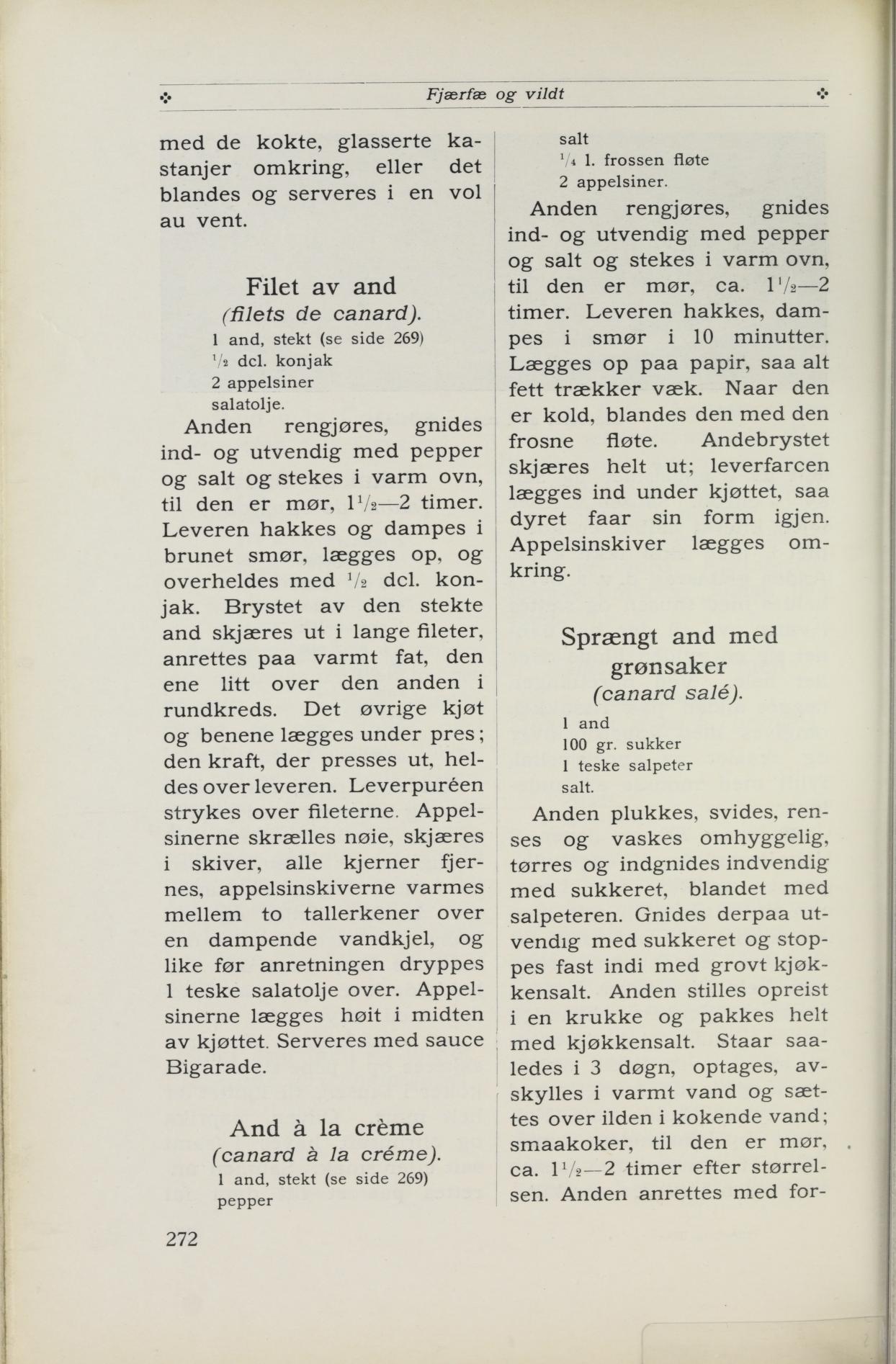
Erken's recipe for duck fillet (filets de canard) from 1914: roast duck whose breast is cut into fillets, covered with a liver purée cooked in butter and cognac, garnished with steamed orange slices drizzled with salad oil, and served with sauce Bigarade.

Source: Henriette Schønberg Erken, Stor kokebok, 1914-utg. s. 272 (falt i det fri)

Be the first to rate

About the dish

The recipe appears in the chapter on poultry and game, among a series of duck recipes with French parallel names. It assumes the duck is first roasted per the base recipe on page 269, and that orange sauce (sauce Bigarade) is served alongside — an early Norwegian variant of the classic canard à l'orange.

How to make it

  1. 1

    Roast the duck

    Clean the duck, rub it with salt and pepper both inside and out, and roast it in a hot oven until tender, 1½–2 hours.

  2. 2

    Steam the liver

    Chop the liver and steam it in browned butter. Lift it out and pour about ½ dl of cognac over it.

  3. 3

    Cut out the fillets

    Cut the breast of the roast duck into long fillets. Arrange them in a ring on a warm platter, each overlapping the next slightly.

  4. 4

    Press the juices

    Put the rest of the meat and the bones under a press and pour the juices pressed out over the liver. Stir the liver into a purée and spread it over the fillets.

  5. 5

    Prepare the oranges

    Peel the oranges carefully, cut them into slices, and remove all seeds. Warm the slices between two plates over a steaming pot of water, and drizzle 1 teaspoon of salad oil over them just before arranging.

  6. 6

    Arrange

    Pile the orange slices high in the center of the meat. Serve with orange sauce (sauce Bigarade).

Changes from the original

Old measures have been converted (1 del. = 1 dl, teske = teaspoon). The amount of cognac in the method is set to 0.5 dl as the OCR suggests, while the ingredient list's 2 dl is kept as the total amount. The steps have been divided and the language modernized, but the method is unchanged.

In stores now

Clean, minimally processed groceries matched to the ingredients — approximate prices.

Product data and prices via Kassalapp. Prices are updated daily and may vary.

Time machine – what changed?

Pick two editions and see what Henriette Schønberg Erken added, removed or changed between them.

Modernised → 1949 (proofread, p. 303)~77% of the text changedremovedadded
(Filets de canard.) 1 stk and (med lever, stekes etter grunnoppskrift). 2 dl and, stekt ½ dd. konjakk (ca. 0,5 dl brukes over leveren). 2 stk appelsiner. 1 ts appelsiner salatolje. 1 ss smør (til bruning av leveren). salt og pepper. Rens anden, gni den Anden rengjøres, gnis inn med salt og utvendig med pepper både inn- og utvendig, salt, og stek den stekes i varm ovn til den er mør, 1½–2 timer.. Hakk leveren i ½—2 timer. Leveren hakkes og damp den dampes i brunet smør. Legg den opp smør, legges op, og hell over ca. ½ dl konjakk.. Skjær brystet overhelles med ⅓ del. konjakk. Brystet av den stekte anden and skjæres ut i lange fileter. Legg dem i ring fileter, anrettes på et varmt fat, den ene litt over den andre.. Legg resten av kjøttet andre i rundkrets. Det øvrige kjøtt og beina benene legges under press og hell kraften som press; den kraft der presses ut ut, helles over leveren. Rør leveren til en puré og stryk den Leverfarsen strykes over filetene.. Skrell appelsinene nøye, skjær dem filetene. Appelsinene skrelles nøie, skjæres i skiver og fjern skiver, alle kjerner. Varm skivene mellom kjerner fjernes, appelsinskivene varmes mellem to tallerkener over en dampende vannkjele, vannkjel, og drypp like før anretningen dryppes 1 teskje salatolje over rett før anretningen.. Legg appelsinskivene høyt over. Appelsinene legges høit i midten av kjøttet. Server Serveres med appelsinsaus (sauce Bigarade). sauce Bigarade.

Note on Modernised

Gamle mål er omregnet (1 del. = 1 dl, teske = teskje). Mengden konjak i fremgangsmåten er satt til 0,5 dl slik OCR-en antyder, mens ingredienslistens 2 dl er beholdt som totalmengde. Trinnene er delt opp og språket modernisert, men metoden er uendret.

Community interpretations

Be the first to share your own version.

See interpretations →

Frequently asked questions

How long should the duck be roasted?
The duck is rubbed inside and out with salt and pepper and roasted in a hot oven for 1 1/2–2 hours, until tender.
What is used for the liver purée?
The duck liver is chopped and steamed in browned butter, lifted out, and poured over with 1/2 deciliter of cognac. The juices pressed out of the remaining meat and bones are poured over the liver. The purée is then spread over the fillets.
How are the oranges prepared?
They are peeled carefully, cut into slices, and all seeds are removed. The slices are warmed between two plates over a steaming pot of water, and just before arranging they are drizzled with 1 teaspoon of salad oil.
Which part of the duck is used for the fillets?
The breast of the roast duck is cut into long fillets and arranged on a warm platter in a circle, each fillet slightly overlapping the next. The rest of the meat and the bones are put under a press to extract juices for the sauce/purée.

Related recipes

More dishes in the same category from the archive

Read also

Kommentarer

Ingen kommentarer ennå. Bli den første til å dele!